
Vintage Champion Value: Reverse Weave and Tag History (2026)
Identify and price vintage Champion sweatshirts: reverse weave era markers, label colors by decade, USA vs imports, and real Grailed sold prices.

Some links on this page are eBay affiliate links. If you buy through them, we may earn a small commission at no extra cost to you.
Why Vintage Champion Is the Gateway Collector Sweatshirt
Some brands take decades to earn their secondhand premium. Champion earned it twice. First as a legitimate American athletic manufacturer supplying college bookstores and pro teams from the 1930s onward. Then again starting around 2015, when streetwear culture rediscovered the archive. That drove prices into territory nobody predicted for a sweatshirt you could have bought for $3 at a thrift store in 2010.
I've watched a plain blank reverse weave in faded maroon sell for $145 on Grailed. The same week, an identical piece with a crack-print sat unsold at $40 on eBay. That gap isn't random. It reflects a very specific knowledge gap between platforms, and between buyers who understand what they're looking at and those who don't. This guide is about closing that gap.
Champion's appeal to new collectors is partly the accessibility. You don't need to understand obscure Italian fashion houses or rare Air Jordan colorways. You need to know three things: how it was built, where it was made, and what's printed on it. Once you have those three reads, you can price almost any vintage Champion piece accurately in under two minutes.
Reselling vintage Champion, not just reading a tag? Reverse Weave, blank labels, and single-stitch tees all price differently, and the tag alone will not tell the whole story. Snap a photo and Underpriced AI reads the details and shows real sold comps. You know a piece's worth before it goes in your cart. Try Underpriced AI on web or mobile. Your first scan is free.
Related: the best apps for resellers.
How to Spot a Real Reverse Weave
The term "reverse weave" is so commonly misused that it's worth starting here. Real reverse weave sweatshirts are constructed with the fabric grain running horizontally rather than vertically. The practical reason was simple. Champion figured out that horizontal construction dramatically reduced vertical shrinkage after washing. That mattered when you were supplying athletic departments with hundreds of identical pieces that needed to fit athletes consistently.
The physical tell is the side panel gusset. It is a separate piece of fabric sewn into each side seam, running from hem to armhole. Run your fingers along the side seam of a sweatshirt. If you feel a distinct third panel inset there, you have a genuine reverse weave. Modern Champion and cheaper imitators skip this entirely. The gusset adds material cost and construction time, and most fast-fashion production won't bother.
Secondary construction details to check:
- Ribbed waistband sewn separately, not just a continuation of the body fabric
- Set-in sleeves (not raglan) on most authentic pieces, though some athletic cuts used raglan
- Thick, dense fleece interior with a characteristic heavy hand feel; newer Champion pieces feel noticeably thinner and lighter
- Flatlock stitching on the side panels visible from the outside
Fake or reproduction reverse weaves do exist. When in doubt, weigh the piece. Authentic vintage reverse weaves typically run 18-21 oz fabric weight. If it feels light, it probably is.
Dating Your Champion by the Tag
This is the fastest dating tool you have, and it works reliably on the vast majority of pieces. Vintage clothing labels tell you more than most sellers realize, and Champion's label evolution is unusually well-documented.
Blue Label (1960s-1970s)
The blue bar label with white text is your oldest and most valuable era. These pieces predate mass collegiate licensing. They often show up with simple university names in chain-stitch embroidery or basic screen print. Condition is almost always compromised at this age. Even a distressed blue-label piece in wearable condition commands serious money from collectors focused on provenance over aesthetics.
White Label (Late 1970s-1980s)
White labels with the red and blue "C" logo. This is the sweet spot for most resellers. It is old enough to carry genuine vintage premium, and common enough that you can find pieces at reasonable source prices if you're patient. USA-made is nearly universal here. Single-stitch hems appear throughout this era. Big Ten and Ivy League collegiate graphics from this period are some of the strongest sellers in the entire vintage Champion category.
Red Label (Early 1990s-Mid 2000s)
The red bar label marks the transition period. Production starts shifting offshore. You'll find both USA-made and imported pieces under this label, so checking the origin tag separately matters. Single-stitch hems disappear around 1990 (more on that below). Red-label pieces are still genuinely vintage and sell well. They go at a discount to white-label equivalents unless the print or colorway is exceptional.
Current/Modern Labels
Anything with the current Champion wordmark label or the "C" patch label is recent production. These are not vintage. They have essentially zero resale premium unless they're part of a specific collab drop.
When Origin Moves the Price
"Made in USA" on a Champion tag is not just a feel-good detail. It is a concrete price driver, particularly for buyers who understand the timeline.
Champion began shifting production offshore in the late 1980s and through the 1990s. Honduras became the dominant source for budget athletic production. Mexico followed a similar pattern. The quality difference is real and tactile. The domestic fleece is denser, the construction tighter, and the hardware (zipper pulls, drawcords) noticeably sturdier.
In practical terms:
- A USA-made white-label reverse weave in a desirable collegiate colorway might fetch $120-200 on Grailed
- The same piece with a Honduras tag from the same era might top out at $65-90 on the same platform
- The gap widens further if the USA piece also has a single-stitch hem and strong graphics
One exception: some Honduras-production pieces from the early-to-mid 1990s still used the older construction standards before cost-cutting fully set in. Judge construction quality alongside the origin tag rather than treating origin as the only variable.
The 1990 Hem Cutoff
Flip the hem of a vintage sweatshirt and look at the bottom edge. Single-stitch means one row of stitching holds the hem in place. Double-stitch means two parallel rows. This matters because the industry-wide shift from single to double-stitch happened around 1989-1991. It was driven by automation changes in garment manufacturing.
For Champion specifically, single-stitch hem equals pre-1990 in almost every case. That's not a rule with zero exceptions, but it's reliable enough to use as a primary dating signal. Collectors pay a real premium for it:
- A single-stitch blank reverse weave in excellent condition: $95-150 on Grailed
- A double-stitch equivalent: $45-75
Stack single-stitch with USA-made and a white label and you have the trifecta. That justifies asking $150+ even on a blank piece with no graphics.
What Collegiate Scripts Actually Sell For
Not all university names carry equal weight on a vintage Champion sweatshirt. The market is surprisingly granular about this.
Tier 1, strongest demand and highest prices: Harvard, Yale, Princeton, Penn, Cornell (full Ivy League). Michigan, Ohio State, Notre Dame (brand-recognition schools). These pieces in excellent condition with clean graphics regularly close $150-350 on Grailed, with outliers higher for exceptional colorways or rare graphic treatments.
Tier 2, solid but not elite: Duke, Georgetown, UCLA, USC, Indiana. Recognizable nationally, genuine collector interest. Expect $80-150 depending on era and condition.
Tier 3, regional and smaller schools. This is where it gets interesting for sourcers. A vintage Champion reverse weave from a small regional school, something like Colgate, Bucknell, or a smaller NESCAC school, often sources cheaper because casual thrift shoppers don't recognize the name. But dedicated collectors and people with alumni connections pay real money for them. I've flipped a Hobart College reverse weave from the mid-1980s for $110 after paying $6 for it at a church sale. The construction was immaculate and the print was nearly perfect.
Graphic quality matters as much as school name. A faded, cracked print on a Harvard piece might actually sell for less than a clean, vivid print on a lesser-known school. The graphic is part of the product.
Blank Reverse Weave Pricing
Here's something counterintuitive: blank reverse weaves (no graphic, no school name, solid color only) have their own strong collector market. Streetwear buyers often prefer them as wearable pieces over graphic versions. The vintage Champion blank reverse weave is essentially the category's answer to a plain white tee. The appeal is entirely about quality, fit, and colorway.
Approximate Grailed sold comps for blank reverse weaves (2024-2025 data):
| Era / Label | Condition | Sold Range |
|---|---|---|
| White label, USA, single-stitch | Excellent | $110-160 |
| White label, USA, double-stitch | Excellent | $75-110 |
| Red label, USA | Good | $55-85 |
| Red label, Honduras | Good | $30-55 |
| Modern (post-2000) | Any | $15-35 |
Faded colorways (washed-out navy, burgundy, forest green) consistently outperform saturated ones. The fading reads as authenticity and age to buyers. Don't over-wash your inventory trying to clean these up.
Champion Collabs and Rare Drops Worth 5-10x
The standard reverse weave market is well-understood. The collab market is where prices go vertical.
Supreme x Champion pieces from 2012-2016 are the ceiling setters. A Supreme-branded reverse weave hoodie from that window can trade at $400-800 depending on colorway and condition. The Supreme box logo treatment on Champion fleece is treated by collectors essentially like Supreme standalone pieces.
Beams x Champion covers Japanese market collaborations. These don't get the same mainstream attention in the US market. But they are extremely well-regarded among Japanese streetwear collectors, and increasingly among American buyers who follow that space. Clean construction, limited distribution, $200-400 range for desirable colorways.
Todd Snyder x Champion deserves mention for the current market. These are contemporary collabs with upgraded fabric specs and retail pricing in the $150-200 range. They don't carry vintage premium but they hold value better than standard Champion retail. They can be flipped if sourced at discount.
University exclusive programs: some schools had specific exclusive Champion programs where the fleece weight, graphic quality, and construction exceeded standard retail. These pieces are hard to identify without deep knowledge. But they trade at the top of the collegiate tier pricing when a knowledgeable buyer encounters them.
What Actually Kills Value
Condition grading for vintage Champion follows general vintage clothing standards with a few category-specific notes.
Print integrity is the most important variable for collegiate pieces. Cracking, peeling, or significant fading on the graphic drops value by 40-60% depending on severity. A "distressed" look has some appeal for blanks. It does not help graphic pieces where the whole point is the print.
Bleach spots are nearly impossible to repair convincingly. They typically make a piece unsellable above clearance pricing. I still source these for my own wear but I don't try to flip them at full comp.
Pilling on the fleece interior is common and signals heavy washing history. Minor pilling is expected and acceptable. Heavy pilling across the entire interior suggests the piece was laundered aggressively. The fabric integrity may be compromised.
Missing or altered tags reduce value for serious collectors. The label is part of the dating evidence. A cut tag means you lose the provenance argument and buyers will price accordingly. A present but faded tag is fine; a cut tag is a discount.
Repairs and alterations: small repairs to seams or hems done correctly are largely accepted. Sleeve shortening or body cropping makes the piece a different item entirely. It should be priced and described as such.
Grailed vs. eBay with Real Comp Data
Platform selection is not trivial for vintage Champion. The same piece can close at 2-3 times the price on Grailed versus eBay, a gap I've confirmed repeatedly across my own sales.
Grailed's audience skews heavily toward streetwear and vintage collectors who understand what they're looking at. When a buyer on Grailed sees "white label, USA-made, single-stitch" in a listing title, they know what that means and they're willing to pay for it. eBay's vintage clothing buyer pool is larger but far more casual. Casual buyers anchor to lower mental price points for "a used sweatshirt."
Practical platform breakdown:
| Piece Type | eBay Typical Close | Grailed Typical Close |
|---|---|---|
| Blank reverse weave, white label USA | $55-80 | $110-160 |
| Collegiate, Ivy League, good condition | $75-120 | $150-250 |
| Supreme collab | $350-500 | $450-800 |
| Red label, Honduras, graphic | $25-40 | $40-65 |
eBay makes sense for higher-volume, lower-tier pieces where you want faster turnover and don't want to wait for the right Grailed buyer. For anything Tier 1 collegiate or a genuine collab piece, wait for Grailed or Depop. The hold time is worth it.
For title optimization on eBay, specific era and construction keywords in your listing title matter significantly. Our guide on eBay title examples for vintage thrift clothing goes deep on this.
If you're newer to flipping vintage clothing more broadly, the principles that apply to Champion apply across the whole category. The secondhand designer fashion authentication and pricing guide covers the research and condition-assessment framework that transfers directly.
Frequently Asked Questions
How much is a vintage Champion reverse weave worth?
It depends on label, origin, hem and graphic. Blank white label USA single-stitch pieces in excellent condition sold for $110 to $160 on Grailed, double-stitch equivalents $75 to $110, and red label Honduras blanks $30 to $55. Tier 1 collegiate scripts like Harvard or Michigan regularly close $150 to $350, and Supreme collabs run $400 to $800.
How can I tell what year my Champion sweatshirt is from?
Start with the label color. The blue bar label runs 1960s to 1970s, the white label with the red and blue C logo covers the late 1970s to 1980s, and the red bar label spans the early 1990s to mid 2000s. Current wordmark or C patch labels are modern production. A single-stitch hem means pre-1990 in almost every case.
Is a Champion sweatshirt made in Honduras worth less than one made in USA?
Usually yes. A USA-made white label reverse weave in a desirable collegiate colorway might fetch $120 to $200 on Grailed, while the same era piece with a Honduras tag often tops out at $65 to $90. One caveat: some early to mid 1990s Honduras pieces still used older construction standards, so judge fleece density and stitching alongside the origin tag.
Should I sell vintage Champion on eBay or Grailed?
Use Grailed for Tier 1 collegiate pieces and collabs, where the same item can close at 2 to 3 times the eBay price because that audience understands label, origin and stitch details. eBay suits higher volume, lower tier pieces you want to turn over fast. Underpriced AI shows real sold comps and can publish your listing straight to eBay.
Putting It Together at the Source
The real money in vintage Champion is made at acquisition, not listing. When you can walk a thrift store rack and pull a white-label USA single-stitch Harvard reverse weave in 30 seconds, you're not competing on luck anymore.
The checklist in your head should run: label color first (15 seconds), origin tag second (10 seconds), side seam gusset third (10 seconds), hem stitch fourth (5 seconds), print condition fifth. That's under a minute to know whether you're holding a $12 flip or a $180 Grailed listing.
If you want to skip the manual comp research and get an instant market price on a piece you've found, Underpriced AI lets you scan the label and graphic with your phone camera and pulls live sold data from across platforms. New accounts get one free scan to try it. Paid plans start at $5 a month for the Starter tier (30 scans), which covers most casual sourcers easily.
The vintage Champion market is not going soft anytime soon. Streetwear's appetite for authentic American athletic heritage keeps pulling new buyers into the category, and the supply of genuine white-label USA single-stitch pieces is finite. Learn to read the tags correctly and you'll find deals that most people in the aisle are literally walking past.
Found a reverse weave and want to know its value? Underpriced AI works on web and mobile. Take a picture and pull real sold-comp data from eBay, Poshmark, Mercari, Facebook, Etsy, and Depop before you buy. The first scan costs nothing. Then credit packs run $3 for 5 scans, and if you price often, plans begin at $5/mo for 30 scans.
What is Vintage Champion actually selling for right now?
Price guides age fast. The most honest answer is what buyers paid this week.
Browse recent Vintage Champion sold listings on eBaySelling these, not just curious what one is worth?
Resellers use these to price a whole pile at once and decide what to list:
Reselling Vintage Champion? Scan, value, and list it.
Snap a photo and see real sold prices from eBay, Poshmark and Mercari, then cross-list to all of them in a few taps. Your first scan is free.
Try a Free ScanFree first scan, no credit card required
Founder of Underpriced AI. Building tools for resellers with 30+ years of software engineering experience.
Know a reseller who'd want this?
Related Articles


What's your Vintage Champion really worth?
Snap one photo and see what yours actually sold for, with the real sold listings behind the price. First scan free, no credit card.

1. Photograph it
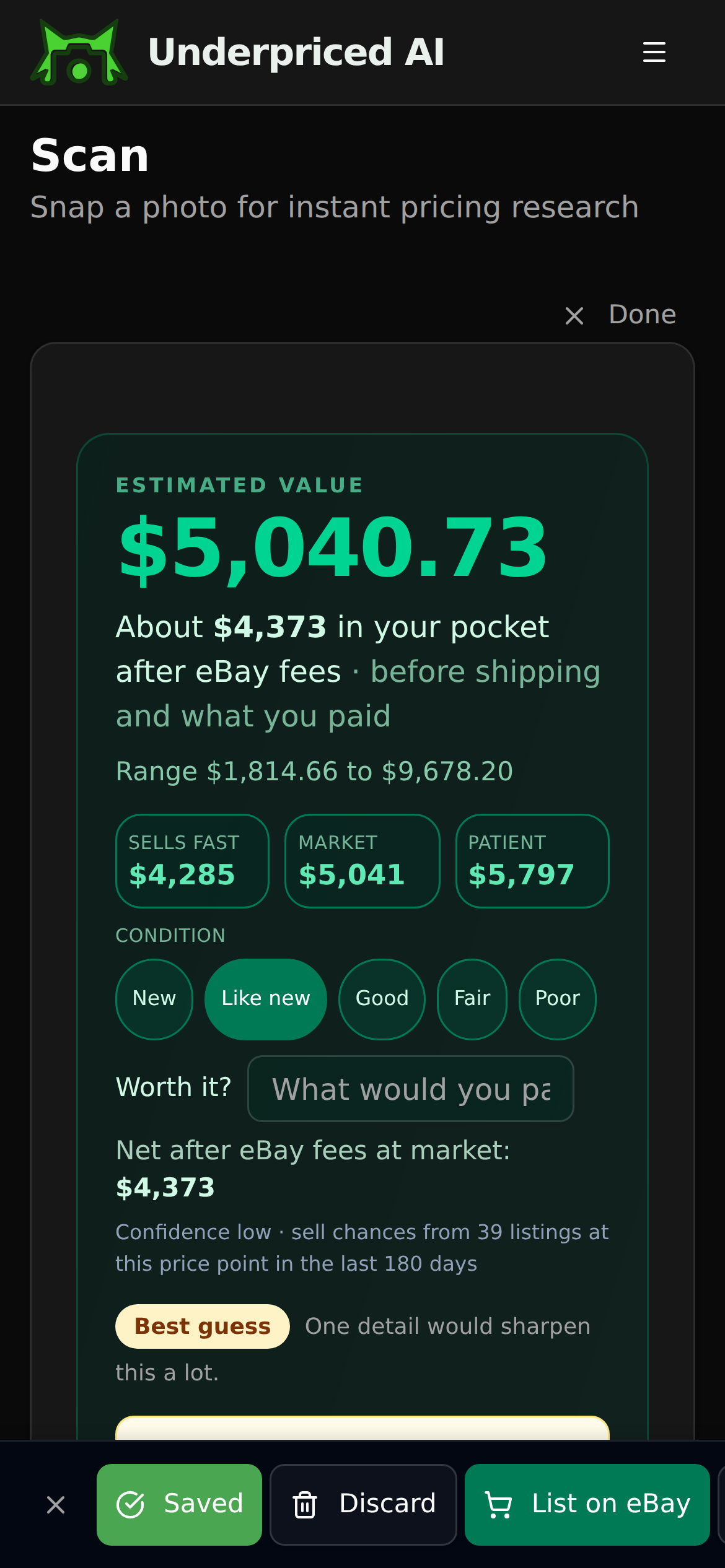
2. See what it sold for

3. List it
Find our guides useful? Get more of them in Google Search.