
Pokemon Card Values 2026: Base Set, 1st Edition and Holos
What your old Pokemon cards are worth now: 1999 Base Set, first edition marks, holo patterns and grading thresholds, priced from real eBay sold listings.

Most People Misprice Their Pokemon Collection. Here's Why.
Someone finds a shoebox of Pokemon cards in a closet, spots a holographic Charizard, and immediately starts mentally spending thousands of dollars. Then they list it on eBay for $800 and wonder why nobody bites. The card sells for $22 three weeks later, and they feel robbed by the market.
The market wasn't wrong. The seller just didn't know what they had.
Pokemon card valuation is genuinely complicated. The gap between "looks rare" and "is rare" is enormous. A holographic card from 2002 might be worth $4. A non-holographic card from 1999 might be worth $4,000. The variables that matter are specific, learnable, and almost invisible to the casual eye. This guide covers all of them.
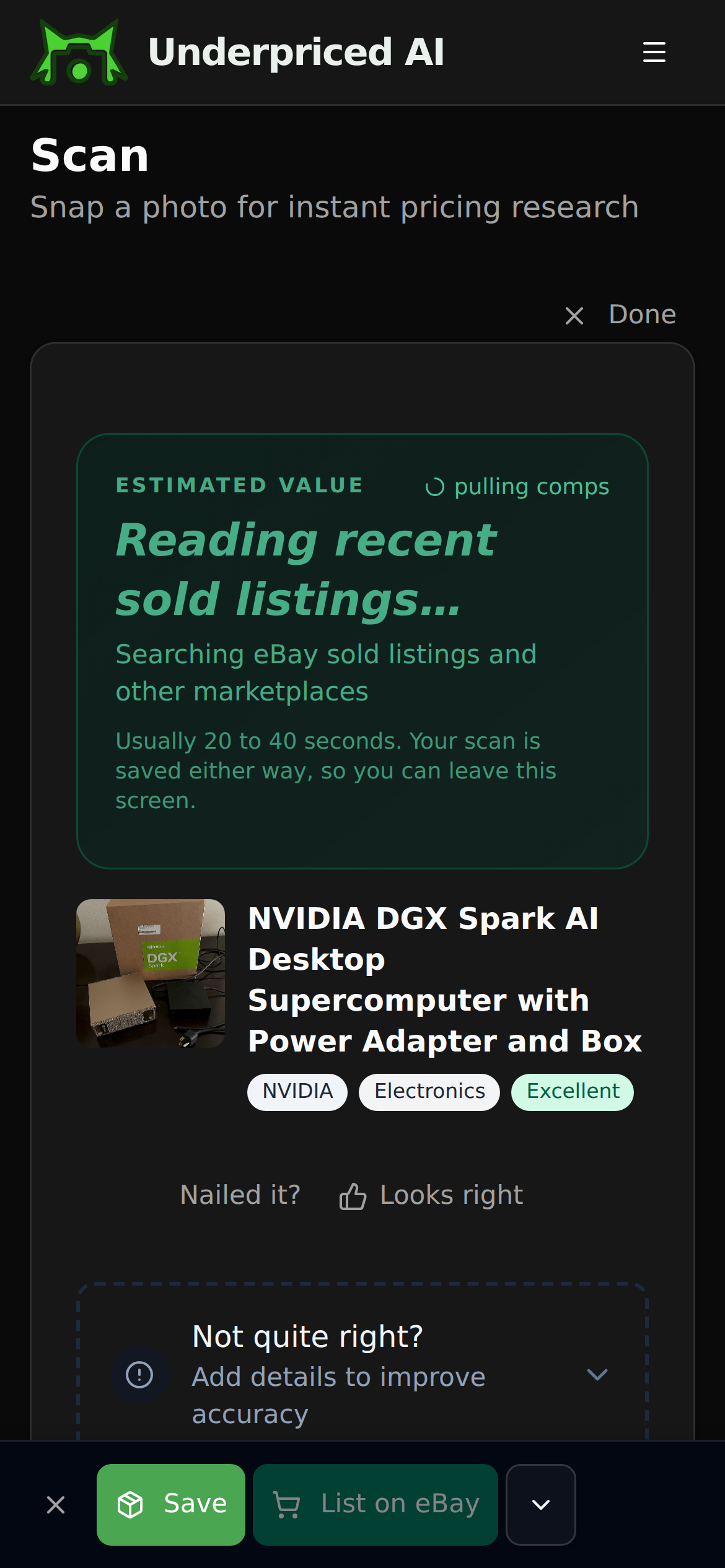
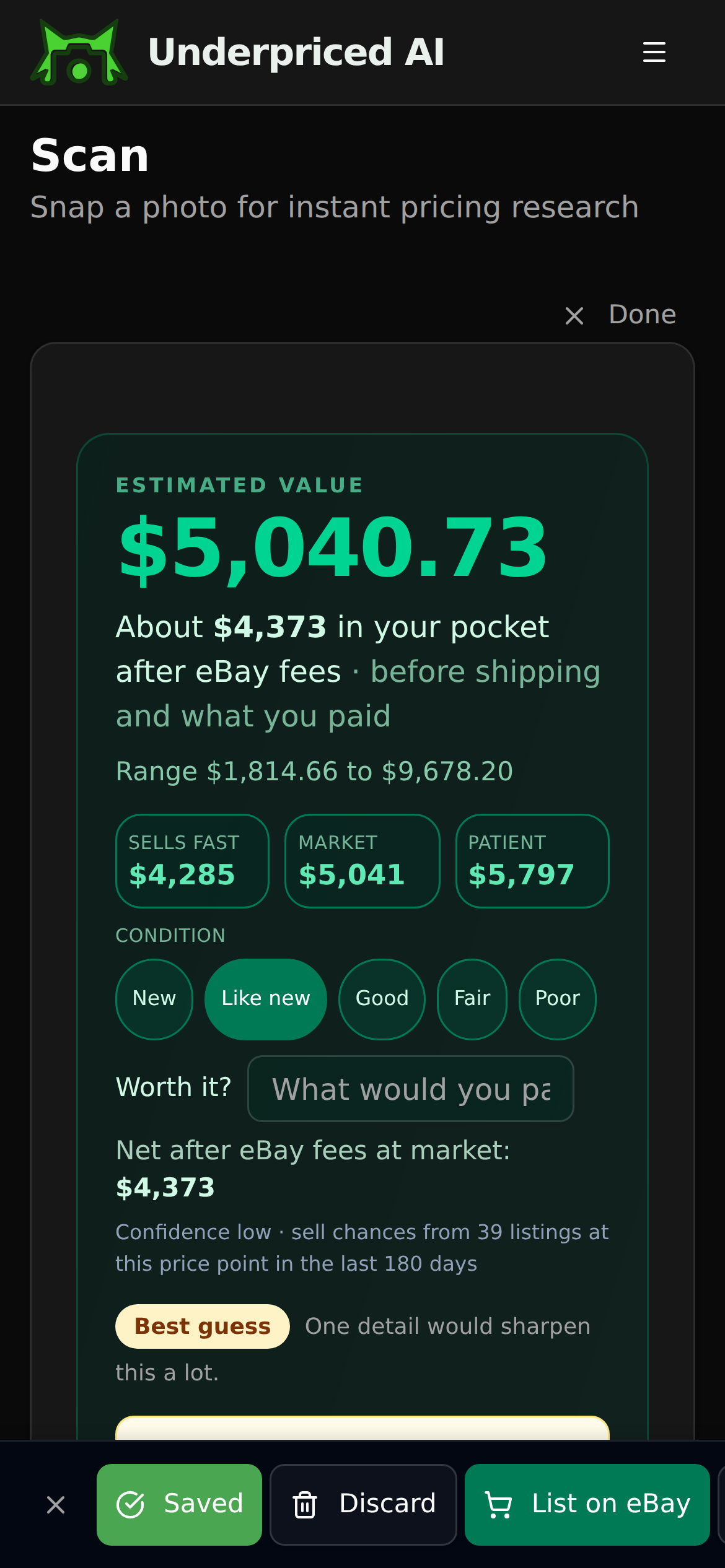
Are you flipping Pokemon cards, not only checking a binder? If you are working a collection or a bulk lot, pricing each card by hand is the slow part. Snap a photo of any card and Underpriced AI reads the set and number, then returns the real sold-comp price in seconds. You will know what a card is worth before you pay for it, and what to list it for after. Try Underpriced AI on web or mobile. Your first scan is free.
The Three Base Set Eras That Define Value
Related: the best apps for finding what your stuff is worth, compared side by side.
The Base Set is where the most valuable cards live, and it's also where the most confusion happens. Three distinct printings exist, and they look nearly identical to an untrained eye.
The 1st Edition (1999) is the rarest printing. Identify it by a small "Edition 1" stamp on the left side of the card, below the featured Pokemon image. The Charizard from this print run in near-mint condition is the most sought-after Pokemon card in existence. The stamp is subtle. Many people miss it entirely.
Shadowless (1999) was printed at the same time as 1st Edition but without the edition stamp. It's called "shadowless" because the card art box lacks the drop shadow seen in later prints. It's also genuinely rare and valuable, though consistently less so than 1st Edition. People frequently confuse these for unlimited prints and underprice them.
Unlimited Base Set (1999-2000) is the mass-produced version most people have. It still carries collector value, but dramatically less than the two earlier prints. Identify it by the drop shadow on the art box and the absence of the edition stamp.
To check for the shadow, look at the right and bottom edge of the artwork window. If you see a thin dark shadow, you have an Unlimited print. No shadow means Shadowless or 1st Edition. Then look for the stamp to separate those two.
This single identification step is worth spending five minutes on before you price anything from this set.
What Makes a Holographic Card Valuable
Most casual sellers get one thing wrong: not all holos are valuable, and not all valuable cards are holos.
A holographic pattern on the card's artwork means the card was a holo rare in its set. That's a print rarity designation, not a collector value designation. The 1999 Base Set had 16 holo rares. Some are worth serious money. Others sell for under $5 raw (ungraded) because supply is plentiful and collector demand is low.
Base Set holos that consistently move above $20 raw in played condition are Charizard, Blastoise, Venusaur, and to a lesser degree Mewtwo and Gyarados. Most of the other 11 holos in the set sell in the $3-$12 range depending on condition and print.
Rarity tier within a set is not the same as market value. Collector demand, character popularity, and print era all matter more than the foil pattern.
I've sorted through estate sale card lots where someone had carefully set aside every holo "because those are the valuable ones." They left a Shadowless Machamp 1st Edition (worth $40-$80 raw) mixed in with commons. The foil catches the eye. The actual money is often hiding in plain sight.
Reading Card Backs, the WOTC vs Nintendo Era Cutoff
Flip a Pokemon card over and look at the copyright line at the bottom. This single line tells you which era the card came from, and that matters enormously for valuation.
WOTC era (1999-2003) cards printed by Wizards of the Coast carry the heaviest collector premium. Sets from this period include Base Set, Jungle, Fossil, Team Rocket, the Gym series, and the Neo series. The copyright line references Nintendo, Creatures, GAME FREAK, but WOTC handled the printing. These cards defined the collecting boom of the early 2000s. Adult collectors chasing nostalgia are spending real money on them.
Nintendo took over printing in 2003. The Nintendo era includes EX Series, Diamond and Pearl, HeartGold SoulSilver, Black and White, XY, Sun and Moon, Sword and Shield, Scarlet and Violet. These sets have their own valuable cards, but they operate in a different market with different buyers and different price logic.
If your cards have the "Wizards of the Coast" text anywhere on them, pay close attention. That's your signal to slow down and research carefully before pricing.
The Charizard Problem
"I have a Charizard" is not a complete sentence in the resale world. There are at least eight meaningfully different Charizards with drastically different values. Confusing them is the most expensive mistake in Pokemon reselling.
Here's a quick breakdown of the major ones:
- Base Set 1st Edition Holo Charizard (PSA 10) is the headline card. It sold for $420,000 at auction in 2022. Raw near-mint copies sell in the $4,000-$8,000 range depending on eye appeal. Even heavily played copies sell for $300-$500 because the card itself is historically significant.
- Base Set Shadowless Holo Charizard (raw NM) sells for $400-$900 depending on condition and centering.
- Base Set Unlimited Holo Charizard (raw NM) sells for $80-$150. Same card, different print, entirely different demand.
- Base Set 2 Charizard looks nearly identical to Unlimited Base Set but is worth significantly less. Identify it by "Base Set 2" in the card number line.
- Charizard EX (various): several EX-era Charizards exist. Values range from $15 to $200+ depending on specific set and condition.
- Shining Charizard (Neo Destiny) sells for $300-$700 raw in NM condition. It's legitimately scarce and underappreciated by casual sellers.
- Charizard VMAX (Sword and Shield) sells for $30-$80 raw, higher in certain variants. Modern competitive play demand drives it.
- Charizard ex (Scarlet and Violet, Obsidian Flames) is the most recent headline Charizard. Tera variants sell for $100-$300+ raw depending on the specific version.
The first question to ask with any Charizard is which set. Then which edition. Then what condition. Answering those three questions in order will get you to an accurate price faster than any other method.
When Grading Is Actually Worth Submitting
Grading is a legitimate value multiplier, but only under specific conditions. Send the wrong card or the wrong condition, and you've spent $25-$50 in fees to get a slab back that sells for less than you paid to grade it.
The math works like this. A PSA 10 Unlimited Base Set Charizard sells for $400-$600. A raw NM copy sells for $100-$150. The grading fee plus return shipping plus the wait of 3-6 months for turnaround means you need reasonable confidence in a PSA 10 outcome before submission makes sense.
Cards worth submitting: any WOTC-era rare where the raw NM value exceeds $50. 1st Edition and Shadowless cards especially. Modern hits too: Special Illustration Rares (SIR) and Secret Rares from recent Scarlet and Violet sets that sell for $80+ raw.
Cards not worth submitting: anything with visible scratches, whitening on the edges, or print lines. The grading companies are blunt about condition flaws. A PSA 5 or 6 rarely justifies fees unless the card is genuinely scarce. Common holos and Base Set Unlimited cards in played condition don't justify it either.
PSA 9 versus PSA 10 is not a small jump. On a 1st Edition Base Set Charizard, a PSA 9 might sell for $3,000-$6,000. A PSA 10 commands $20,000+. That gap is why collectors obsess over centering and edge condition before submitting.
BGS (Beckett) and CGC are legitimate alternatives to PSA. BGS is particularly respected among certain collectors for its sub-grade system. CGC entered the Pokemon market in 2020 and has gained traction. PSA remains the dominant brand for Pokemon specifically, and PSA 10s typically command a liquidity premium at auction.
Modern Era Valuations, Sword and Shield, Scarlet and Violet
The modern Pokemon TCG market moves faster and hits harder than the vintage market in some ways. Sets from Sword and Shield (2020-2022) and Scarlet and Violet (2023-present) have produced cards that swing wildly in value within months of release.
The cards to know in modern sets:
Alternate Art (AA) cards feature full-art illustrations that cover the entire card face with no text box visible. They're collector favorites. Top Sword and Shield AAs include Umbreon VMAX (Evolving Skies) at $150-$400+ raw, and Rayquaza VMAX (also Evolving Skies) at $80-$200 raw.
Special Illustration Rares (SIR) are the Scarlet and Violet equivalent of AAs. Charizard ex SIR from Obsidian Flames, Gardevoir ex SIR from Paldea Evolved, and several others from Paradox Rift have sold for $100-$500 raw depending on the card and timing.
Trainer Gallery cards (Sword and Shield) are often overlooked by casual sellers. Some sell for $20-$60 raw. Check the card number; TG prefix means Trainer Gallery.
The modern market rewards speed in a way vintage doesn't. New set releases create 2-4 week windows where box-topper pulls sell at peak prices before the market gets saturated. If you flip modern cards, sell quickly.
Promo Cards and Tournament Prizes
Promo cards are a deeply undervalued category among casual sellers and a goldmine for collectors who know what to look for.
Tournament prize cards from the 2000s WOTC era can be worth hundreds to thousands of dollars. The Trophy Pikachu cards, the Tropical Wind promos, and the Pre-Release Raichu are all legitimately scarce. They were distributed in small quantities to event participants. A Trophy Pikachu (Trainer class) has sold for $10,000+.
More accessible promos include Black Star promos from the early 2000s, stamped versions of popular cards given out at Toys R Us and Burger King promotions. Most of these sell for $5-$30 raw. A few command real premiums, especially the Pikachu illustrator card, which is arguably the rarest Pokemon card in existence (recent auction: $5.2 million for a PSA 10).
If you find cards with a "PROMO" stamp or a black star where the set symbol usually appears, research them individually before pricing.
Booster Packs and Sealed Product
Sealed product follows different logic than single cards. Unopened booster packs from WOTC-era sets have become legitimate collectibles in their own right. Base Set packs consistently sell for $300-$1,000+ depending on the artwork, condition, and whether they've been weighed. Weighed packs lose value because buyers suspect the heavy cards have been identified and the pack cherry-picked.
Sealed booster boxes command serious premiums. An Unlimited Base Set booster box in good condition trades in the $8,000-$15,000 range. For a 1st Edition Base Set sealed box, the last major auction cleared over $400,000.
For modern sets, sealed boxes and ETBs (Elite Trainer Boxes) from sets that go out of print can double or triple in value within 12-18 months. Evolving Skies ETBs that retailed for $45 in 2021 were selling for $150+ by 2023.
Frequently Asked Questions
How do I find out what my old Pokemon cards are worth?
Start with the set and print run, then condition. Flip the card over: Wizards of the Coast era cards from 1999 to 2003 carry the heaviest collector premium. Then search eBay completed sold listings, not active ones, for that exact set and edition. Underpriced AI reads the set and number from one photo and returns real sold-comp prices, which helps with bulk lots. Your first scan is free.
How much does it cost to grade a Pokemon card and how long does it take?
Grading fees run roughly $25 to $50 per card, plus return shipping, and turnaround typically takes three to six months. That math only works when you have reasonable confidence in a high grade. Skip grading when raw value is under $40, when the card shows scratches, edge whitening or print lines, or when you need the money sooner than the wait allows.
How can I tell if my Base Set card is Shadowless or Unlimited?
Look at the right and bottom edge of the artwork window. A thin dark shadow means you have an Unlimited print. No shadow means Shadowless or 1st Edition. To separate those two, check for the small Edition 1 stamp on the left side, below the featured Pokemon image. Shadowless cards are genuinely rare and frequently underpriced by sellers who assume they are Unlimited.
Are old unopened Pokemon booster packs worth anything?
Yes. Sealed WOTC era packs are collectibles in their own right, with Base Set packs selling for $300 to $1,000 and up depending on the artwork and condition. Packs that have been weighed lose value, because buyers suspect the heavy cards were identified and the pack cherry-picked. Sealed Unlimited Base Set booster boxes trade in the $8,000 to $15,000 range.
Where to Sell and When Not to Grade
For raw singles, eBay remains the dominant platform and the best price discovery tool available. Search completed sold listings, not active listings, to find real market values. TCGPlayer is strong for modern cards and offers a more structured selling experience, though with a more commoditized feel. Facebook Pokemon groups and Discord servers are solid for bulk lot sales and direct deals that avoid fees.
For graded cards, eBay again leads, but PWCC Marketplace and Goldin Auctions handle the high-end material. A PSA 10 of something worth $1,000+ is better served at auction than a fixed-price eBay listing.
Don't grade when the raw value is under $40. Don't grade when the card has visible condition issues. Don't grade when you need the money faster than grading turnaround allows. Don't grade when you're selling to a casual buyer who doesn't care about the slab.
If you're trying to price an unfamiliar card quickly and accurately, tools like Underpriced AI can pull real sold-listing data from a single photo. That's genuinely useful when you're sorting through a bulk lot and don't recognize every card by sight.
For anyone who sources regularly at estate sales, Pokemon cards turn up more often than you'd expect. They're frequently priced by people who pulled the $800 Charizard figure from a headline article without checking print run or condition. Knowing this material cold means finding real value in lots that most resellers walk past. That same discipline applies whether you're sourcing at estate sales or digging through thrift store bins.
The Pokemon card market in 2026 rewards specificity. Not "I have a holographic Charizard." Instead: "I have a 1999 Base Set Shadowless holographic Charizard in near-mint condition with strong centering." That sentence is worth real money. The vague version is worth a $22 sale and a story about how the market cheated you.
Learn to read the cards before you price them, and the market will make a lot more sense.
Want to check what your next Pokemon card is worth? Underpriced AI works on web or mobile. Photograph the card and pull real sold-comp data from eBay, Poshmark, Mercari, Facebook, Etsy, and Depop before you buy. We cover your first scan for free. Beyond that, credit packs begin at $3 for 5 scans, and regular pricing runs from plans at $5/mo for 30 scans.
Scan, value, and list, all in one app.
Snap a photo and see real sold prices from eBay, Poshmark and Mercari, then cross-list to all of them in a few taps. Your first scan is free.
Try a Free ScanFree first scan, no credit card required
Related value guides
Founder of Underpriced AI. Building tools for resellers with 30+ years of software engineering experience.
Know a reseller who'd want this?
Related Articles


Ready to find out what your stuff is worth?
Snap a photo and see what it actually sold for, with the real sold listings behind the price. First scan free, no credit card.
1. Photograph it
2. See what it sold for
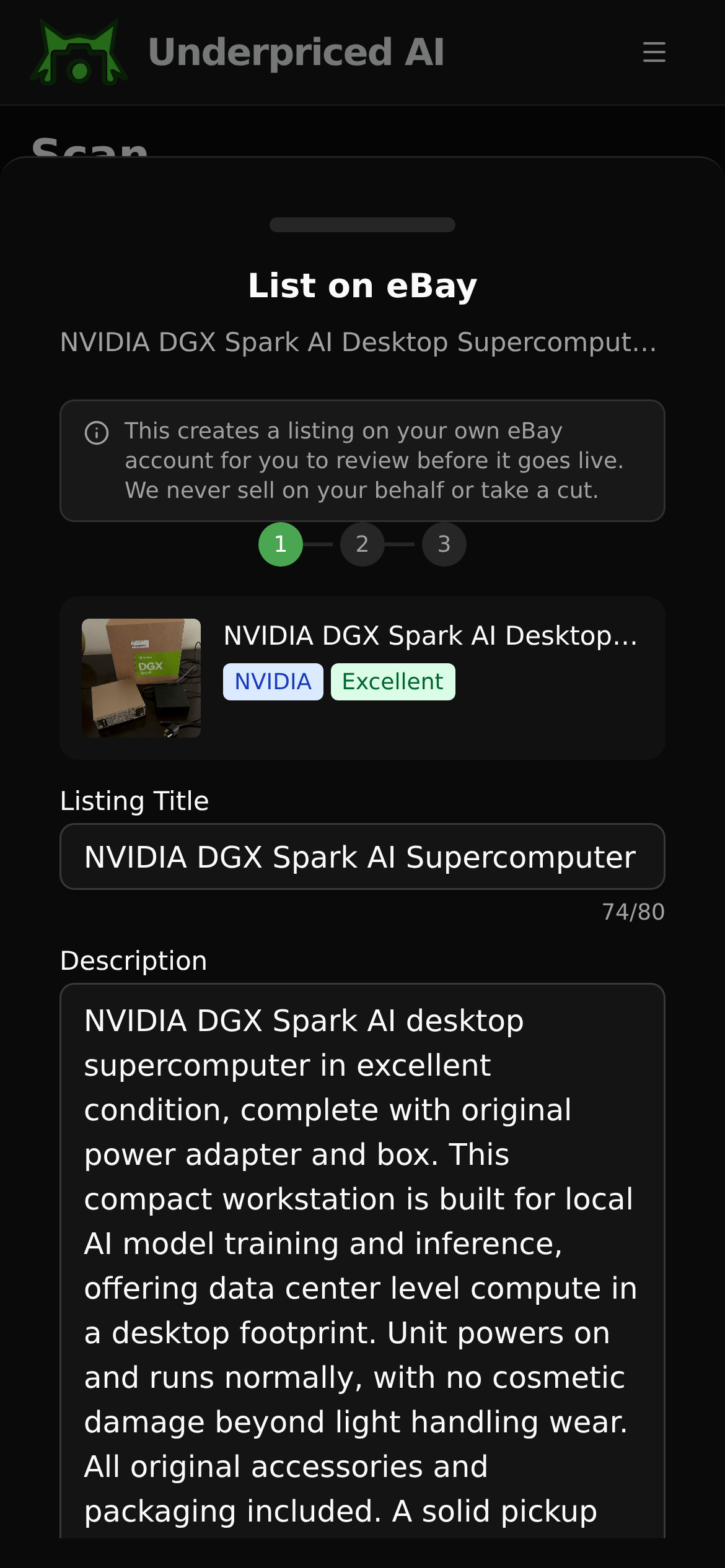
3. List it
Find our guides useful? Get more of them in Google Search.