
Vintage Polo Ralph Lauren Value: Snow Beach, P-Wing, Polo Sport
What vintage Polo Ralph Lauren is really worth. Snow Beach ($800 to $3000), P-Wing rugby, Polo Sport and P-Patch, era markers and real Grailed comps.

Some links on this page are eBay affiliate links. If you buy through them, we may earn a small commission at no extra cost to you.
Why Vintage Polo Dominates the Grailed Sub-Collector Market
No other American brand has a collector ecosystem quite like Polo Ralph Lauren. On Grailed, searches for vintage Polo consistently outperform legacy streetwear brands, luxury houses, and even Supreme drops from the same era. The reason is layered. Nostalgia from the Lo-Life movement, scarcity of specific sub-branded pieces, and a genuinely complex authentication puzzle that rewards people who do their homework.
For resellers, that complexity is an opportunity. A piece hanging on a Goodwill rack for $6.99 can be a $400 P-Wing rugby or a $2,000 Snow Beach pullover. The collectors who buy at the top of the market know exactly what they're looking for. If you don't, you'll either miss it entirely or sell it for the wrong price.
This guide covers the pieces that actually move, the sub-brands that matter, and the details that separate a $35 thrift flip from a grail-level listing.
Sub-Brand Decoder for Polo, Polo Sport, P-Wing, P-Patch, RRL, and Country
Ralph Lauren built a brand universe, not a single label. Each sub-brand has its own collector tier, and confusing them is expensive.
Polo Ralph Lauren is the core standard pony-logo line. Widely available, widely collected at a casual level. Most thrift Polo ends up in the $20-80 range unless it has specific markers like era, print, or pony size.
Polo Sport is the technical and athletic sub-line launched in the 1990s. It has bold block lettering, color-blocked nylon, and a more utilitarian aesthetic. Polo Sport sits above standard Polo in collector demand. Its distinct 90s aesthetic gives it crossover appeal with sportswear collectors. A clean Polo Sport pullover or jacket regularly clears $80-200, with rarer colorways pushing higher.
P-Wing is the most sought-after sub-brand in the collector hierarchy, full stop. The P-Wing logo, a stylized "P" with a wing motif, appears on a relatively narrow range of pieces. P-Wing > Polo Sport > standard Polo in terms of what collectors will actually compete for on Grailed. Good condition P-Wing rugby shirts and jackets run $150-500 depending on colorway and condition.
P-Patch is a patchwork-style hooded sweatshirt line with a distinct look. Vintage P-Patch hoodies sit comfortably in the $300-600 range on the secondary market. The same nostalgia engine drives them as Snow Beach, but with a slightly smaller collector pool. Don't overlook these at thrift.
RRL, or Double RL, is a parallel collector market entirely. It is Ralph Lauren's Americana and workwear sub-brand, pulling from early American military, ranch, and denim heritage. RRL collectors are purists who focus on selvedge denim, chambray shirts, and vintage-style outerwear. The crossover with Polo collectors is minimal. You're dealing with a different buyer. A clean RRL denim jacket or heavy flannel can go for $200-600 with the right buyer.
Polo Country, or Polo by Ralph Lauren Country, is the outdoorsy, Barbour-adjacent sub-line. It is less collected than P-Wing or Polo Sport but has a dedicated niche. Waxed cotton and heavy canvas pieces from this line have a quiet ceiling around $150-300.
Snow Beach Pullover, the Grail, and Why Authentication Is Everything
If you find a Snow Beach pullover at a thrift store, stop what you're doing.
The Snow Beach Pullover was released in 1992 as part of Ralph Lauren's Snow Beach collection, a ski-inspired capsule that included the pullover, pants, bag, and accessories. The pullover's colorblock design and bold "RALPH LAUREN / POLO SPORT" graphic made it iconic in hip-hop culture immediately. It was cemented further when Rakim wore it on the cover of The Source in 1993. Original 1992-94 pieces now sell for $800-3,000 depending on condition and colorway. Deadstock or provenance-documented examples push past that ceiling on rare occasions.
Polo snow beach value on the secondary market has held remarkably well through market fluctuations, which tells you something about the depth of demand.
What to look for on an authentic original:
- The tag reads "POLO SPORT RALPH LAUREN" with a USA or Hong Kong country of origin (more on made-in tags below)
- The colorblock pattern on originals is specific. Check reference photos from trusted Grailed sellers who have sold authenticated pieces
- Stitching on the logo graphic is consistent and dense. Fakes often have slightly blurry or raised printing
- The pullover has a specific weight and fabric hand. Originals feel substantial. Lightweight or thin shell fabric is a warning sign
- Interior drawcord details and cuff construction differ between originals and reproductions
This is the most-faked piece in the entire Polo collector market. Ralph Lauren re-released a version of the Snow Beach collection in 2018, creating additional confusion. The 2018 reissue is not worthless, and it trades for $100-300. But it is not the 1992-94 original. Pricing them the same is a mistake you'll regret after a buyer dispute. Provenance matters here more than almost any other vintage garment. If a seller has receipts, original packaging, or a credible acquisition story, that has real value.
Stadium Collection and the 1992 USA Olympics Gear, the Second Tier
The Stadium Collection and the 1992 USA Olympics pieces occupy a strong second position in the collector hierarchy. Stadium Collection jackets with the all-over print or patchwork construction sell for $300-800 in clean condition. The 1992 USA Olympics uniforms designed by Ralph Lauren carry nationalistic collector appeal on top of the vintage Polo premium.
For resellers, Stadium Collection is slightly safer than Snow Beach. Authentication is a bit more forgiving and the price floor is more predictable. A Stadium Collection piece in rough condition might still move for $150-200. A Snow Beach pullover with significant damage drops more severely.
Pony Size and Position as an Era Marker
One detail separates casual pickers from serious Polo resellers. The polo pony logo changed over time, and those changes are a reliable dating tool.
The small pony is early production, from the 1970s into early 1980s. The original pony was discreet, small, and sat close to the chest. These early shirts are more collectible in certain circles for their historical significance. They're often confused with later small-pony iterations.
The large or oversized pony ran from the late 1980s into early 1990s. Ralph Lauren experimented with an exaggerated big-pony logo that became its own collector magnet. Big-pony pieces from this era can carry a 2-3x premium over standard-pony equivalents in the same condition.
On authentic vintage polo shirts, the pony sits above the chest pocket or pocket line consistently. Pieces where the pony rides unusually high, low, or toward the shoulder should be examined more carefully.
Pony color matters too. Certain color combinations on the pony, such as a red pony on specific shirt colors, were limited to specific eras or sub-lines. Cross-referencing pony color with tag generation is the fastest way to confirm or challenge a piece's claimed date.
Tag Generation Guide for Dating Polo by the Label
Vintage clothing labels are one of the most reliable tools in a reseller's kit. Polo has a reasonably well-documented tag history.
Early Ralph Lauren pieces before the Polo brand fully crystallized carried sport-oriented tags in the 1960s. These are rare and primarily of interest to deep collectors.
The 1970s introduced the "Polo by Ralph Lauren" branding in a simpler font. The label material is typically a woven fabric with visible texture. Country of origin often reads "USA" or "Made in U.S.A." Labels from this era are smaller and more understated than what came later.
The 1980s are where most collectors focus. Tags become more standardized, sub-brand labels appear like Polo Sport and Polo Country, and font treatments evolve. The RN number on the care label can be cross-referenced with the FTC's RN database to help confirm production era, though this requires some patience.
The early 1990s are the Snow Beach era. Tags often read "POLO SPORT RALPH LAUREN" with specific font sizing and layout. This is the generation most heavily forged, so scrutinize them against verified references.
I've flipped probably 60 or 70 Polo pieces over the past few years. The single biggest mistake I see newer resellers make is treating all vintage Polo as the same product. A 1985 Polo shirt and a 2001 Polo shirt are not the same thing to a collector. The tag tells that story in seconds.
What Makes Rugby Shirts Valuable
Polo rugby shirts have their own sub-collector ecosystem. Not all rugbies are equal.
Heavy cotton construction from the 1980s is significantly more collectible than lighter, later iterations. The fabric should feel almost stiff when new, with substantial heft. Thin or stretchy rugby fabric is a sign of later, less desirable production.
Certain stripe combinations and colorways were produced in limited windows. Wide horizontal stripes in specific color palettes are more documented and more sought-after than standard two-color versions.
A rugby shirt with an oversized pony logo from the late 1980s is a specific collector target. These cross over with the big-pony premium mentioned above and can clear $200-400 with the right buyer.
Rugby shirts get worn hard. Collar wear, cuff fraying, and pilling are common. Graded honestly, a rugby in very good condition can be worth 3-4x one in fair condition.
Made-In Tags: USA, Korea, Hong Kong vs. Current Imports
Country of origin is a meaningful value signal in vintage Polo. Here's the general hierarchy:
- Made in USA is the top premium. Earlier production, higher perceived quality, collector preference. Adds 20-40% to value in most categories.
- Made in Hong Kong or Made in Korea is mid-tier. Still vintage, still collectible, covering much of the 1980s and early 1990s production. Solid value but not the ceiling.
- Made in India, Bangladesh, or China is current or recent import labeling. These are not vintage pieces regardless of how they're described. A piece with these country-of-origin tags from a "vintage" listing is either misdated or misrepresented.
For Snow Beach specifically, the made-in tag is part of authentication. Knowing which factories produced originals and matching that to the tag is homework worth doing before you price a piece.
Counterfeit Checklist for a Forged-Heavy Market
Vintage Polo authentication deserves its own checklist. The fakes are sophisticated and have been circulating long enough to develop their own patina.
Red flags to check immediately:
- Font inconsistencies on the tag, such as wrong weight or wrong letter spacing versus verified originals
- Country of origin that doesn't match the claimed era
- Pony embroidery that looks machine-printed rather than stitched, or has an incorrect color sequence
- Zipper hardware with wrong branding or feel. Check pulls on jackets and vests
- Snow Beach graphic that is slightly off-register or has bleed on edges
- Fabric weight inconsistent with the era, too light for a claimed 1980s heavy cotton piece
- Price too good to be true. A Snow Beach pullover priced at $150 from an unknown source deserves maximum skepticism
For detailed guidance on authenticating secondhand designer pieces more broadly, the Secondhand Designer Fashion authentication guide covers a framework that applies here.
Where to Sell by Matching the Piece to the Platform
Not every Polo piece belongs on Grailed. Platform selection directly affects both sell-through rate and final price.
Grailed is the right home for Snow Beach, P-Wing, Stadium Collection, P-Patch hoodies, and any piece with documented provenance and strong collector demand. Buyers here are educated and will pay for authenticity. Keyword your titles carefully. Include tag photos, interior construction photos, and any provenance you have. For title strategy, see the eBay title examples guide for vintage clothing since the principles transfer.
eBay is the right home for mid-tier Polo Sport, standard era rugbies, Polo Country, and solid vintage polos where the buyer is value-conscious rather than collector-obsessed. eBay's search volume means more eyeballs, but collector buyers are harder to reach. eBay listing optimization matters more here because you're competing against volume sellers.
Poshmark is best for accessible vintage Polo: standard pony polos, casual shirts, and pieces where the buyer is a style consumer rather than a collector. Poshmark buyers generally won't pay Grailed-level premiums for P-Wing pieces. But they will pay fair market for a clean vintage polo shirt in a great color.
For the highest-value pieces, especially Snow Beach with provenance, consignment can help. A shop that specializes in vintage streetwear can occasionally outperform self-listing, particularly if you don't have an established seller reputation on Grailed.
A Quick Note on the Polo Bear
Polo Bear sweaters deserve a mention even though they weren't in the original outline. The search volume around polo bear sweater value is real and the market is active. Hand-knit Polo Bear sweaters from the early 1990s sell for $400-900 depending on the bear's depicted activity and outfit. Ski Bear and Holiday Bear versions carry the strongest premiums. These are heavily faked as well. Look for consistent knit structure, correct tag generation for the era, and natural wool or cotton weight.
Frequently Asked Questions
How much is a vintage Snow Beach pullover worth?
Original 1992 to 1994 Snow Beach pullovers sell for $800 to $3,000 depending on condition and colorway, with deadstock or provenance documented examples occasionally going higher. The 2018 Ralph Lauren reissue trades for $100 to $300, so pricing the two the same invites buyer disputes. Verify the POLO SPORT RALPH LAUREN tag, USA or Hong Kong origin, dense logo stitching, and substantial fabric weight.
Is Polo Sport worth more than regular Polo Ralph Lauren?
Yes. Standard thrift Polo mostly lands in the $20 to $80 range, while clean Polo Sport pullovers and jackets regularly clear $80 to $200, with rarer colorways pushing higher. The bold 1990s block lettering and color blocked nylon give it crossover appeal with sportswear collectors. P-Wing sits above both, with good condition rugbies and jackets running $150 to $500.
How do I spot a fake vintage Polo Ralph Lauren piece?
Compare tag font weight and letter spacing against verified originals, then confirm the country of origin matches the claimed era. The pony should be stitched, not machine printed, with the correct color sequence. Check zipper branding and feel, fabric weight versus the claimed decade, and graphic registration. A Snow Beach pullover offered at $150 by an unknown seller deserves maximum skepticism.
How do I price a vintage Polo piece I found at the thrift store?
Price from sold comps, not active asking prices, because vintage Polo value swings on sub-brand, era, pony size and condition. Underpriced AI does this from a photo: snap the piece on web or mobile and get resale value from real eBay, Poshmark and Mercari sold listings, then publish to eBay. The first scan is free with no card, then credit packs start at $3 for 5 scans.
One Scan Can Settle the Question
The difference between a $30 thrift rack Polo and a $600 P-Patch hoodie often comes down to 60 seconds of attention. Knowing the sub-brand hierarchy, reading the tag generation, checking the made-in label, and running a counterfeit check mentally before you buy is the skill set. For pieces where you're genuinely uncertain, tools like Underpriced AI let you scan the item and pull real sold comps to anchor your decision before you commit money or time to a listing.
The collectors who buy at $800 for a Snow Beach pullover are not guessing. They've done this work hundreds of times. The resellers who find those pieces for $15 at an estate sale have too.
Found a vintage Polo piece and want to price it? Underpriced AI runs on web and mobile. Photograph the item to see real sold-comp data from eBay, Poshmark, Mercari, Facebook, Etsy, and Depop, so you know its worth before buying. We cover your first scan. Then credit packs begin at $3 for 5 scans, or plans begin at $5/mo for 30 scans when you price often.
What is Vintage Polo Ralph Lauren actually selling for right now?
Price guides age fast. The most honest answer is what buyers paid this week.
Browse recent Vintage Polo Ralph Lauren sold listings on eBaySelling these, not just curious what one is worth?
Resellers use these to price a whole pile at once and decide what to list:
Reselling Vintage Polo Ralph Lauren? Scan, value, and list it.
Snap a photo and see real sold prices from eBay, Poshmark and Mercari, then cross-list to all of them in a few taps. Your first scan is free.
Try a Free ScanFree first scan, no credit card required
Related value guides
Founder of Underpriced AI. Building tools for resellers with 30+ years of software engineering experience.
Know a reseller who'd want this?
Related Articles


What's your Vintage Polo Ralph Lauren really worth?
Snap one photo and see what yours actually sold for, with the real sold listings behind the price. First scan free, no credit card.

1. Photograph it
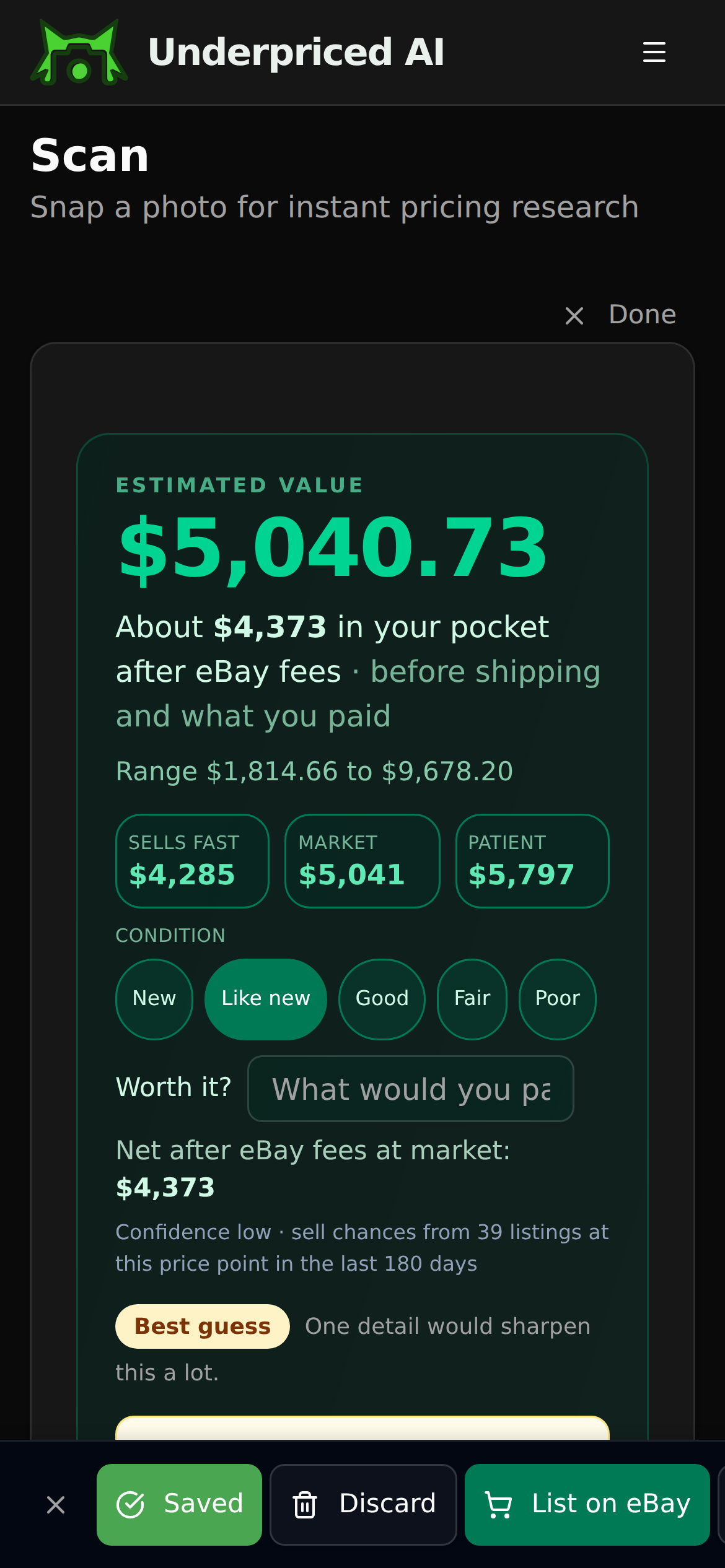
2. See what it sold for

3. List it
Find our guides useful? Get more of them in Google Search.