
What Is My Stuff Worth? 7 Free Apps to Find the Value of Items (2026)
The best free app to find the value of items depends on the job. 7 whats it worth apps compared, from Value Scout to Google Lens, prices checked Sept 2026.

Some links on this page are eBay affiliate links. If you buy through them, we may earn a small commission at no extra cost to you.
The best free app to find the value of items depends on what you want to know. To learn what something would sell for, use an app that prices from real sold listings: Underpriced AI identifies the item from a photo and shows the sold listings behind its number, and the first scan is free. To learn what something is, Google Lens is free and fast but gives no resale price. Value Scout is a legitimate paid scanner, PriceCharting is the free guide for games and cards, and WorthPoint is the archive for rare antiques.
Disclosure: I built Underpriced AI. Every competitor fact below was checked on the vendor's own page or App Store listing on September 27, 2026, and linked.
What's it worth apps compared
| App | Identifies from a photo | Prices from | Price (checked Sept 27, 2026) | Source |
|---|---|---|---|---|
| Underpriced AI | Yes, any item | Real sold listings you can open | First scan free, packs from $3 for 5, plans from $5 a month | Pricing |
| Google Lens | Yes | Retail and asking prices only | Free | Google Lens |
| Value Scout | Yes | "Comparable sales" and demand signals, per its listing | Free download; weekly $4.99 to $9.99, yearly $39.99 to $119.99 | App Store |
| What is it Worth? (Web Air AI) | Yes | "Comparable sold listings" and metals prices, per its listing | Pro $4.99 a month or $29.99 a year | App Store |
| eBay app | Barcode only | eBay sold listings, searched by hand | Free | eBay help |
| PriceCharting | No, search by title | Sold prices for catalogued games, cards and collectibles | Free; Collector $6 a month; Legendary $49 a month | PriceCharting |
| WorthPoint | No | Archive of past auction and online sales | Paid subscription with a trial; its pricing page would not load for us | WorthPoint |
The short version: most apps do one job. Lens names the item, PriceCharting and WorthPoint price items you can already name, and the scanners do both. Among the scanners, the question that matters is whether you can see the sales behind the number.
Asking ChatGPT what it's worth, tested
You can, and it is closer than you might expect. We test it every week on our accuracy page: the first photo of items sellers recently sold goes to other AI with no hints, and every answer is scored against the real sale price beside ours. In the September 28, 2026 update, on a $100 item:
| Model | Typically off by | Us, on the same sales | Showed sold listings | Sales |
|---|---|---|---|---|
| Underpriced AI | $33 | 82% | 78 | |
| ChatGPT | $33 | $33 | 0% | 76 |
| Perplexity | $43 | $33 | 51% | 77 |
| Gemini | $30 | $25 | 11% | 9 |
So on price alone we tie ChatGPT and beat Perplexity, and Gemini answered too few to call. The real difference is proof. A chatbot gives you a number; 82% of our answers came with the eBay sold listings behind it, so you can check the comps yourself before you sell something for too little. No one prices every item right: on sales where the seller set their own price, half landed within 38% of our number, and vintage, toys and pottery run widest. The page updates every Tuesday.
The 7 best apps for finding out what your stuff is worth
1. Underpriced AI
Best for: finding out what an item will sell for when you do not know what it is.
You photograph the item, from vintage jewelry and antique furniture to old toys, designer bags and vinyl records. It names the brand, model, maker's marks and condition, then finds real sold listings for that exact item. Sold prices come from eBay first, through five sources in order, with Poshmark added for fashion, Grailed for vintage clothing, Mercari when eBay sales are thin, and AbeBooks for books. Lots, bundles and wrong variants are filtered out before the price is set.
You get a price, a range, a confidence grade and the sold listings one tap away. If you decide to sell, it writes the listing and publishes it to eBay, and a free browser extension fills it in on Facebook, Poshmark, Mercari, Depop, Vinted, Whatnot, OfferUp and Etsy.
Price: first scan free with no card, then $0.25 a scan pay as you go, packs from $3 for 5 scans, or plans from $5 a month for 30 scans. iOS, Android and web.
Limits: rare and one of a kind pieces sell across a wide spread, and the result page says so next to the number. Past the first scan it is paid.
2. Google Lens
Best for: naming an item when you have no idea what it is.
Point your camera at a vase, a painting or an old gadget and Lens finds visually similar items across the web, often with the maker or model. It is free and on most phones already. What it does not give you is a resale value: the prices it shows are retail and asking prices, and a lamp listed at $500 may sell for $75. Use it to get a name, then check what that name has sold for.
3. Value Scout
Best for: resellers of mainstream items who want a photo estimate plus listing text.
Value Scout, from Rhythm App, LLC, is a real and actively updated app: 4.4 stars from 589 ratings on the App Store, and a 4.2 TrustScore from 206 reviews on the Trustpilot page for valuescout.ai. You scan an item, it identifies it and estimates resale value, and it writes a title and description for Facebook Marketplace or eBay. Its listing says it uses "marketplace data, comparable sales, pricing trends, and demand signals."
It is a subscription after the free download: weekly plans at $4.99 and $9.99, and yearly plans from $39.99 to $119.99 on the App Store. Our read: a fair choice for mainstream clothing, shoes and household goods. Before you subscribe, check whether it shows you the actual sold listings for your item, because an estimate you cannot check is hard to trust on vintage and one of a kind pieces. We compare the two in detail on our Value Scout alternative page.
4. What is it Worth? and other "worth" scanners
Best for: a quick photo estimate on common items.
Several App Store apps answer to "what's it worth". The largest we found, What is it Worth? by Web Air AI LLC, has 4.7 stars from 236 ratings, costs $4.99 a month or $29.99 a year for Pro with scan credits from $1.99, and says it uses "comparable sold listings and live metals pricing where relevant." A smaller one, What's it worth on eBay? by Rafael Kolloch (3.5 stars from 73 ratings), averages recent eBay sales and sells 100 identifications for $2.99. Try the free part of any of them on something you already know the value of before paying.
5. The eBay app
Best for: items with a barcode, and free sold price checks by hand.
The eBay app scans a barcode to pull the catalog listing, which is fast for books, sealed games and boxed retail. For anything else, search the item and filter to Sold items to see what it fetched. Both are free. The catch is that most attic, estate and storage unit finds have no barcode, and a sold search only works if you already know what to type.
6. PriceCharting
Best for: video games, trading cards and graded or catalogued collectibles.
PriceCharting is a price guide, not an identifier. Search a game, card or console and you get sold prices split into loose, complete in box, new and graded, which is exactly the distinction that sets value in those categories. The core guide is free. Collector ($6 a month or $59 a year) adds deal alerts, a lot calculator and a photo appraiser; Legendary ($49 a month) adds downloads and API access. It will not help with pottery, glass or general household goods.
7. WorthPoint
Best for: rare antiques and art when you already know what you have.
WorthPoint is the long running archive of past sales for antiques and collectibles, with auction results and a maker's marks library; its own landing page puts the archive at more than 540 million "sold for" prices. When a piece almost never comes up for sale, that history is hard to replace. It has no photo identification, so you need to know enough to search, and it is a paid subscription. Its pricing page returned an access error on September 27, 2026, so check the current price at sign up.
Pricing collectibles: name the exact version first
Collectibles are the hardest thing to value because identification and pricing are one problem. Call a common reissue a first edition and the price is fiction. So work in that order: get the exact version (the mark, the edition, the variant, the colorway), then look at what that version sold for. Google Lens or a scanner gets you the name; a sold comps tool, PriceCharting for games and cards, or WorthPoint for rare antiques gets you the number.
The quickest way to trust any of these apps is to test it on a piece whose value you already know. If it names the exact version and lands near the price you expect, use it on the unknowns.
What makes a good item value app
- Photo identification. The whole point is that you do not know what you have. If you need the name before you can search, it is a research tool.
- Sold prices, not asking prices. Anyone can list a lamp at $500. If every sold listing shows $75, it is worth $75.
- Sales you can see. An estimate is only as good as the comps behind it. Apps that show the sold listings let you catch a wrong match.
- Speed. For a whole house or storage unit you need seconds per item, not ten minutes of searching.
Common items people want to price
Vintage jewelry. Costume jewelry from Trifari, Weiss and Miriam Haskell can be surprisingly valuable, and signed pieces sell well above unsigned ones. Check clasps and backs for marks.
Rare coins. Date and mint mark decide everything, and a key date in high grade can be worth many times a common one. Never clean coins.
Sports cards. Rookie cards drive the market, and a high graded copy can be worth far more than a raw one. Centering, corners, edges and surface all matter.
Vinyl records. First pressings carry the value. A common reissue of the same album might sell for $10.
Antique furniture. Mid century modern pieces lead demand, and maker's labels and stamps add a lot.
Designer handbags. Louis Vuitton, Chanel and Hermes hold value; dust bags, boxes and receipts help.
Vintage clothing. Brand and era matter enormously; see our valuable vintage clothing brands guide.
Vintage toys. Original packaging is the biggest factor. Star Wars, Transformers, LEGO and Hot Wheels are always sought after.
First edition books. The dust jacket can be worth more than the book. Photograph the title and copyright pages.
Vintage watches. Originality beats cosmetics; a scratched original dial usually beats a refinished one.
Tips for the most accurate valuation
Take clear photos in natural light, without flash. Photograph maker's marks, labels and stamps in a separate close up: flip the item and check bottoms, lids, clasps and tags. Capture every side and any damage, and be honest about condition, because chips, stains and missing pieces change the value. Gather the complete set before you scan, since boxes, manuals and matching pieces add value. For more on judging finds at sales, see our estate sale buying guide, or the step by step what is this worth from one photo walkthrough.
Frequently Asked Questions
What is the best free app to find the value of items?
For a name, Google Lens is free. For a free resale value, the eBay app's Sold filter shows what items fetched if you know what to search, and PriceCharting is free for games and cards. Underpriced AI gives one free scan that identifies the item and prices it from sold listings, then packs start at $3 for 5 scans.
Is there an app that tells you what your stuff is worth?
Yes. Photo scanners such as Underpriced AI, Value Scout and What is it Worth? identify an item and estimate its value. Look for one that prices from sold listings and shows them, because asking prices overstate value.
What is the best app to find out what my stuff is worth?
It depends on the item. A photo scanner that shows sold listings suits mixed household finds, PriceCharting suits games and cards, and WorthPoint suits rare antiques you can already name.
Is Value Scout legit and worth it?
Value Scout is a real, actively maintained app with 4.4 stars from 589 App Store ratings. It is worth it if you resell mainstream items and want a photo estimate plus listing text on a weekly or yearly subscription. Check whether it shows the sold listings for your item before relying on it for vintage or unusual pieces.
Can ChatGPT tell me what my stuff is worth?
It can give a number, and in our weekly test it was typically $33 off on a $100 item, the same as us on those sales. What it did not do was show the sales behind the number: 0% of its answers linked a listing, against 82% of ours. Full results are on our accuracy page.
What is the difference between asking prices and sold prices?
An asking price is what a seller hopes to get. A sold price is what a buyer paid. The same item can be listed at $500 and sell for $75, so only sold prices tell you real value.
Do I need to know what an item is before I can price it?
Not with a photo scanner. Research tools like WorthPoint and PriceCharting need the name first; a scanner identifies the item from the photo, then prices that version.
Try Underpriced AI on web or mobile with one item you want to know about: the first scan is free, and packs start at $3 for 5 scans.
Scan, value, and list, all in one app.
Snap a photo and see real sold prices from eBay, Poshmark and Mercari, then cross-list to all of them in a few taps. Your first scan is free.
Try a Free ScanFree first scan, no credit card required
Founder of Underpriced AI. Building tools for resellers with 30+ years of software engineering experience.
Know a reseller who'd want this?
Related Articles


Ready to find out what your stuff is worth?
Snap a photo and see what it actually sold for, with the real sold listings behind the price. First scan free, no credit card.
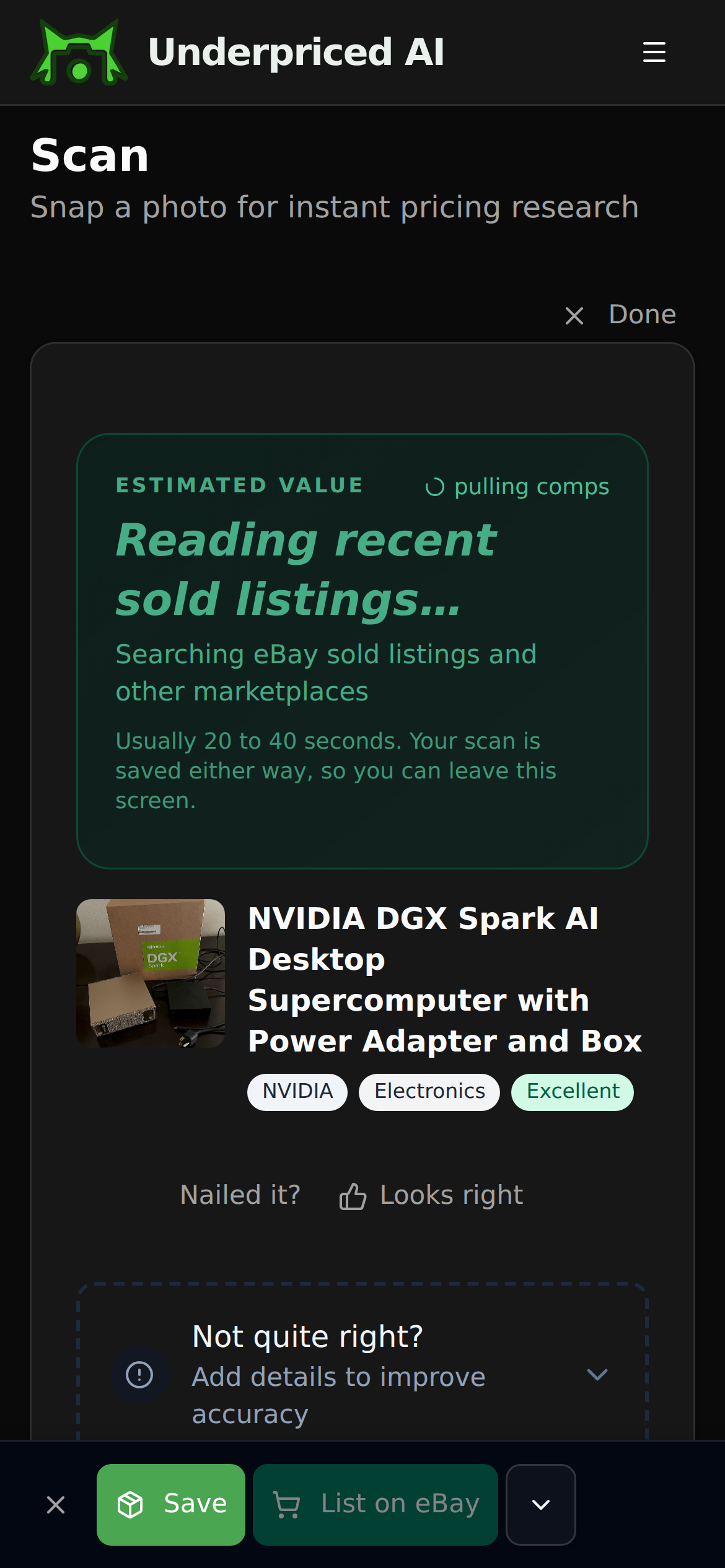
1. Photograph it
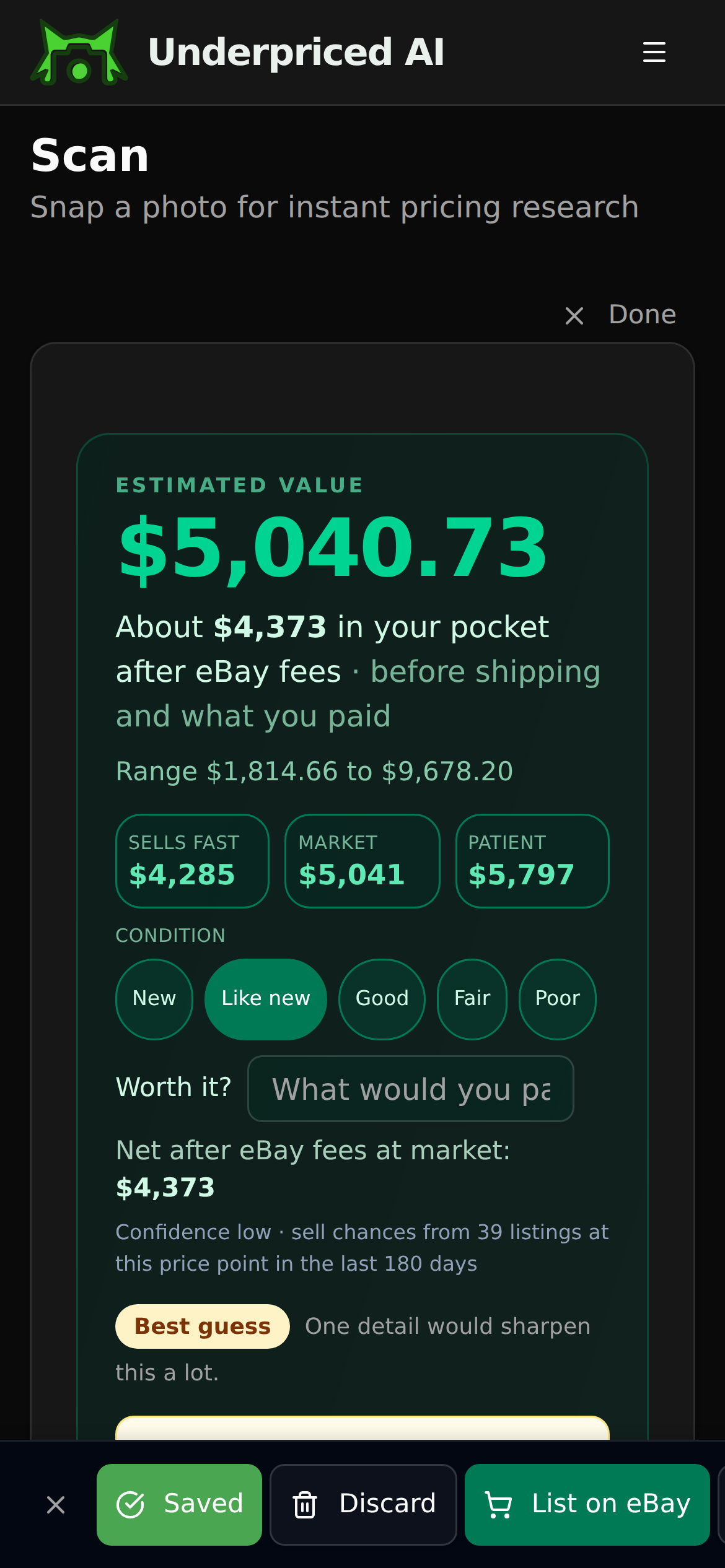
2. See what it sold for
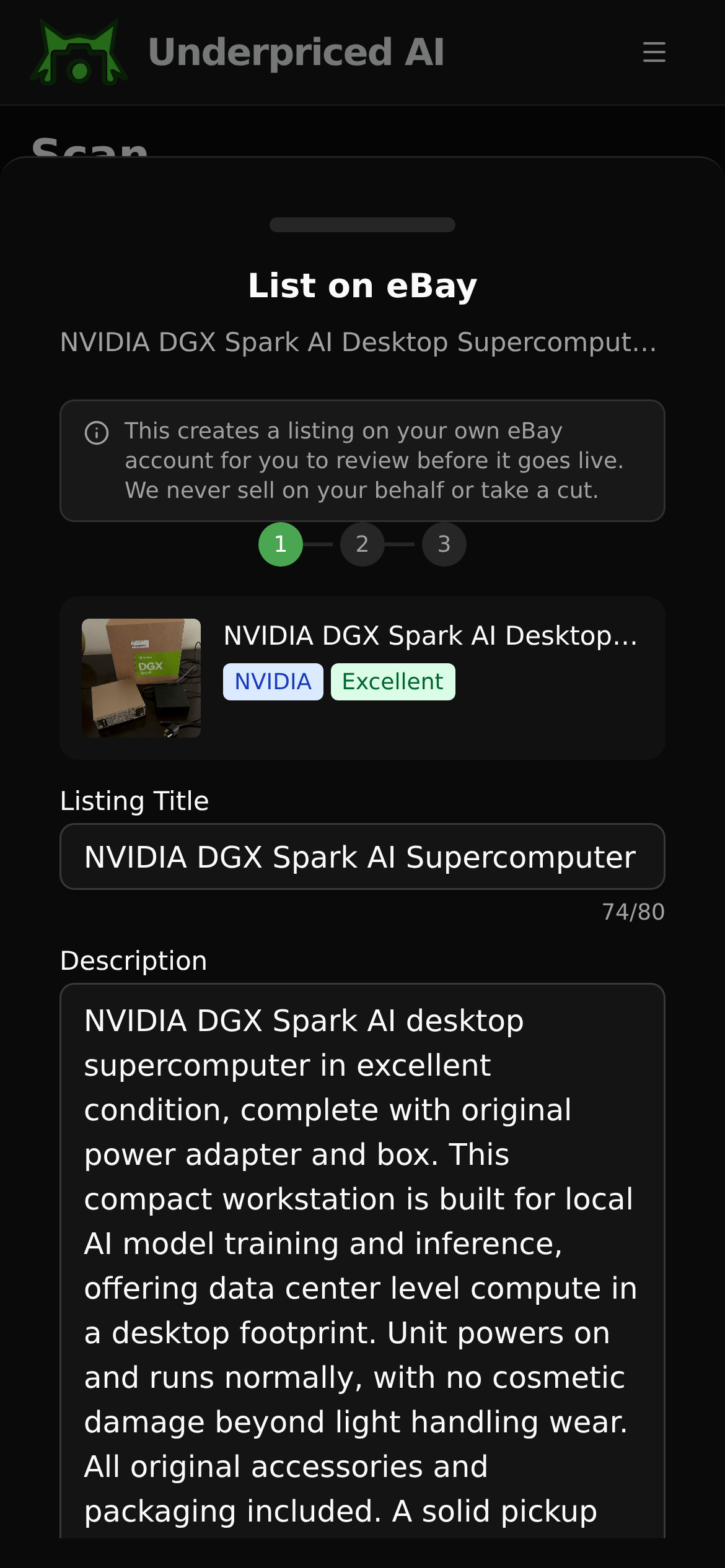
3. List it
Find our guides useful? Get more of them in Google Search.