
5 eBay Reselling Strategies to Boost Sales in 2026
Proven eBay tips for 2026: source better, list smarter, price trends, relist actives, accept offers. Increase profits as a flipper or reseller.

Stop Guessing What Sells, Start Using Data
Most eBay resellers plateau not because they're lazy, but because they're operating on gut instinct in a market that's moved on. The flippers making consistent money in 2026 aren't working harder. They're working with better information, tighter systems, and a willingness to adjust fast when something isn't moving.
These five strategies aren't theoretical. They're the habits that separate a seller doing $500 a month from one clearing $5,000. If your sales have stalled or you're drowning in dead inventory, at least one of these is probably the reason.
Source Smarter by Leading With Sell-Through Data
Almost every new reseller makes the same mistake. They buy what looks good instead of what sells fast. A gorgeous piece of Depression glass might catch your eye. But if the sell-through rate on eBay is 12%, you're tying up capital in something that could sit for months.
Sell-through rate is the percentage of active listings that actually sell within a given period. It's the single most important sourcing metric you're probably ignoring. Anything above 50-60% in a category means demand is outpacing supply. Below 20% and you're in crowded or slow territory.
Before your next thrift run or estate sale, pull up eBay's completed listings for the exact item you're considering. Filter by "Sold" and compare that count to the total active listings. Do the math. Tools like Terapeak (built into eBay Seller Hub) give you 90-day sell-through data by category, and learning to read it is one of the most valuable skills in this business. The best Terapeak research tips for eBay sellers in 2026 can help you build that habit properly.
The focus principle matters here too. One of the most effective eBay flipping tips is simple: pick one category and go deep. When you specialize, say vintage Levi's denim, mid-century Pyrex, or 80s Nintendo games, you develop pattern recognition that generalist resellers don't have. You know which colorways command premiums, which sizes move fastest, which variations are rare. That knowledge pays off at the source, not only at the listing stage.
I've watched resellers try to flip everything from furniture to fast fashion at once and burn out because they never build real expertise. The ones consistently clearing $3,000-$5,000 a month almost always have a core category they own.
Optimize Your Listings Like It's Part of Your Job
Listing an item once and walking away is a passive strategy in an active marketplace. eBay's Cassini search algorithm rewards engagement signals. Click-through rate, watch counts, offer activity, and purchase history all factor into visibility. A listing that sat idle for 30 days will rank lower than a freshly optimized one, even if the item is identical.
Daily listing optimization doesn't mean rewriting everything every morning. It means building a routine:
- Review your lowest-performing listings each day (sorted by "least viewed" in Seller Hub)
- Test a different title structure for items with high impressions but low clicks
- Add or swap photos if your current shots aren't showcasing condition or details
- Update item specifics. eBay frequently adds new fields, and unfilled specifics hurt your search placement
Titles deserve special attention. The difference between "Vintage Jacket" and "Vtg 90s Carhartt Detroit Chore Coat J97 Brown Canvas Blanket Lined Size L" is not subtle. It's the difference between 12 impressions a week and 400. For a deep breakdown of how to structure titles for maximum visibility, eBay listing optimization: write titles that sell covers the mechanics in detail.
Photos are often the bigger problem. On a phone screen, buyers make split-second decisions. Clean backgrounds, natural light, and multiple angles (especially showing labels, tags, measurements, and any flaws) dramatically improve conversion. If you're shooting on a cluttered shelf or in bad lighting, you're sabotaging listings that might otherwise rank well.
One thing worth doing monthly: run a search on eBay for your own item as a buyer would. Are competitors using better photos? Lower prices? Different keywords? Treat it like a mini audit.
Price Based on Market Movement, Not What You Paid
Pricing is where emotions kill profits. A lot of sellers anchor their price to what they paid. If they spent $15 at the thrift store, they want at least $60 to feel like they won. But the market doesn't care about your cost basis. It only cares about supply and demand right now.
Prices on eBay move seasonally, cyclically, and sometimes randomly. A vintage Pendleton wool shirt that sells for $85 in October might struggle to move at $55 in July. Cast iron cookware spikes after certain YouTube channels cover it. Vintage electronics fluctuate with nostalgia cycles. If you're not monitoring price trends, you're either leaving money on the table or holding items longer than you should.
The practical approach:
- Set a price review schedule. Every 30 days, pull your unsold listings and check what comparable items actually sold for in the last 30 days, not the last year.
- Adjust down systematically. If an item hasn't sold in 45 days, drop it 10-15%. If it hasn't sold in 90 days, either reprice aggressively or consider cross-listing to another platform.
- Watch for price spikes. If a category suddenly gets hot (vintage camp shirts in spring, Halloween décor in late summer), be ready to price at the top of the range rather than the middle.
For a tactical framework built around thrifted items specifically, eBay pricing strategies for thrifted flips in 2026 is worth bookmarking.
The broader point is that pricing is not a one-time decision. It's an ongoing conversation with the market. Sellers who treat their initial listing price as permanent are the same ones complaining about dead inventory six months later.
Use Offers and Promotions Aggressively Without Discounting Your Value
There's a psychological wall a lot of resellers hit around accepting low offers. Someone offers $28 on a $45 listing and it feels like an insult. But look at the math. If that item has been sitting for 60 days and you paid $8 for it, accepting $28 nets you $20 in profit. It also frees up capital to buy something that sells faster. The alternative is earning $0 and paying eBay's final value fee when it eventually sells at a lower price anyway.
Accepting lowball offers is a capital velocity strategy, not a surrender. The sellers who increase eBay sales in 2026 understand that cash cycling quickly through inventory beats waiting for full price on slow movers.
A few practical ways to use eBay's offer ecosystem:
- Enable Best Offer on everything priced over $20. You're not obligated to accept anything, but you signal openness to negotiation, which attracts more offer activity.
- Set auto-accept and auto-decline thresholds. If your item is $60, auto-accept at $48 (80%) and auto-decline below $36. This saves time and keeps negotiations moving without you monitoring every listing.
- Use Seller-Initiated Offers. eBay lets you send offers directly to buyers who have watched your listing for 3+ days but haven't purchased. This is one of the most underused features on the platform. A 10-15% discount offer to a watcher converts surprisingly often.
- Run Coded Coupons and Markdown sales for your store during peak shopping windows: holiday weekends, tax refund season (February-March), back-to-school (July-August).
eBay's Promoted Listings have gotten increasingly expensive, and many sellers are finding better ROI in organic optimization and strategic discounting. For a look at how that's shifted in 2026, eBay promoted listings changes 2026: best organic SEO alternatives lays out the current options clearly.
Don't dismiss promotions as "desperate." They're tools. The best brick-and-mortar retailers use them constantly, and there's no reason a smart eBay reseller shouldn't.
Relist Stale Inventory Daily
This one sounds almost too simple, but it's one of the most consistently effective ebay reselling strategies in practice. Relisting active items, ending the listing and creating it fresh, resets the listing's position in Cassini's algorithm. It pushes it back into search visibility.
The recommended cadence is 5-10 relists per day. You're not necessarily changing anything about the listing, though it's a good chance to update photos or tweak a title. The act of relisting signals activity to eBay's system and gets your items in front of fresh eyes.
This works because eBay's algorithm gives a visibility boost to new listings. After a listing has been active for 30+ days without a sale, its organic reach typically drops. Relisting gives it a second chance at that new-listing visibility window.
How to build the habit:
- Sort your active listings by "oldest first" each morning
- Pick 5-10 items that haven't had views or watchers in the past week
- End the listing, then relist (not just revise), ideally with at least one small improvement
- Do this before you list any new inventory for the day
Some sellers rotate their entire catalog this way over a 30-60 day cycle. It's not glamorous work, but it keeps your store looking active and your items circulating in search results consistently.
There's also a secondary benefit. The process forces you to look at your dead inventory regularly. When you pull up a listing for the fourth time to relist it and it still hasn't sold, that's a signal to reprice, reconsider the category, or move it to a liquidation bundle. Relisting and pricing review naturally feed each other.
Putting It Together in a Weekly Rhythm
The resellers who execute on these strategies consistently aren't spending more time than anyone else. They're spending it more intentionally. Here's what a functional weekly routine looks like:
Daily (15-20 minutes):
- Relist 5-10 stale items
- Check and respond to offers
- Review impressions/clicks on newest listings
Weekly (1-2 hours):
- Audit lowest-performing listings and update titles or photos
- Pull sold comps for items listed 30+ days ago and reprice if needed
- Send Seller-Initiated Offers to watchers
Before every sourcing trip:
- Check sell-through rate on your target category
- Set a max buy price based on current sold comps, not hopeful asking prices
The compounding effect of these habits is real. Sellers who implement just two or three of these consistently report measurable increases in monthly sales within 60-90 days. Not because the strategies are magic, but because most of the competition isn't doing them at all.
Frequently Asked Questions
What is a good sell-through rate on eBay?
Above 50 to 60 percent in a category signals that demand is outpacing supply, which is where you want to source. Below 20 percent means the category is crowded or slow, so your capital sits tied up. Check it by filtering eBay completed listings to Sold and comparing that count to total active listings, or pull 90 day data from Terapeak in Seller Hub.
How often should I relist items on eBay?
Aim for 5 to 10 relists per day. Sort active listings oldest first, pick items with no views or watchers in the past week, then end and relist them rather than just revising. Relisting resets the listing's position in Cassini and gives it another shot at the new listing visibility boost that fades after roughly 30 days.
Should I accept lowball offers on eBay?
Often yes, if the item is slow moving. A $28 offer on a $45 listing you paid $8 for still nets about $20 and frees capital for faster inventory. The alternative is $0 while it sits. Enable Best Offer on anything over $20, set auto accept around 80 percent of asking, and auto decline below 60 percent.
How do I know what an item is worth before I buy it at a thrift store?
Check recent sold comps, not asking prices, and set a max buy price before you go. When you only have seconds to decide, Underpriced AI lets you photograph the item on web or mobile and pull sold prices from eBay, Poshmark, Mercari, Facebook, Etsy and Depop. The first scan is free with no card, then packs start at $3 for 5 scans.
The Sourcing Edge You Might Be Missing
One thing that makes all of this easier is having fast, accurate pricing data at the point of sourcing, before you commit to a purchase. Tools like Underpriced AI let you scan an item with your phone camera and instantly pull resale pricing and market data. That's exactly what you need when you're standing in an estate sale with 10 seconds to decide if that ceramic lamp is worth $8.
Pair solid sourcing data with the listing and pricing habits above, and you've got the foundation that most successful eBay sellers are actually running on in 2026. Not luck, not hustle culture, just better information used consistently.
Price your inventory correctly before you ever spend a dollar sourcing it. One photo is all Underpriced AI needs to return real sold-comp pricing from eBay, Poshmark, Mercari, Facebook, Etsy, and Depop, every scan powered by the premium AI model that comes with each plan. Your item gets identified, clickable verified sold prices appear, and you list with confidence. Try your first scan free, no card required.
Scan, value, and list, all in one app.
Snap a photo and see real sold prices from eBay, Poshmark and Mercari, then cross-list to all of them in a few taps. Your first scan is free.
Try a Free ScanFree first scan, no credit card required
Founder of Underpriced AI. Building tools for resellers with 30+ years of software engineering experience.
Know a reseller who'd want this?
Related Articles


Ready to find out what your stuff is worth?
Snap a photo and see what it actually sold for, with the real sold listings behind the price. First scan free, no credit card.
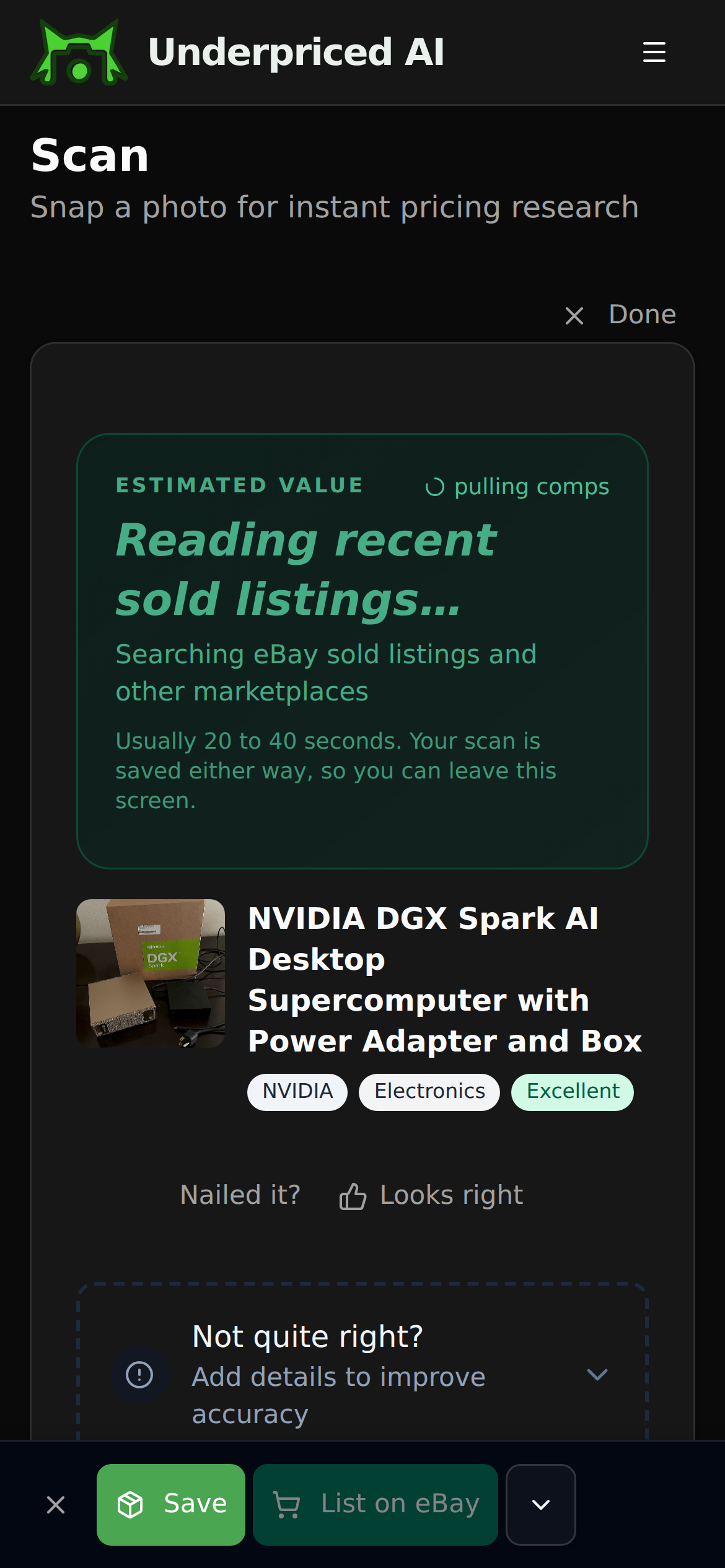
1. Photograph it
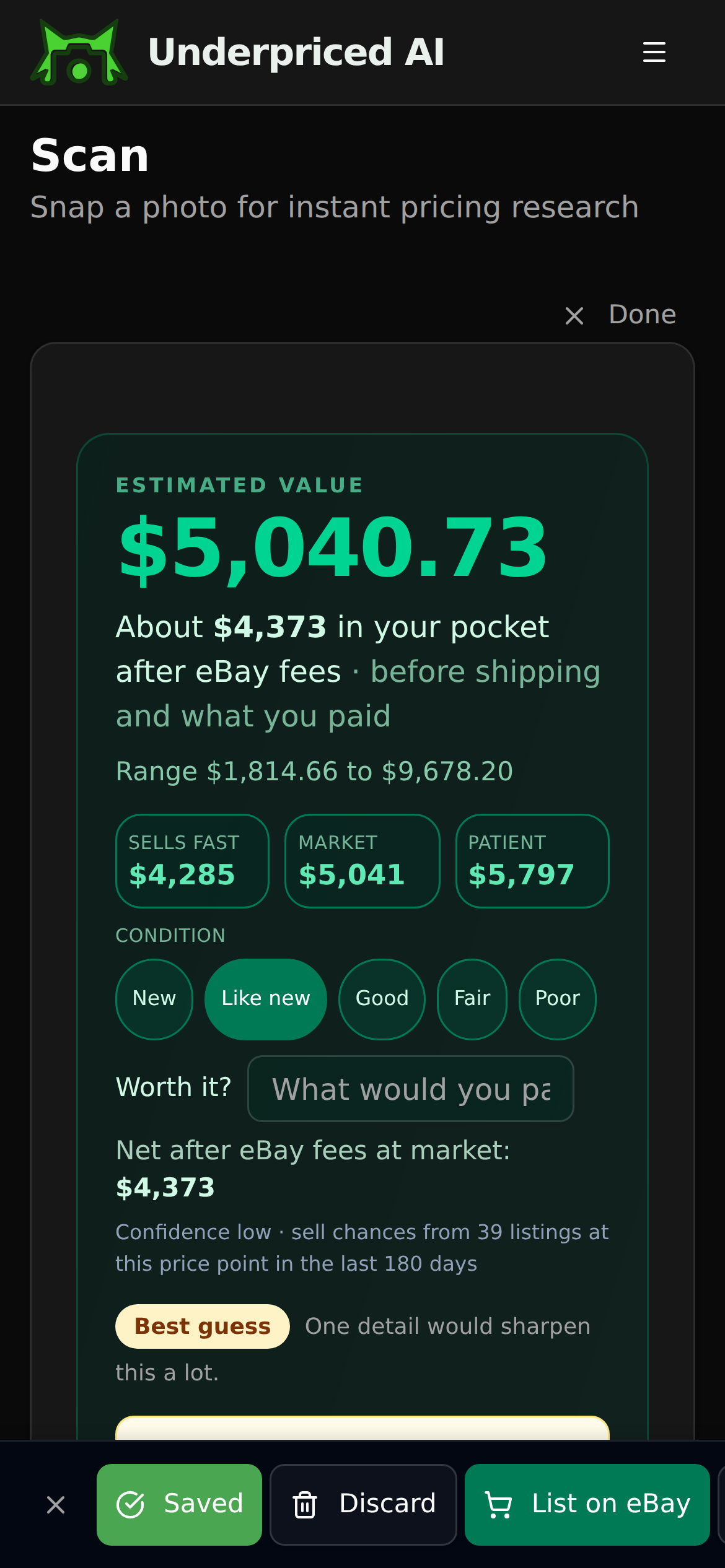
2. See what it sold for
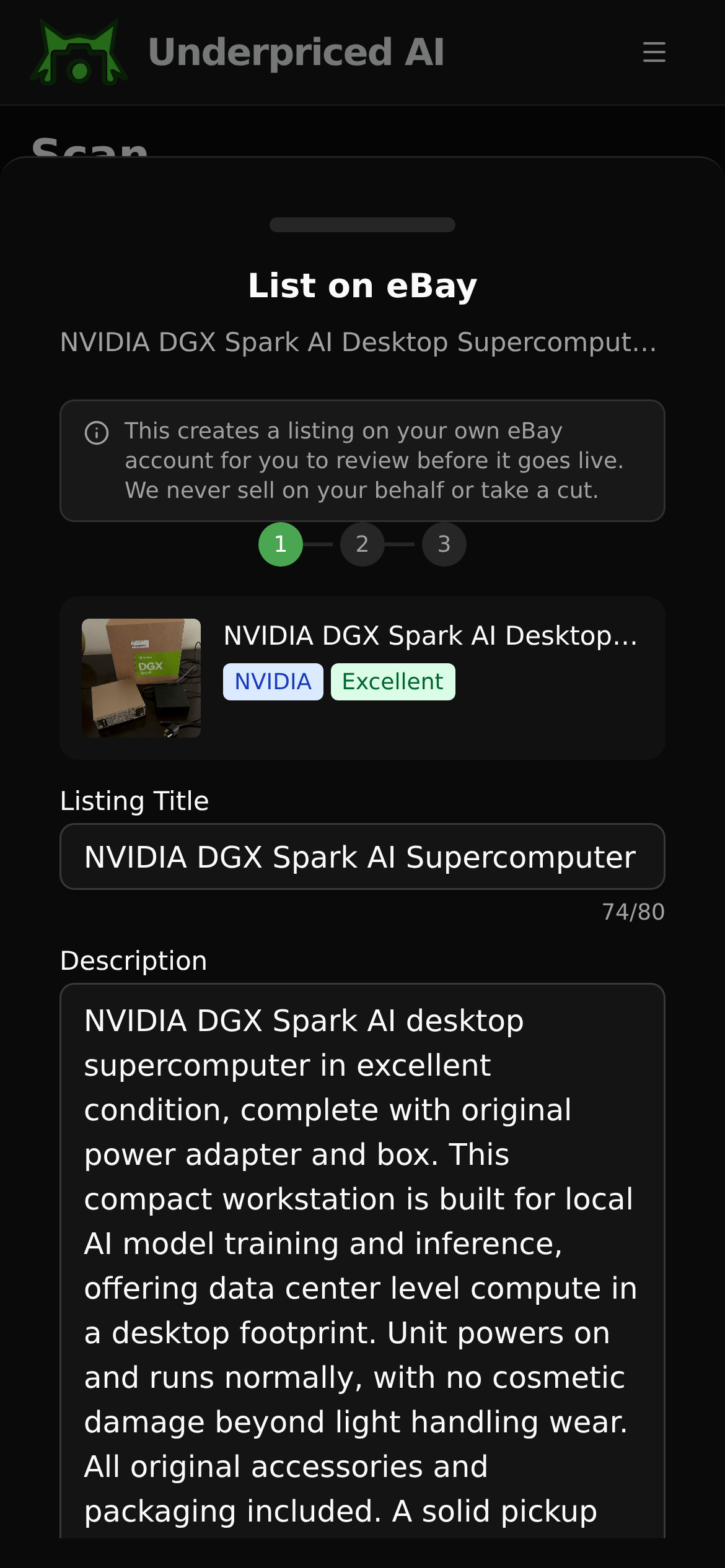
3. List it
Find our guides useful? Get more of them in Google Search.