
eBay Listing Optimization 2026: Rank, Convert, Sell
Every lever in a 2026 eBay listing: titles, item specifics, photos, pricing, categories, shipping, and when Promoted Listings are worth it.

eBay Listing Optimization: The 2026 Guide to Ranking and Selling
An eBay listing ranks on keyword match in the title, complete item specifics, sell-through and conversion. It converts on photos, sold-comp pricing and shipping. Use all 80 title characters with the brand first, fill every item specific, and shoot twelve natural-light photos. Price to the last 30 days of Sold comps, pick the deepest category, and use calculated shipping on anything over 2 lbs.
Updated September 2026: added outcome data from about 2,800 real eBay listings and a structured FAQ.
A great listing on eBay in 2026 does two things. It ranks in Cassini (eBay's search algorithm) for the queries your buyers actually type, and it converts once a buyer lands on the page. Most resellers optimize for one but not the other. The result is listings that either get seen but not bought, or bought when seen but rarely surfaced.
This guide covers every lever in a modern eBay listing and how to pull each one correctly.
How Cassini Actually Works in 2026
Cassini is eBay's search ranking algorithm. It decides what shows up when a buyer searches. The factors that move rankings meaningfully in 2026:
Keyword match in the title is the single strongest signal. If the buyer types "vintage Levi's 501 Big E 32x32" and your title doesn't contain those words, you don't rank.
Item Specifics completeness covers the structured attributes: brand, size, condition, color, material. A listing with all specifics filled in ranks higher than one with just a few. Missing specifics is how thousands of listings fall out of rotation.
Sell-through rate matters too. Listings that sell fast at their price point get ranked higher for new buyers. Listings that sit for months get demoted. The algorithm learns what clears.
Seller feedback and defect rate are account signals. Top Rated Sellers get a visible ranking boost. Defect rate above 2% tanks placement.
Conversion rate from the listing counts. If buyers click your listing and don't buy, Cassini learns the listing is low-quality for that query. Photos, pricing, and shipping drive this.
Freshness plays a role. New listings get a 48-to-72 hour visibility boost to test them. After that, they rank based on performance.
Each of these is controllable. Most resellers pay attention to one or two.
Titles Are the Single Biggest Lever
eBay gives you 80 characters. Use every one. Your title is competing against thousands of nearly identical listings. The only variable that differentiates them in search results is word match.
Structure that works in 2026:
[Brand] [Model/Pattern] [Key Specifics] [Descriptive Modifiers] [Year/Era if relevant]
Example, bad: "Vintage Pyrex Bowl"
Example, good: "Vintage Pyrex Butterprint Cinderella Mixing Bowl 443 Blue White 1 1/2 Qt"
The good version contains every word a buyer might search: "vintage Pyrex", "Butterprint" (pattern), "Cinderella" (shape name), "mixing bowl" (category), "443" (model number), color, and size. It will rank for dozens of query variations.
Do not:
- Use all caps (eBay actively suppresses SHOUTING titles)
- Use "L@@K", "WOW", or other attention words (these signal spam)
- Include store names or your username
- Repeat keywords (Cassini reads repetition as stuffing)
Do:
- Include brand, era, exact model or pattern name, size or dimensions, color, material, and condition qualifiers ("NOS", "sealed", "MIB" when accurate)
- Lead with the highest-value keyword (usually brand)
- Use descriptive nouns (bowl, jacket, figurine) that match how buyers search
For long-tail keyword work in specific categories, see best long tail keywords for eBay listings to drive resale sales.
Item Specifics Are the Hidden Ranking Multiplier
Item specifics are the structured attributes eBay shows as filters in the sidebar. They're also a major Cassini ranking signal.
The rule: fill every specific eBay offers for your category. Not only the required ones. All of them.
When a buyer uses the filters in the sidebar, and millions do, your listing only appears if the relevant specific is filled in. A vintage Pyrex listing with "Brand: Pyrex" but no "Pattern" filled in won't show when a buyer filters to "Pattern: Butterprint".
Modern specifics to never skip in 2026:
- Brand (always)
- Condition (granular, not just "Used")
- Material
- Country/Region of Manufacture
- Style
- Era or Year Made (for vintage)
- Size (for clothing or dimensional items)
- Color
- Model or pattern name
For vintage items, adding era or decade ("1970s", "1990s") is the ranking gain many resellers miss.
Photos Drive Conversion More Than Ranking
Photos don't directly rank your listing, but they control whether people who see it click buy. Conversion rate feeds back into ranking, so photos matter indirectly but heavily.
Hit these photo standards:
- Twelve photos minimum. eBay gives you twelve slots. Use all twelve.
- Natural light. Window light, neutral background (white sheet, seamless paper, or plain floor). Avoid yellow indoor bulbs that cast color.
- Every angle. Front, back, both sides, top, bottom, tag, mark, detail shots of any wear.
- Every defect. Photograph stains, scratches, chips, tears. Disclose in text. Buyers returning items because "it had a chip" hurts your defect rate more than a lost sale would.
- Scale reference. For smaller items, include a ruler or hand for size context.
For photo technique, see best way to photograph thrift clothes for eBay.
Price to Sold Comps, Not Guesses
The most common listing failure is pricing to asking comps instead of sold comps.
Asking prices on eBay are fantasy. Anyone can list anything for any price. Sold prices are real. The filter is on every eBay search. Under filters, check "Sold Items." That's your market data.
Pricing strategy by item type:
- Liquid items (consistent sell-through): price at the median of last 30 days sold. Will likely clear in 14 to 30 days.
- High-variance items (condition-driven): grade your item against sold comps, price proportionally. A mint example at the high end, a worn example at the low end.
- Rare items with thin sold data: start at the high end. You can lower but rarely raise. Use Best Offer if you want negotiation room.
For detailed pricing strategy on thrift flips, see how to price thrift flips for eBay and eBay pricing strategies for thrifted flips.
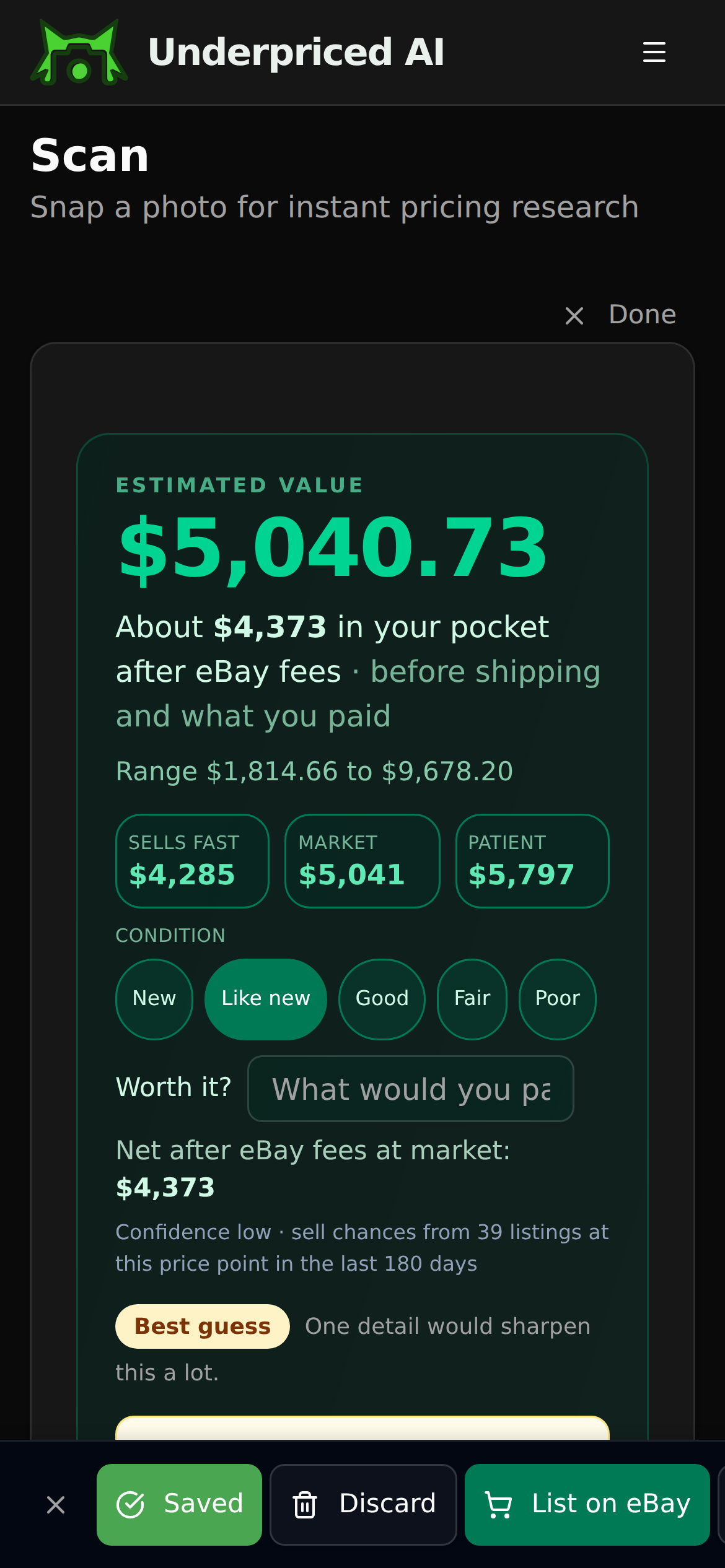
A pricing app like Underpriced AI pulls sold comps from eBay, Poshmark and Mercari plus category specialists in seconds. That includes platforms outside eBay that often show higher clearing prices (Poshmark for contemporary clothing, Depop for streetwear). Knowing the cross-platform picture tells you whether eBay is actually the right listing destination.
Descriptions: Complete, Not Flowery
eBay's modern buyer reads the description to confirm details already promised in the title and photos, and to check condition. They don't read prose.
Description structure that works:
- Opening line: one sentence confirming what the item is
- Bullet list: dimensions, materials, specific model or pattern info, year or era
- Condition statement: clear, specific, honest about any wear
- Shipping note if non-standard
Avoid:
- Long opening paragraphs about the item's history
- "Buyer to pay shipping" (it's in the listing already)
- "As is, no returns" (kills conversion, accept returns as the cost of higher ranking)
Put the Item Where the Buyer Looks
eBay suggests a category automatically. Often it's wrong, or not the best fit. Take ten seconds to check if a more specific subcategory exists.
For example, a vintage Pyrex dish might auto-classify as "Home & Garden > Kitchen > Dinnerware." The specific subcategory "Pottery & Glass > Glass > Glassware > Pyrex" gets three times the filter traffic from category-specific buyers.
Drilling into the deepest applicable subcategory exposes your listing to collectors who browse by category rather than search. For vintage and collectible items, category depth is a major visibility win.
Free Shipping If You Can Math It
Buyers filter by free shipping. If you can work shipping into the sale price and still clear margin, offer free shipping. You capture the free-shipping filter audience and Cassini gives a modest ranking boost.
Shipping checklist:
- Weigh items. Guessed shipping eats margin.
- Use calculated shipping for anything over 2 lbs. Flat rate kills you on heavy items.
- Combined shipping discount for multi-item buyers.
- Ship within one business day. Cassini tracks your dispatch time.
When Promoted Listings Are Worth It
eBay's Promoted Listings (Priority CPC and Standard as of 2026) boost visibility in exchange for a percentage of the sale price. When to use it:
- New listing without sold history, needs the initial visibility burst
- Competitive category where organic rank is hard to reach
- Higher-margin items where a 5-to-10% ad spend is absorbable
When to skip:
- Thin-margin items (every ad dollar eats profit)
- Listings already ranking organically
- Commodity categories where ad competition is crushing
For 2026-specific guidance on the promoted-listings changes, see eBay Promoted Listings 2026: What Changed, What Works Now.
The Overlooked Levers
Three levers most resellers ignore that move listings meaningfully:
List Sunday evening 7 to 10 p.m. local time for maximum first-48-hours impressions. That's when weekly eBay shoppers are most active.
Set up store categories. If you have an eBay Store, use custom categories. Buyers who land on one of your items can browse your other inventory by category and stay in your store.
Choose between auction and Buy It Now deliberately. Auctions create price discovery for unique items and drive urgency. Fixed-price with Best Offer works for items with deep sold-comp data. Don't default to one style. Match the format to the item.
What 2,800 Real Listings Show
Underpriced AI publishes listings straight to eBay, so we can see what happens after the advice above meets real buyers. Across about 2,800 eBay listings our sellers published in the six months to early September 2026:
Long titles are table stakes, not an edge. Sold listings had a median title of 71 characters, and 76% used 65 or more of the 80 available. Unsold listings looked almost identical: 73 characters, 77%. A full title gets you into the race. Specifics, photos and price decide it.
The clock is short. Of the listings that sold, the median went in 7 days. 47% sold within a week and 67% within 30 days. A listing that has not moved in 30 days is in the slow third. The fix is price or photos, not patience.
Buyers paid the asking price. The median sold price was 100% of the listed price. That is what pricing to sold comps does: the number is already the market's number, so there is little left to haggle.
Cheap does not mean fast. Sold listings were priced higher than unsold ones, a $25 median against $19. One likely reason: at $19 the shipping and fees make the buyer's total feel out of proportion to the item. Bundle low-value items or price them for free shipping instead of racing to the bottom.
The 90-Second Listing Audit
Before you hit publish, run this pass. It catches the misses that quietly bury listings:
- Title uses all 80 characters, brand first, no repeated words, no all-caps or "L@@K"
- Every item specific eBay offers is filled in, not just the required ones
- Era or decade added for anything vintage (the specific most sellers skip)
- Twelve photos, natural light, every angle, every defect shown
- Price set from the last 30 days of Sold comps, not asking prices
- Deepest applicable category chosen, not eBay's auto-suggestion
- Calculated shipping for anything over 2 lbs, free shipping if the margin allows
- Returns accepted (the ranking and conversion gain beats the occasional return)
Eight lines. If a listing fails two or more, it is leaving rank and sales on the table.
Frequently Asked Questions
What is the most important factor for ranking an eBay listing?
Keyword match in the title is the single strongest signal, followed closely by complete item specifics. Cassini cannot rank a listing for words it does not contain, so a title that includes every term a buyer might type does most of the ranking work.
How many photos should an eBay listing have?
Use all twelve slots eBay gives you. Shoot in natural light against a neutral background, cover every angle, and photograph every defect. Photos do not rank a listing directly, but they drive conversion, and conversion feeds back into ranking.
Should I price from sold prices or asking prices on eBay?
Sold prices. Asking prices are what sellers hope for; Sold prices are what buyers actually paid. Filter any eBay search to "Sold Items" and price to the median of the last 30 days for items that sell consistently.
Do item specifics really affect eBay search ranking?
Yes. Item specifics are both a Cassini ranking signal and the attributes buyers filter by in the sidebar. A listing missing the "Pattern" specific never appears when a buyer filters to that pattern, no matter how good the title is.
Is free shipping worth offering on eBay?
If you can build the shipping cost into the price and still clear your margin, yes. Buyers filter for free shipping, and eBay gives free-shipping listings a modest ranking boost. For heavy items where that math does not work, use calculated shipping instead.
When are eBay Promoted Listings worth the cost?
Use them for new listings with no sold history that need an initial visibility burst, or in competitive categories where organic rank is hard to reach. Skip them on thin-margin items and on listings that already rank organically, where the ad spend just eats profit you were going to earn anyway.
Nail Every Lever, Not Just Two or Three
eBay listing optimization in 2026 is not about any single trick. It is about systematically doing the unglamorous things: completing every item specific, writing a title that includes every searchable keyword, photographing in twelve angles with natural light, pricing to sold comps, and shipping with calculated rates.
Listings that nail each lever rank higher, convert better, and clear faster. Listings that phone in two or three levers get buried by the ones that don't.
Try Underpriced AI on web or mobile to pull sold-price data from eBay, Poshmark and Mercari plus category specialists before you price your next listing. Credit packs start at $3 for a 5-scan pack.
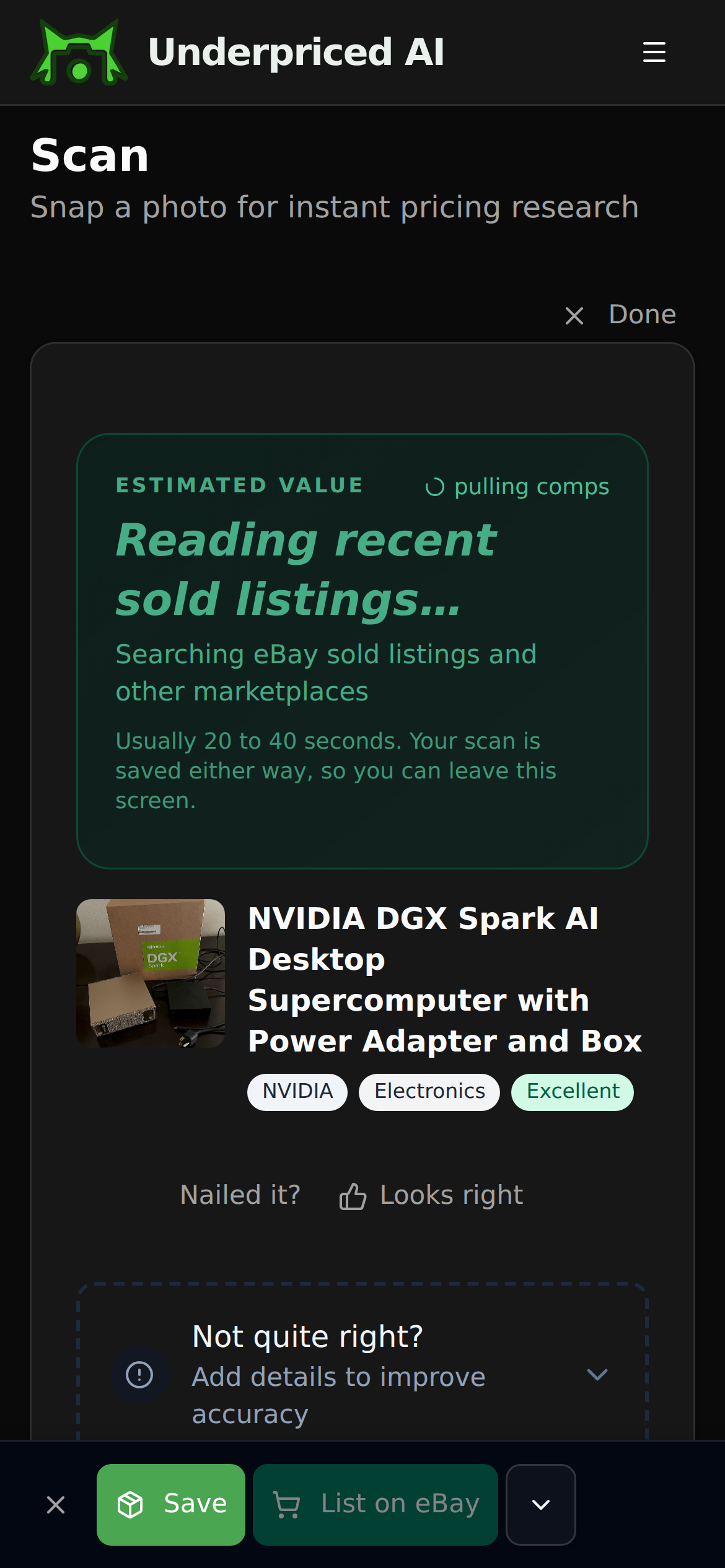
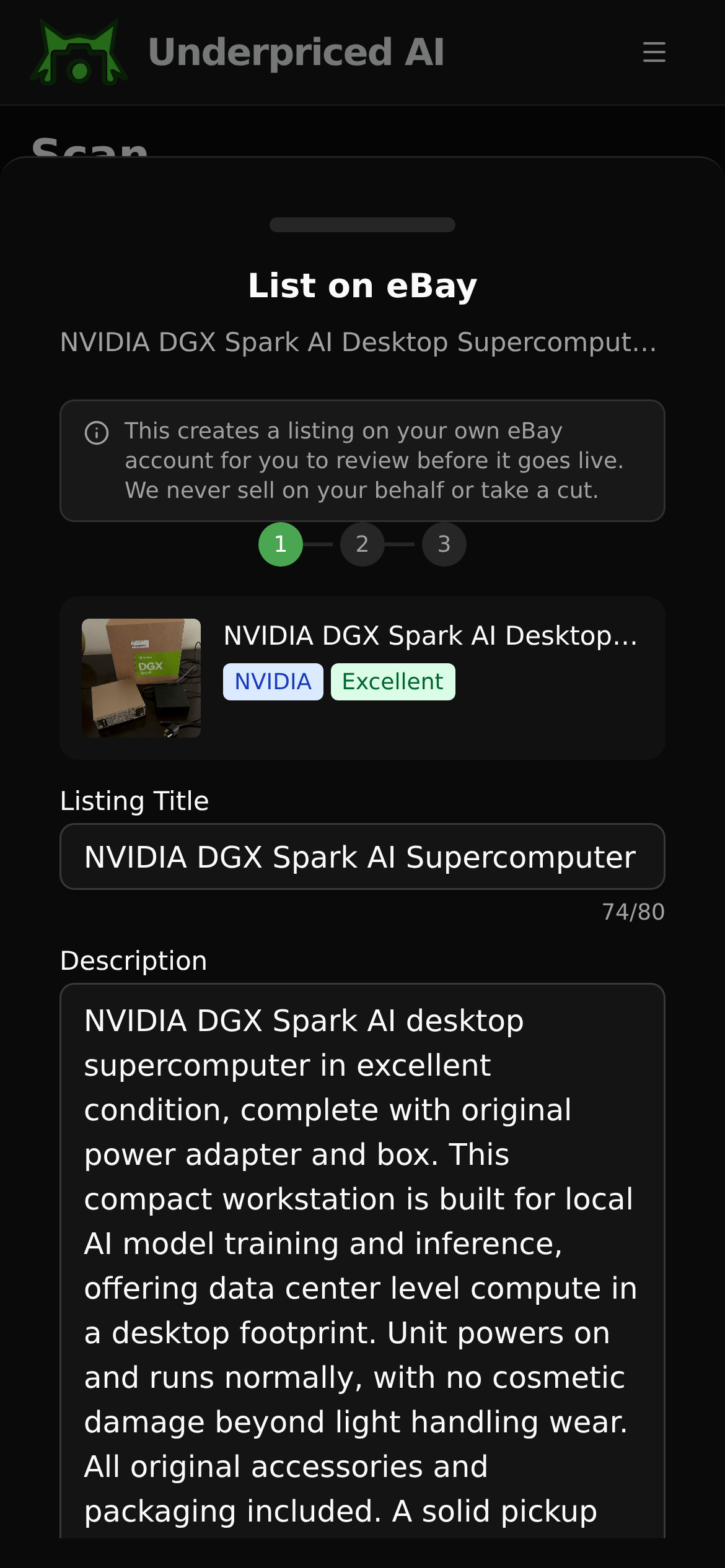
From photo to listed in one flow. Underpriced AI identifies any item from a photo, shows real sold comps from eBay, Poshmark and Mercari plus category specialists, then generates the listing and publishes it straight to eBay across 10 markets. Refresh value keeps your prices current as the market moves. Try your first scan free, no card required.
Scan, value, and list, all in one app.
Snap a photo and see real sold prices from eBay, Poshmark and Mercari, then cross-list to all of them in a few taps. Your first scan is free.
Try a Free ScanFree first scan, no credit card required
Founder of Underpriced AI. Building tools for resellers with 30+ years of software engineering experience.
How this was made: drafted with AI from our own sold-listings data and the sources cited, and published by Frank for Underpriced AI. Spot something wrong? Tell us and we'll fix it.
Know a reseller who'd want this?
Related Articles


Ready to find out what your stuff is worth?
Snap a photo and see what it actually sold for, with the real sold listings behind the price. First scan free, no credit card.
1. Photograph it
2. See what it sold for
3. List it
Find our guides useful? Get more of them in Google Search.