
Best Long Tail Keywords for eBay Listings to Drive Resale Sales
Find the best long tail keywords for eBay listings in thrifting and flipping. Increase visibility and sales with specific, low-competition phrases.

Why Long-Tail Keywords Are a Secret Weapon for eBay Resellers
Most new eBay sellers make the same mistake. They write titles like "vintage lamp" or "old pottery" and then wonder why their listings sit unsold for weeks. Meanwhile, experienced resellers are quietly dominating search results with hyper-specific phrases that buyers are actually typing into the search bar.
The difference is long-tail keywords.
A long-tail keyword is a phrase, typically three to five words, that targets a very specific search query. Instead of "vintage dress," you write "1960s mod shift dress wool." Instead of "pottery bowl," you write "McCoy pottery brown drip glaze bowl." These longer phrases have lower search volume individually. But they convert dramatically better because the person searching them already knows exactly what they want.
Research consistently shows that long-tail keywords convert 2.5 to 5 times higher than broad, single-word searches. For resellers, that's the difference between a listing that sells in three days and one that expires after 30.
This guide breaks down how to find, use, and profit from the best long-tail keywords for eBay listings. It uses real examples built for thrift flippers, estate sale hunters, and vintage sellers.
The Reseller's Case for Long-Tail Keyword Strategy
Here is the reality of eBay's marketplace in 2026. There are over 1.7 billion listings active at any given time. If you sell a "vintage camera," you compete with thousands of other sellers who listed the same vague term. But if you sell a "Minolta X-700 35mm film camera body with strap," your competition drops dramatically and your buyer is much closer to purchasing.
eBay's Cassini search algorithm rewards relevance and sell-through rate. When a buyer searches a specific phrase and your listing matches it closely, Cassini bumps your item higher in results. When buyers click your listing and purchase quickly, your seller score improves, creating a compounding visibility advantage.
Long-tail eBay sellers understand this cycle intuitively. They are not trying to rank for everything. They target the exact phrase a motivated buyer is using right now.
This is especially true in the thrift and vintage category. Collectors don't search for "old glass." They search for "green depression glass footed bowl anchor hocking." They know what they want, they know the terminology, and they're ready to buy.
The Real Benefits of Long-Tail Keywords for Resellers
Let's get specific about why this strategy works so well for thrift and estate sale flippers.
Buyers Using Long-Tail Phrases Have Buying Intent
A person searching "pottery" is browsing. A person searching "Roseville pottery Magnolia pattern brown vase 1940s" has their credit card out. eBay keyword research consistently shows that specificity correlates with purchase probability. You want buyers in the second group, and long-tail phrases attract almost exclusively that audience.
Lower Competition Means Better Visibility Without Ad Spend
Broad keywords are expensive to compete on organically. If you are not already a top-rated seller with thousands of transactions, you won't beat established resellers on "vintage clothing." But "1970s Levi's orange tab corduroy flare jeans 32x30" might have only a handful of competing listings. Yours can rank at the top without spending a dollar on promoted listings. And with eBay Promoted Listings changes in 2026, organic keyword placement is more valuable than ever.
They Align With How Collectors Actually Search
Serious buyers, the ones who pay full price, search with the vocabulary of their hobby. They use maker names, pattern names, era descriptors, condition terms, and model numbers. If your listing matches that language, you look like an expert seller instead of a random thrift flipper. That builds trust.
Niche Thrift and Vintage Items Are Perfectly Suited
The secondhand market is built on specificity. A Pyrex "Butterprint" casserole dish with a lid commands $45-80 on eBay. A listing titled "vintage Pyrex casserole" might get $18. The keyword communicates value to the right buyer.
Tools for Long-Tail eBay Keyword Research
You don't need enterprise-level software to do solid eBay keyword research. Here are the tools that actually work for resellers.
eBay's Own Search Bar (Autocomplete)
This is the most underrated free tool available. Type a partial phrase into eBay's search bar and watch the autocomplete suggestions populate. These suggestions are pulled from real search data. They're what buyers are actually typing. Start with a category term ("fiesta ware") and let autocomplete show you the long-tail variations ("fiesta ware vintage cobalt blue dinner plate," "fiesta ware discontinued colors set").
Terapeak Product Research
Terapeak, built directly into eBay Seller Hub, is the most valuable keyword and pricing research tool available for long-tail eBay sellers. You can search for terms and see sell-through rates, average sale prices, and which exact keywords are driving the most successful listings in your category.
For example, if you are researching vintage glassware, Terapeak can show you that "Indiana Glass sandwich plate clear pressed glass" has a strong sell-through rate while "vintage glass plate" barely moves. That's eBay keyword research with actual data behind it.
For more on using this tool effectively, see How to Do Market Research for eBay Flipping in 2026: Terapeak Guide.
Google Keyword Planner and Ubersuggest
These are technically Google tools, but buyer search behavior on Google often mirrors what people search on eBay. This is especially true for high-value items where shoppers do research before buying. Use these tools to confirm that your long-tail phrase has real search demand, even if it's modest.
Sold Listings Analysis
This is research you can do manually, and it's extremely powerful. Filter eBay search results to "Sold" and study the titles of successful listings in your category. What specific words do high-sale listings use? What patterns do you notice? Top-performing resellers do this constantly. It's basically crowd-sourced keyword research.
Underpriced AI
Sometimes you are standing in a thrift store or estate sale and you need to quickly understand what an item is, what it's called, and what specific model or pattern it is. That's where Underpriced AI fits in. Scan an item with your camera, and the app identifies it and pulls real resale pricing from the market. Knowing the exact name of something, maker, pattern, era, is the foundation of writing accurate long-tail keywords. You can't target "Hull Pottery woodland pattern vase 1950s" if you don't know that's what you're holding.
Where to Place Long-Tail Keywords in Your Listings
Finding the right keywords is only half the battle. You need to deploy them in the right places.
eBay Title (Most Important)
Your title is worth 80% of your keyword weight in Cassini's algorithm. You have 80 characters, so use almost all of them. The best long-tail strategy for titles is to build one core descriptive phrase that functions as your primary keyword, then layer in a secondary modifier.
Bad title: Vintage Pottery Vase Blue Nice
Good title: Hull Pottery Woodland Pattern Blue Pink Vase 7" 1950s Matte Glaze USA
The second title targets multiple long-tail searches at once: "Hull Pottery Woodland pattern vase," "1950s Hull Pottery matte glaze," "hull pottery blue pink vase," all in one natural phrase.
For a complete breakdown of title construction, eBay Listing Optimization | Write Titles That Sell covers the full framework.
Item Specifics
eBay's item specifics fields (brand, style, color, era, material, pattern, size) feed directly into filtered search results. A buyer who searches eBay and then filters by "Era: 1950s" and "Material: Ceramic" will only see your listing if you filled these fields out. Every item specific is essentially a long-tail keyword phrase broken into components.
Don't skip these. Fill out every applicable field, even if it feels redundant with your title.
Item Description
The description matters less for Cassini than the title and specifics, but it still contributes. It matters enormously for human buyers and for Google indexing your eBay listings, which does happen. Write naturally but include relevant long-tail phrases where they fit. If you sell a piece of vintage silver, mention the hallmarks, the silversmith, the pattern name, and the date letter if you know it. Buyers searching "sterling silver Gorham Chantilly pattern salad fork 1895" will find you in Google even if they didn't start on eBay.
Store Categories and Saved Search Titles
If you run an eBay store, your store category names and descriptions can include keywords too. "Vintage American Pottery 1940s-1960s" is a better store category name than "Pottery."
Long-Tail Keyword Examples for Vintage and Secondhand Items
This is where it matters. Here are category-by-category examples of how to upgrade vague listings to high-converting long-tail keyword phrases.
Vintage Clothing
| Weak Keyword | Strong Long-Tail Keyword |
|---|---|
| Vintage dress | 1950s circle skirt cotton dress floral print xs |
| Old jeans | 1980s Levi's 501 red tab straight leg jeans 34x30 |
| Vintage jacket | 1970s Levi's Type III denim trucker jacket medium |
| Vintage blouse | 1940s rayon crepe blouse puff sleeve navy blue M |
Vintage clothing is one of the most competitive categories on eBay. Long-tail specificity, decade, brand, style, fabric, color, size, is what separates listings that sell for $65 from listings that sell for $12. Dating items by their labels is a critical skill here. If you are not sure how to interpret vintage clothing tags, Vintage Clothing Labels: How to Date, Identify and Price Vintage Fashion by the Tag is worth bookmarking.
Vintage Glassware
| Weak Keyword | Strong Long-Tail Keyword |
|---|---|
| Old glass bowl | Green depression glass ruffled bowl Anchor Hocking |
| Vintage plate | Pyrex Butterprint amish wheat dinner plate 10" |
| Glass pitcher | Blenko amethyst crackle glass pitcher 1960s signed |
| Vintage vase | Fenton milk glass hobnail vase ruffled edge 8" |
The glassware category rewards collectors who know their terminology. A seller who correctly identifies a piece as "Vaseline glass uranium fluorescent bowl" will sell it for $40-80. The same item listed as "old yellow glass bowl" might get $8. If you are sourcing glassware, Vintage Glassware Identification: How to Identify, Date and Price Antique Glass is essential reading.
Pottery and Ceramics
| Weak Keyword | Strong Long-Tail Keyword |
|---|---|
| Old pottery | McCoy Pottery green leaf jardiniere planter 1940s |
| Vintage bowl | Fiesta Ware persimmon pasta bowl retired color |
| Ceramic figurine | Royal Doulton "The Balloon Man" figurine HN1954 |
| Pottery vase | Roseville Pottery Snowberry pattern vase 1947 blue |
Backstamp identification is everything in this category. Knowing the difference between a Rookwood mark and a Weller mark, or being able to read a Wedgwood date code, directly affects your title quality and sale price. For more on this, Pottery Marks Identification: The Reseller Guide to Ceramic Backstamps and Values breaks down exactly what to look for.
Electronics and Cameras
| Weak Keyword | Strong Long-Tail Keyword |
|---|---|
| Old camera | Canon AE-1 Program 35mm film camera black body only |
| Vintage radio | Zenith Trans-Oceanic Royal 1000 portable tube radio |
| Old record player | Technics SL-1200MK2 direct drive turntable serviced |
| Vintage calculator | HP 12C financial calculator gold tested working |
Thrift stores are full of electronics that look worthless but carry serious collector value. Model numbers are your best friend here. They're essentially ready-made long-tail keywords. A Technics SL-1200 is worth $300-500 in good condition. A listing that just says "old turntable" might sell for $40 to a flipper.
Estate Jewelry and Silver
Jewelry and silver require careful keyword construction around material, maker, style, and hallmarks. "Sterling silver" vs. "silver plated" vs. "silverplate" all draw different buyers at different price points. "Taxco sterling silver turquoise cuff bracelet 925 Mexico" will outperform "silver bracelet" in both search visibility and final sale price.
For resellers working with silver, understanding the hallmark system is non-negotiable. Silver Hallmarks: The Complete Guide to Identifying Sterling, Plated & Antique Silver Marks covers the full identification system.
Building a Long-Tail Keyword Habit
The most successful long-tail eBay sellers don't treat this as a one-time optimization project. They build keyword research into their sourcing and listing workflow permanently.
Before you list anything, spend three minutes:
- Searching eBay's sold listings for the item
- Noting the language used in the top-selling titles
- Checking autocomplete for your primary phrase
- Filling out all item specifics completely
That's it. Four steps, three minutes, and your listing is built around real buyer behavior instead of guesswork.
Over time, you'll develop category intuition. You'll know automatically that "Bakelite" is the right word instead of "old plastic," that "cobalt blue" beats "dark blue," that "RARE" in a title actually hurts you with Cassini, and that a four-word descriptive phrase almost always outperforms a two-word vague one.
Frequently Asked Questions
How many long tail keywords can I fit in an eBay title?
eBay titles allow 80 characters, and you should use almost all of them. Build one core descriptive phrase as your primary keyword, then layer in a secondary modifier. A title like "Hull Pottery Woodland Pattern Blue Pink Vase 7" 1950s Matte Glaze USA" targets several long tail searches at once while still reading naturally to buyers.
Do long tail keywords actually help items sell faster on eBay?
Yes. Research consistently shows long tail keywords convert 2.5 to 5 times higher than broad single word searches. Someone typing "Roseville pottery Magnolia pattern brown vase 1940s" already knows what they want, while someone typing "pottery" is browsing. With over 1.7 billion active listings, specificity also cuts your competition dramatically and helps Cassini rank you for relevance.
How do I write specific keywords when I don't know what the item is?
Start by identifying the maker, pattern and era, since you cannot target "Hull Pottery Woodland pattern vase 1950s" if you do not know that is what you are holding. Underpriced AI works on web or mobile: scan the item with your camera and it identifies it and pulls real resale pricing. Your first scan is free with no card.
Are eBay item specifics as important as the title for search?
The title carries roughly 80 percent of your keyword weight in Cassini, but item specifics decide whether you appear in filtered results. A buyer filtering by "Era: 1950s" and "Material: Ceramic" only sees your listing if those fields are complete. Fill out brand, style, color, era, material, pattern and size, even when it feels redundant with your title.
The Payoff of Accurate Keywords
The best long-tail keywords for eBay listings aren't fancy or complicated. They're just accurate. They reflect the specific language that motivated buyers use when they're ready to spend money. For thrift resellers and estate sale flippers, this is especially powerful. Secondhand items often have collector-specific names, maker marks, pattern names, and era identifiers that dramatically narrow competition and increase value perception.
Start with what you can observe about an item: brand, model, decade, color, size, material, pattern, condition. Build your title around those specifics. Fill in every item specific field. Write a description that naturally reinforces those terms.
Do that consistently and your sell-through rate will improve, often significantly, without any additional ad spend. That's the compounding power of eBay keyword research done right, and it's one of the highest-use skills any reseller can develop.
Underpriced AI pairs photo identification with verifiable sold comps from eBay, plus Poshmark, Mercari or Grailed for the categories that sell there. It also offers barcode scanning, listing generation, direct eBay publishing (10 markets), inventory and profit tracking, and analytics, all on the same premium AI model. Try your first scan free, no card required.
Scan, value, and list, all in one app.
Snap a photo and see real sold prices from eBay, Poshmark and Mercari, then cross-list to all of them in a few taps. Your first scan is free.
Try a Free ScanFree first scan, no credit card required
Founder of Underpriced AI. Building tools for resellers with 30+ years of software engineering experience.
How this was made: drafted with AI from our own sold-listings data and the sources cited, and published by Frank for Underpriced AI. Spot something wrong? Tell us and we'll fix it.
Know a reseller who'd want this?
Related Articles


Ready to find out what your stuff is worth?
Snap a photo and see what it actually sold for, with the real sold listings behind the price. First scan free, no credit card.

1. Photograph it
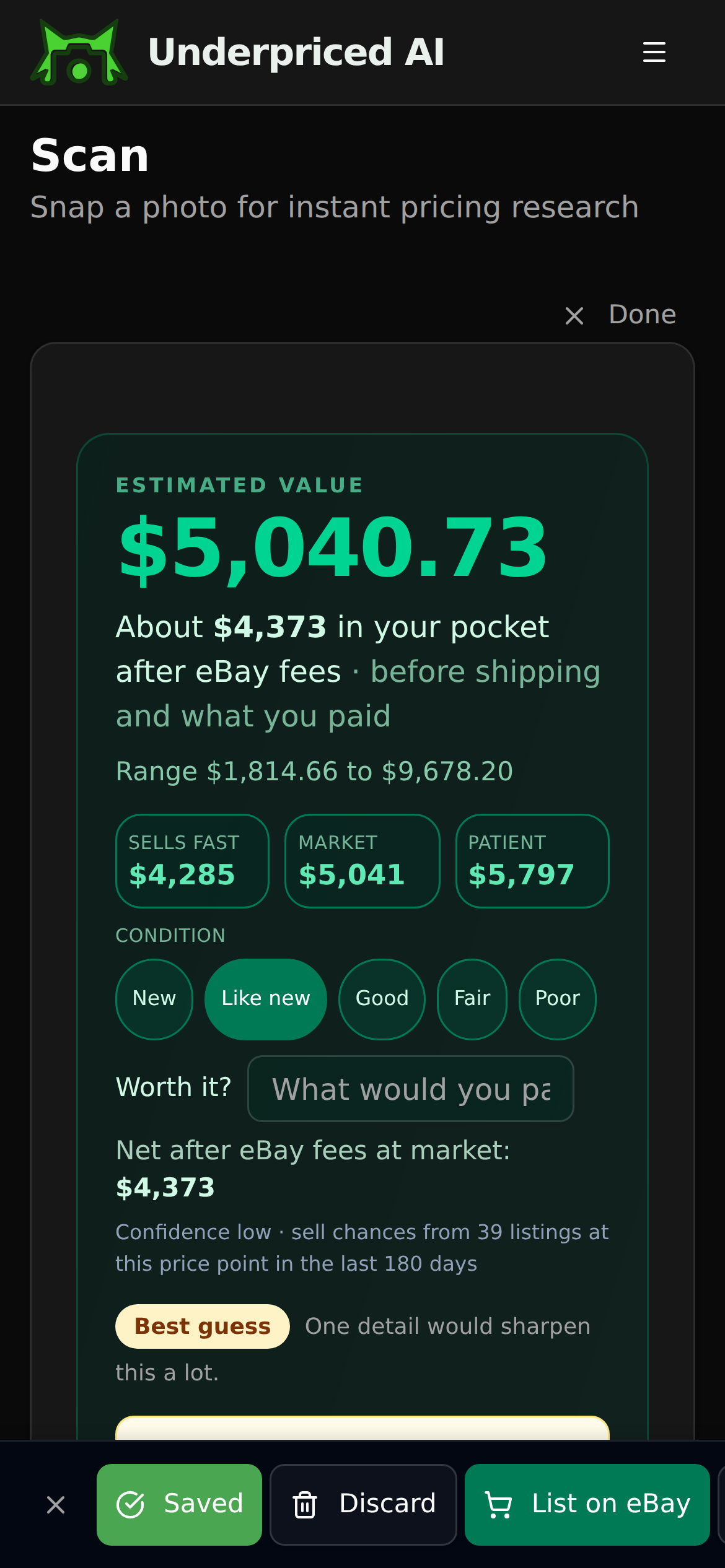
2. See what it sold for
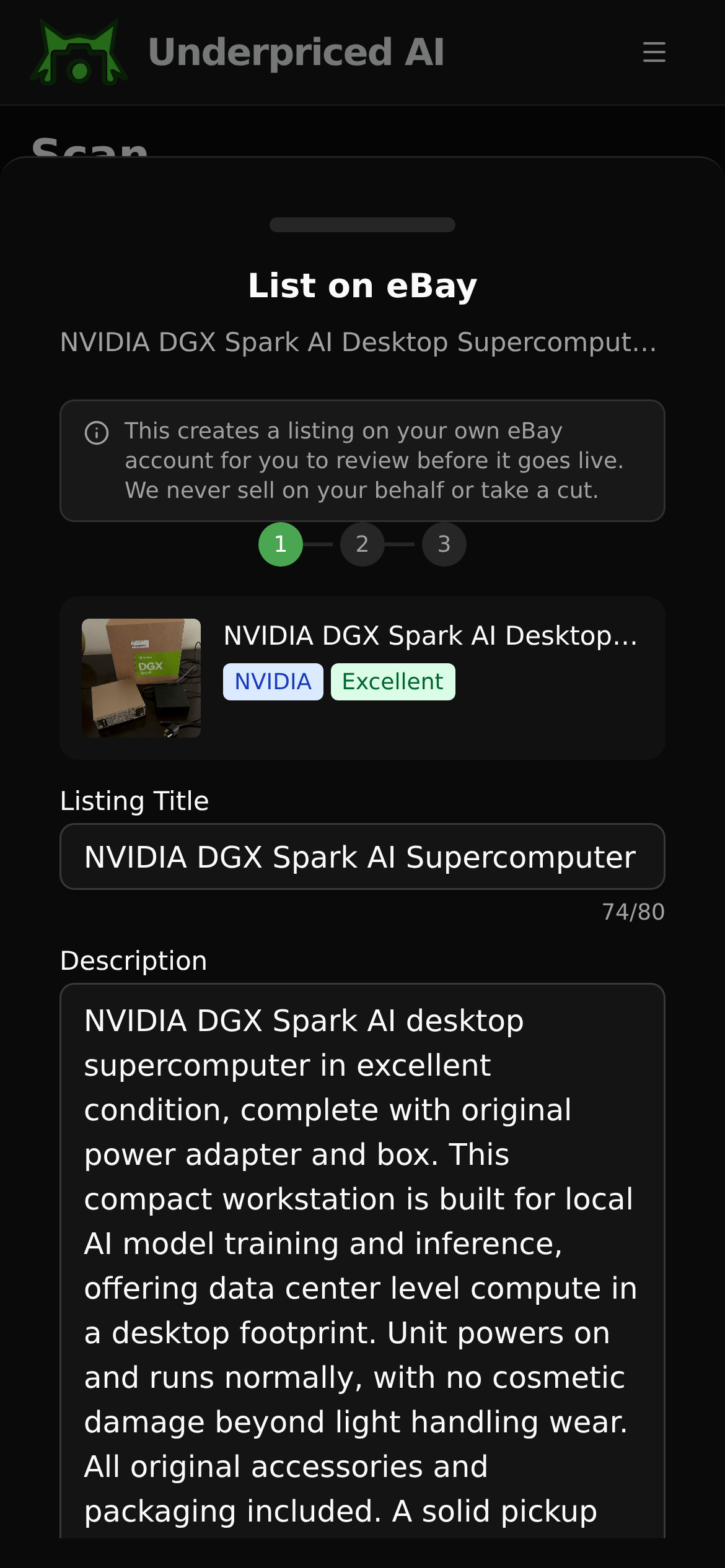
3. List it
Find our guides useful? Get more of them in Google Search.