
eBay Market Research Tools: Terapeak and Competitor Analysis
Discover top eBay market research tools including Terapeak. Analyze competitors, track demand, and identify profitable products with data-driven insights.

Why Market Research Is the Difference Between Guessing and Knowing
Most resellers start with gut instinct. They pick up a vintage lamp at an estate sale, assume it'll sell, list it for $45, and wait. Sometimes that works. But gut instinct doesn't scale. It definitely doesn't help you decide between two items when you've only got $20 left in your sourcing budget.
That's where eBay market research tools come in, specifically Terapeak, eBay's own built-in analytics platform. Combine it with competitor pricing analysis, sold listing research, and demand signal tracking. You can stop guessing and start making decisions backed by actual market data.
This guide is built for resellers ready to get serious: thrift flippers, estate sale hunters, collectors, and anyone who wants to know exactly what the market is paying before they buy inventory.
What Terapeak Shows You
Terapeak is eBay's proprietary market research tool, available for free to all sellers with an eBay Store subscription. You'll find it inside Seller Hub under the Research tab. If you've never used it, you're leaving real money on the table.
Terapeak pulls from eBay's own transaction database. That means the data isn't estimated or scraped from third-party sources. It's real.
What Terapeak Shows You
- Average sale price for a specific item or category over the last 365 days
- Sell-through rate, the percentage of active listings that actually result in a sale
- Total number of sold listings in a given time window
- Top listings with the highest view counts and sales velocity
- Trending products that are gaining momentum in searches and sales
- Seasonal demand patterns for specific categories
Say you're considering a lot of vintage Fisher-Price Little People toys from an estate sale. Search Terapeak, filter by condition, and you can see that complete sets have averaged $38-$65 over the past 90 days with a 74% sell-through rate. That's useful. That's the kind of number that makes a $12 sourcing decision feel a lot more confident.
Terapeak Product Research vs. Terapeak Sourcing Insights
There are two components worth knowing:
Terapeak Product Research is best for researching specific items you already have or are considering buying. Search by keyword, filter by category, condition, and date range, and get granular sales data.
Terapeak Sourcing Insights offers more category-level data. It's good for identifying which product types within a broader niche, like "vintage electronics" or "women's denim," are outperforming others.
If you're learning Terapeak from scratch, start with Product Research. It's more immediately actionable for the item-by-item decisions you're making at the thrift store or estate sale.
The Free Sold Listings Method Everyone Should Know
Even without a Seller Hub subscription, you can manually search eBay's sold listings to verify real sales volume and pricing trends. This is one of the most underused free tools in a reseller's toolkit.
Here's how to do it:
- Search for your item on eBay
- On the left sidebar, scroll to Show Only and check Sold Items
- Sort by Sold: recently to see the most current transactions
What you're looking for isn't the price, it's the pattern. Are items selling consistently, or was that $200 sale a one-time anomaly? Are most things selling within a few days, or are listings sitting for weeks before moving?
The Sell-Through Rate Trick
Here's a quick mental math formula experienced resellers use. Divide the number of sold listings by the total active listings, sold plus unsold, for the same search.
If you see 30 sold listings and 120 active listings for a specific item, your rough sell-through rate is about 20%. That's a crowded, slow-moving market. If you see 45 sold and 20 active, that's a hot item. Demand is outpacing supply.
This sold listings analysis is especially powerful for niche categories where Terapeak's data might be thinner. For items like vintage pyrex, specific Pokémon card lots, or particular camera models, manually checking sold listings often gives you a more nuanced picture than aggregate averages.
Monitoring Competitor Listings and Pricing Strategies
Knowing what sold is only half the equation. You also need to understand your competition right now: who you're up against, how they position their listings, and where there might be pricing gaps you can exploit.
How to Analyze Competitor Listings
Search your item on eBay and filter to active listings, not sold. Look at the top results and ask yourself:
- How many competitors exist? If there are 400 active listings for a "vintage Sony Walkman," that's a competitive market. If there are 12, you've got breathing room.
- What are their price points? Note the range: low end, average, and high end.
- What's driving the high-end sellers? Usually it's photo quality, condition, completeness (original box, accessories), or feedback score.
- Are competitors making obvious mistakes? Bad titles, poor photos, wrong category, missing item specifics, any of these are opportunities for you to rank higher and sell faster.
Reading Competitor Pricing Strategy
Look for patterns in how competitors price. Some use round numbers ($50.00), some use psychological pricing ($49.99), and some anchor high with Best Offer enabled.
If you see a lot of stale listings at $75 and your sold data shows items actually moving at $45-$55, that's a pricing gap you can fill. List at $52, price to move, and you'll often outsell the optimistic sellers who've been sitting on inventory for months.
For deeper dives into dynamic pricing approaches, Dynamic Pricing & Promotions: Accelerate eBay Sales with Smart Discounting is worth a read. It covers how to use data like this to adjust pricing in real time.
Tracking View Counts and Watchers: Demand Signals Most Sellers Ignore
Here's a metric that doesn't get enough attention: watchers and view counts.
eBay shows you how many people are watching your listings inside Seller Hub. You can also pick up watcher data while browsing competitor listings. eBay sometimes displays "X people watching this" or "X sold in the last 24 hours" on busy listings.
What High Watchers Actually Mean
A lot of watchers doesn't automatically mean a sale is imminent. Sometimes people watch and never buy. But it's one of the clearest demand signals available without paying for a premium tool.
High watchers plus a competitive price means a fast sale. If a listing has 18 watchers and the seller drops the price by $5, expect it to sell within hours.
High watchers plus a high price means opportunity. If your competitors have lots of watchers but are priced out of what buyers will actually pay, you can undercut strategically and capture that demand.
Inside your own Seller Hub, watch your listings that accumulate watchers but don't convert. That's a classic sign that your price is slightly too high. Even a 5-10% reduction can shake loose several watchers who were on the fence.
View Count Benchmarks
eBay's Seller Hub gives you view data per listing. As a rough benchmark:
- Under 10 views in 7 days: Your listing has a visibility problem, likely a title, category, or item specifics issue
- 10-50 views: Normal for most categories
- 50-200+ views: Strong interest; your pricing and positioning will determine if it converts
If you're getting views but no sales, the problem is usually price or photos. If you're getting neither, it's almost always a listing optimization issue. How to Optimize eBay Listings for Better Visibility in 2026 covers the mechanics of fixing that.
Using Demand Data to Select Profitable Products Before You Buy
This is where everything comes together. The real power of eBay market research tools isn't in managing inventory you already have. It's in making better buying decisions before you spend a dollar.
The Pre-Purchase Research Workflow
Here's the workflow experienced resellers use at estate sales and thrift stores:
- Spot a potential item
- Search eBay sold listings on your phone, look at the last 30 days of sales
- Check sell-through rate, mentally or with a quick count
- Note the price range, not the outliers, the consistent middle
- Factor in your costs: purchase price plus eBay fees (~13.25% for most categories) plus shipping plus your time
- If margin is there, buy. If not, walk.
This sounds obvious. But the discipline of actually doing it, every item, every time, is what separates profitable resellers from people who accumulate piles of stuff that doesn't move.
Spotting Trending Products with Terapeak
Terapeak's trending products feature shows categories and items that are gaining search volume and sales velocity on eBay. This is useful for two things:
- Validating a niche you're already in (good to see your category heating up)
- Discovering adjacent categories you haven't sourced yet
Say you're primarily a vintage clothing seller and Terapeak shows that Y2K-era accessories are trending hard. That's a signal to start paying attention to belts, bags, and sunglasses from that era at your next thrift run.
To dig deeper into sourcing strategy for thrift and estate sale finds, Thrift Store Flipping Guide: How to Flip Items from Thrift Stores for Profit on eBay and Estate Sale Sourcing Guide: How to Find & Flip Vintage Items for Maximum Profit both go deep on sourcing decisions.
Seasonal Trends and Historical Price Data
One of Terapeak's most underrated features is its ability to show you 12 months of historical pricing and volume data in a single chart. This lets you see exactly when demand spikes and when it dips.
Some patterns that consistently show up in the data:
- Vintage holiday décor peaks October-December, nearly dead January-August
- Outdoor and sporting goods spike March-June
- Video game consoles and retro electronics stay consistent year-round, with a bump in November-December
- Vintage fashion and accessories stay fairly steady, with upticks around prom season (March-May) and fall fashion cycles
Knowing this lets you time your listings strategically. Hold certain inventory and list it when demand is peaking, rather than dumping everything at once.
Beyond Terapeak: Other Tools Worth Knowing
Terapeak is the best free option for eBay-specific research, but it's not the only tool in the ecosystem.
Third-party tools like Algopix, 3Dsellers, or WatchCount.com offer additional layers of data. They're particularly useful for cross-platform sellers or those doing high volume. WatchCount.com is especially handy for seeing which eBay listings have the most watchers in a given category, without needing a Seller Hub subscription.
Google Trends is a surprisingly useful complement to Terapeak for understanding broader consumer interest in a product category before the eBay-specific data catches up. Once you've validated demand, our eBay Promoted Listings 2026 update shows how to factor current ad-tier costs into your margin math before you commit budget.
For resellers who source and list across multiple platforms, having a fast way to check pricing across channels is critical. That's where tools like Underpriced AI come in. Using your phone camera to instantly surface market data, you can check eBay, Poshmark, Mercari, and other platforms in seconds rather than running manual searches on each. When you're moving through an estate sale quickly, that speed matters. If you're selling across multiple platforms, Cross-Listing Strategy for Resellers 2026: Maximize Sales Across Platforms is worth bookmarking.
A Repeatable Research System
The resellers who consistently find profitable products on eBay aren't the ones with the best instincts. They're the ones with the best systems. Here's what a solid research loop looks like:
- Pre-sourcing: Use Terapeak Sourcing Insights to identify which categories are performing well right now
- In the field: Run quick sold listing searches on your phone before buying anything
- Back home: Use Terapeak Product Research to validate pricing on items you acquired
- Listing: Price based on actual sold data, not active listing prices, which are often inflated
- Post-listing monitoring: Track views and watchers weekly; adjust price if you're not converting
- Ongoing: Check competitor listings monthly to make sure your pricing hasn't drifted out of range
This isn't a complicated system. It just requires consistency. And the data is all there, most of it free, inside the tools eBay has already built for you.
Common Terapeak Mistakes That Quietly Eat Your Margins
Even sellers who use Terapeak weekly fall into the same traps. Here are the ones worth fixing first.
Don't look at average price without checking condition distribution. A $75 average for a vintage camera might include pristine examples at $140 and "for parts" units at $20. Click into the individual sold listings and figure out where your specific item lands on that spectrum before you set a price.
Don't ignore shipping costs. Heavy or bulky items like vintage appliances, sporting goods, lamps, and furniture can eat your entire margin in shipping. Terapeak shows average shipping costs in the results panel. Factor that into the math before you commit.
Don't research too broadly. "Vintage camera" returns garbage data. "Canon AE-1 Program 35mm film camera black" returns comps you can act on. The more specific the search, the more useful the average.
Don't use data that's too old. A six-month-old average price for a gaming console can be meaningless after a new generation drops or a popular YouTuber covers it. For trend-sensitive categories like sneakers, electronics, and collectibles, default to a 30 or 90 day window.
Don't use auction data when you'll list Buy It Now. Auction-format sales skew lower for most categories. If your plan is fixed-price BIN, filter Terapeak to BIN sales only so your comps match your listing format.
Working Off-Season: The 90-Day Reverse Lookup
One of the most reliable profit tactics in Terapeak is off-season sourcing with peak-season comps. The trick is using the date range filter to look at the prior year's peak month, not the current 90 days.
Concrete example: it's July and you find a vintage wool peacoat at Goodwill for $8. Pull Terapeak, search the brand and style, and set the date range to October through December of the previous year. If you see consistent sales at $75 to $95, that's your target. Buy now, hold the listing, push it live in early September so eBay's algorithm has time to index it before peak demand hits.
The full sequence:
- Identify peak demand months for the category (Terapeak's 12-month price chart shows it cleanly).
- Set your date range to the equivalent peak window from the previous year.
- Calculate your buy price for a 3x return after fees and shipping.
- Source aggressively 60 to 90 days before the next peak.
- List 4 to 6 weeks before peak so listings have time to gain views and watchers.
A few more seasonal patterns worth memorizing:
- Space heaters and electric blankets spike 30 to 50 percent October through December. Sourcing in March at $15 sets up $45 to $65 flips by November.
- Vintage board games (Fireball Island, HeroQuest, original Risk) climb 30 to 60 percent in November and December.
- Spring lawn and garden gear (Husqvarna, Sun Joe, vintage Toro) climbs steadily February through May.
- Back-to-school electronics (TI-84 Plus calculators especially) move heavily late July through September.
Build a Buy List Before You Hit the Sale
Resellers who win at estate sales and thrift stores don't research from scratch on the floor. They preload a buy list before they walk in.
Spend 20 to 30 minutes in Terapeak the night before a sourcing trip and identify:
- 10 to 15 specific items you'd buy on sight at the right price
- A maximum buy price for each (a useful default is 25 to 33 percent of the 90-day average sold price after fees)
- A condition floor below which the flip stops working
Write it down or save your Terapeak searches. When you're standing in a crowded estate sale with 30 other buyers, you don't want to be searching from zero on your phone. You want quick reference points so you can make a decision in under 10 seconds.
This preloading process is also how you avoid the impulse-buy trap. Say a vintage avocado-green KitchenAid stand mixer catches your eye and your gut says "this is worth something." Your Terapeak buy list either confirms it (working units run $110 average sold, your $45 ask is fine) or kills it (a $45 ask is a thin margin once you factor shipping and fees on a heavy appliance). The list converts gut into math.
Frequently Asked Questions
Is Terapeak free for eBay sellers?
Yes, Terapeak is free to all sellers with an eBay Store subscription. You find it inside Seller Hub under the Research tab. It pulls from eBay's own transaction database, so the numbers are real sales rather than scraped estimates. It shows average sale price, sell-through rate, total sold listings, top listings, trending products and seasonal demand patterns.
How do I calculate sell-through rate on eBay?
Divide the number of sold listings by the total listings, sold plus unsold, for the same search. For example, 30 sold against 120 active is roughly 20 percent, which signals a crowded, slow market. 45 sold against 20 active means demand is outpacing supply. Filter to Sold Items on eBay, then compare that count with active results.
Why do my eBay listings get watchers but no sales?
Usually the price is slightly too high. Watchers show real interest that stalls at checkout, and a 5 to 10 percent reduction often shakes loose buyers who were on the fence. If you are getting views but no sales, price or photos are the likely problem. Under 10 views in seven days points to a title, category or item specifics issue instead.
How can I research prices quickly while sourcing at a thrift store or estate sale?
Search the item on eBay from your phone, filter to Sold Items, sort by Sold: recently, review the last 30 days, then subtract eBay fees of roughly 13.25 percent, shipping and your time. Underpriced AI speeds that up by pricing from a photo using eBay, Poshmark and Mercari sold comps on web or mobile. The first scan is free, no card.
Validate With Sales Volume, Not Single Sales
One sale doesn't make a market. This is the single most common mistake newer resellers make in Terapeak. They find one sold listing at $180 and assume every similar item moves at $180.
What you actually want is consistent volume across multiple sellers. A useful framework:
- 30 or more units sold in 90 days across multiple sellers means a strong, validated market. Source aggressively.
- 10 to 30 units in 90 days is decent demand but competitive. Source selectively. Differentiate with condition and listing quality.
- Under 10 units in 90 days is niche or slow. Buy only at deep discount and accept you may hold for months.
- A spike concentrated in a 2-week window with flat sales otherwise is trend or season driven. Note the timing and plan around it.
Also check how many unique sellers contributed to those sales. If 300 of 400 sold units came from one large commercial seller, the market is dominated and you're competing against scale. If sales are spread across 50 or more sellers, the category is genuinely open and individual flippers can compete on listing quality and price.
A 90 percent sell-through rate on 8 total units is a curiosity. A 90 percent sell-through rate on 400 units is a real recurring market. Treat them very differently.
What sets Underpriced AI apart:
- Snap a photo of any winner and the premium AI model on every plan names it, while barcode scanning covers books, CDs, and vinyl.
- Confirm winners against tappable sold comps, from eBay first plus Poshmark, Mercari or Grailed by category, backed by live listings, market saturation, sell-through rates, and a fee/take-home calculator.
- Let AI write your listings and post them with one click to eBay (any of 10 country sites) or Bonanza, and tap Refresh value to reprice any prior scan.
- Track inventory, log purchase prices, and monitor profit and ROI through an analytics dashboard, giving you a complete reselling workflow beyond simple item identification.
Built on one premium AI model, Underpriced AI recognizes your item from a photo and backs the value with real eBay sold comps, plus Poshmark, Mercari or Grailed for the categories that sell there. It also scans barcodes, writes listings, publishes straight to eBay in 10 markets, and tracks your inventory, profit, and analytics. Try your first scan free, no card required.
Scan, value, and list, all in one app.
Snap a photo and see real sold prices from eBay, Poshmark and Mercari, then cross-list to all of them in a few taps. Your first scan is free.
Try a Free ScanFree first scan, no credit card required
Founder of Underpriced AI. Building tools for resellers with 30+ years of software engineering experience.
How this was made: drafted with AI from our own sold-listings data and the sources cited, and published by Frank for Underpriced AI. Spot something wrong? Tell us and we'll fix it.
Know a reseller who'd want this?
Related Articles


Ready to find out what your stuff is worth?
Snap a photo and see what it actually sold for, with the real sold listings behind the price. First scan free, no credit card.
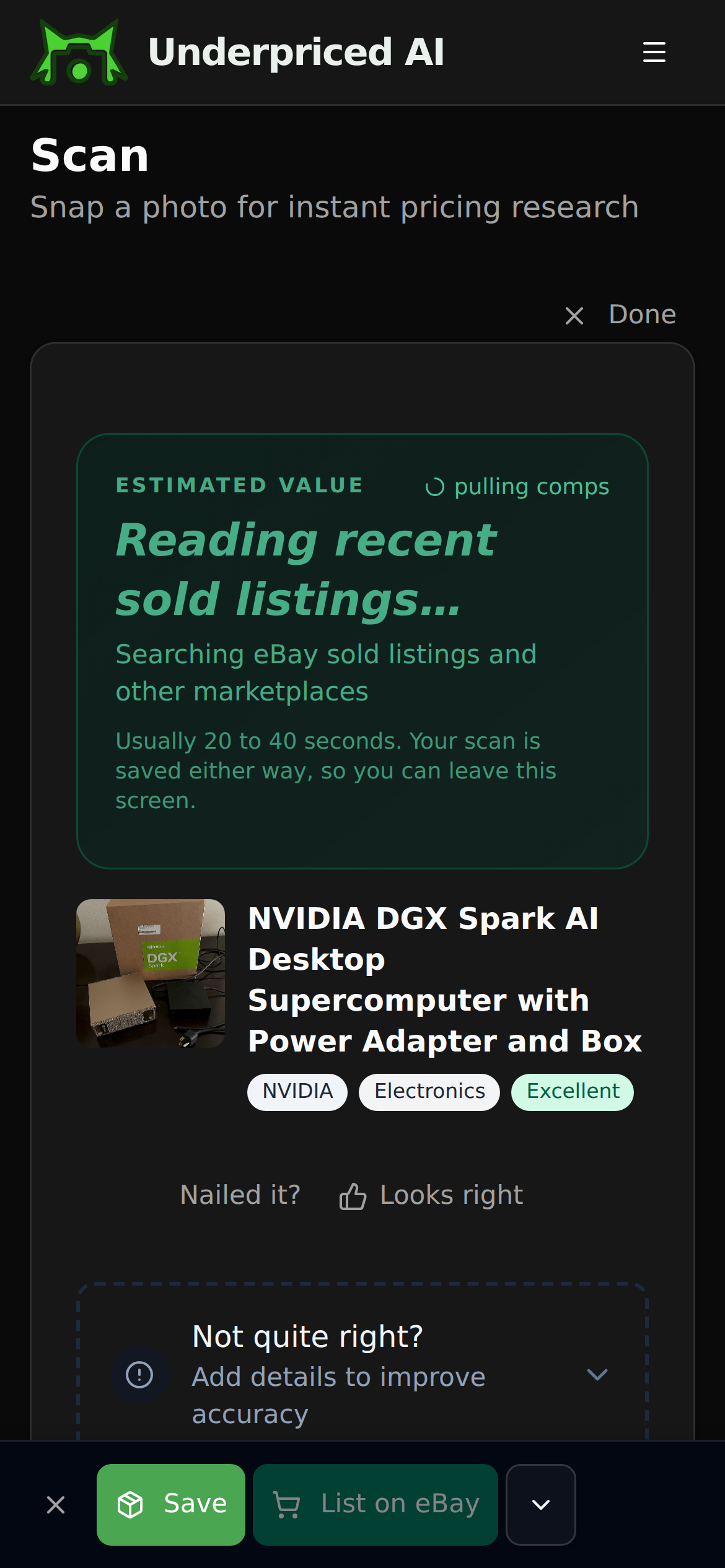
1. Photograph it
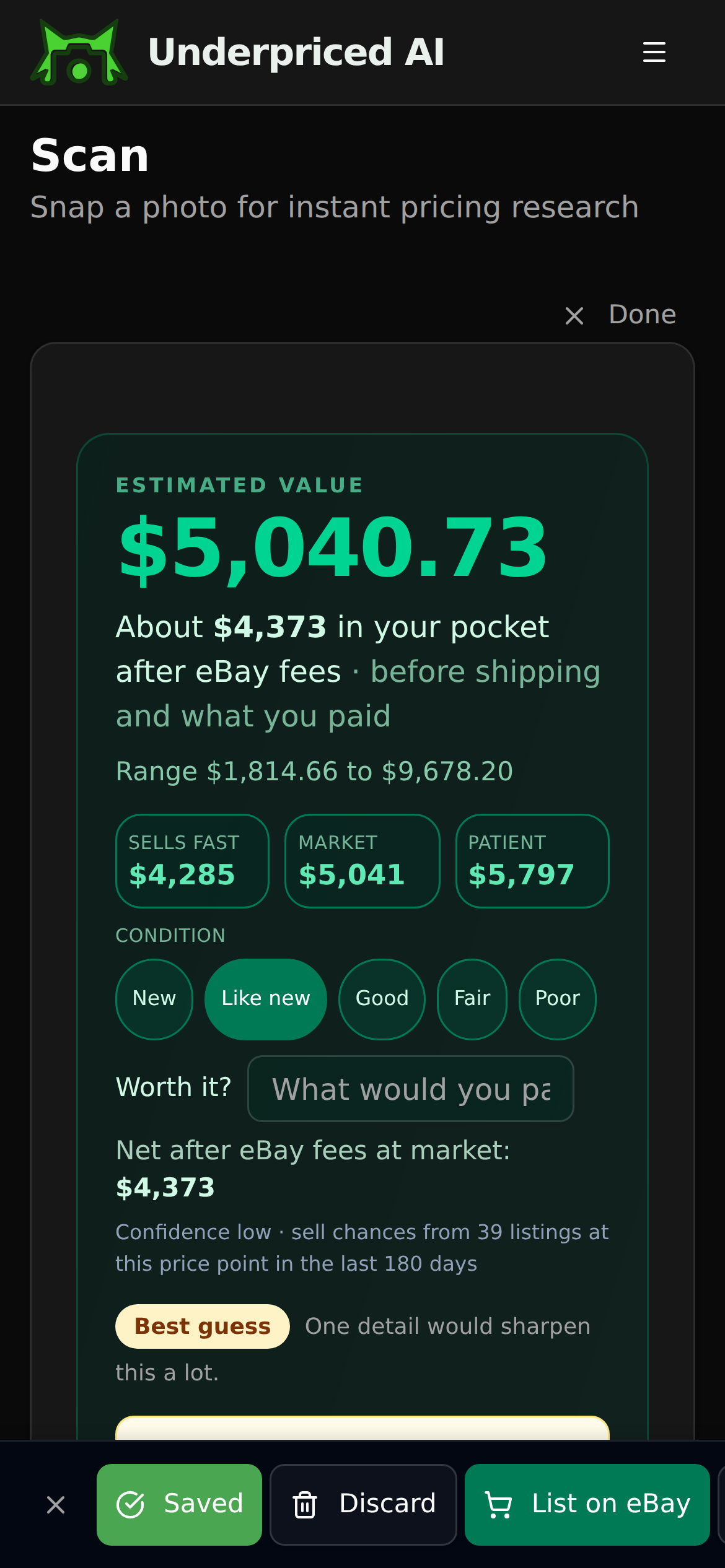
2. See what it sold for

3. List it
Find our guides useful? Get more of them in Google Search.