
How to Find Underpriced Items at Thrift Stores (2026 Guide)
The repeatable process for finding underpriced thrift store items: which categories have the biggest knowledge gaps and the ten-second decision framework.

How to Find Underpriced Items at Thrift Stores (2026 Guide)
Underpriced thrift finds cluster where identification is hard: ceramics and glass, vintage clothing, sterling and gold, and vintage toys and collectibles. The repeatable method is identify first, then check the real Sold price (not the asking price). Buy when the tag is under about 30% of the median sold price. A photo pricing app such as Underpriced AI closes both steps in well under a minute.
Updated September 2026: added category hit-rate data from roughly 15,000 recent scans and a structured FAQ.
The best thrift store flips almost always come down to the same pattern. An item priced by volume (everything at this rack is $4.99) that actually has category-specific value (a 1970s Pyrex Butterprint casserole that clears $55 sold). The store didn't know. You did. The gap is the profit.
This guide covers how to systematically find those underpriced items at thrift stores. It shows which categories they cluster in, and the identification habits that separate reliable sourcing from luck.
What "Underpriced" Actually Means
Before looking for underpriced items, understand what creates them. Four things.
Volume pricing. Thrift stores price by category shelf or weight, not by item. A pair of dressmaker's shears from 1955 and a $2 plastic kitchen gadget end up priced the same because they're both "kitchen stuff."
Knowledge gaps. Most thrift store employees can't authenticate a vintage Coach bag, date vintage Levi's by the red line tab, or tell real sterling silver from plate. When the store doesn't know, they default to the generic price.
Category lag. A hot collectible category gets priced at what last year's market paid. Vintage Carhartt went from $30 to $200 in two years. Thrift store prices lag the secondary market by six to eighteen months.
Pure variance. Some employees recognize brands, some don't. The same designer bag priced $15 at one Goodwill is $150 at another across town. Data and tools beat luck over time.
The Mental Model: Identify, Then Check
The reliable workflow at a thrift store has exactly two steps:
- Identify what it is (brand, era, model, mark)
- Check what it actually sold for (not asking price, sold price)
Most resellers who struggle get stuck on step one. They can't recognize enough brands and marks to pick up signal at speed. The workaround: lean on tools that do the identification for you, and focus your brain on step two.
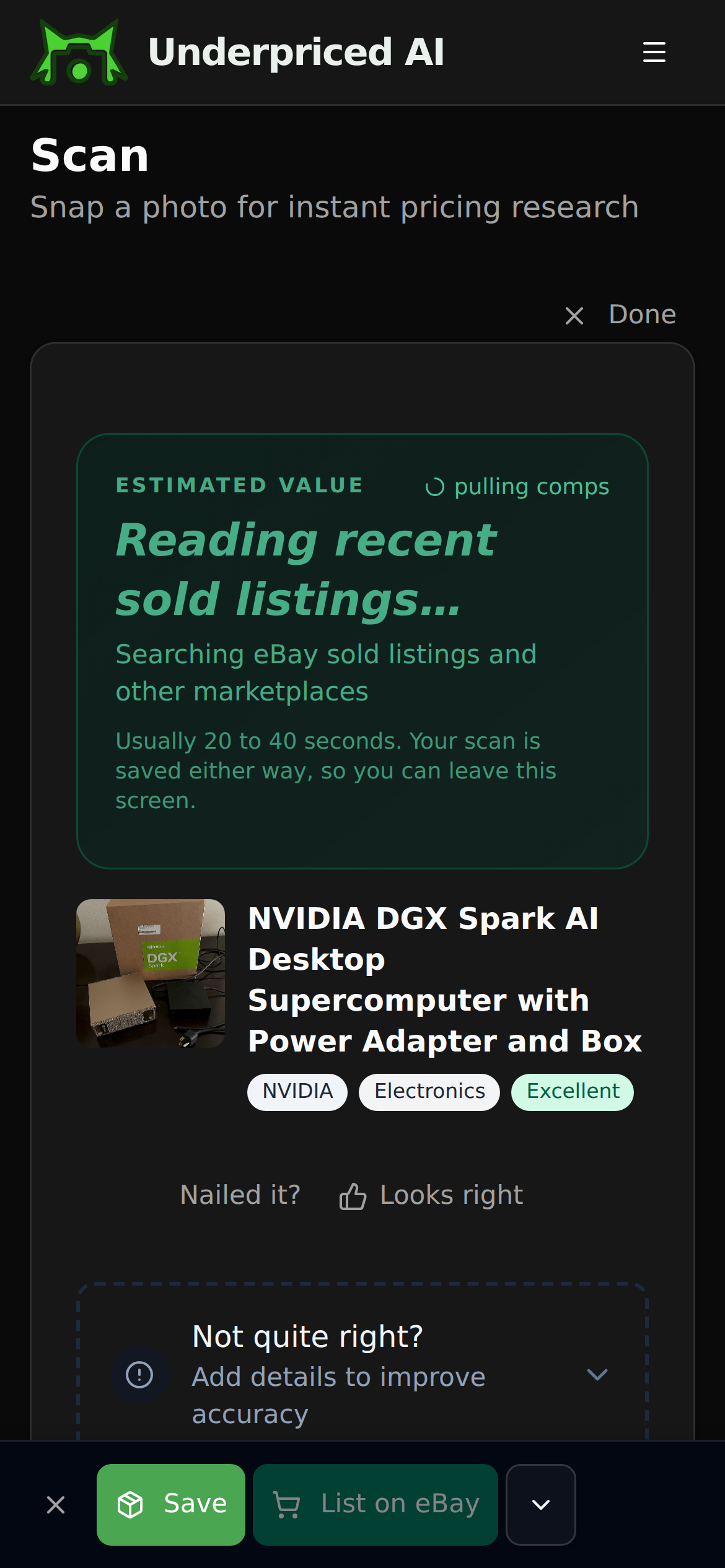
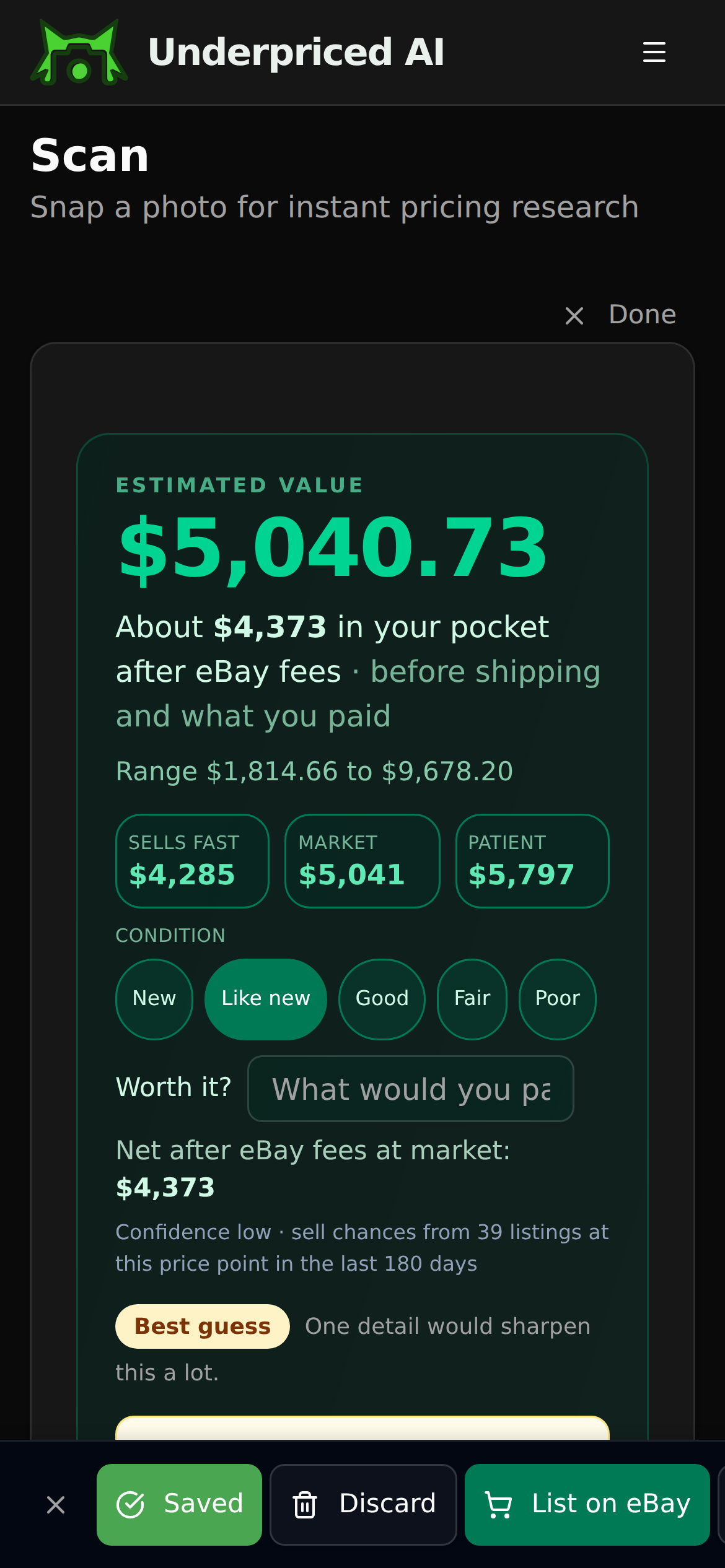
A scanner app like Underpriced AI identifies the item from a photo. It pulls real eBay sold prices, plus Poshmark, Mercari or Grailed for the categories that sell there. That closes both steps in fifteen seconds of phone time. That is the speed you need while another picker is eyeing the same shelf.
For a broader look at valuation apps, see best thrift store apps and what is this worth: 7 apps that tell you the value of anything.
The Categories Where Underpricing Actually Happens
Not every aisle is a hunting ground. Underpricing rates cluster highest in categories where identification is hard and modern substitutes confuse the staff.
Ceramics and Glassware
The number one volume category for underpriced finds. Thrift stores price ceramics by shelf, not by piece. A Hall Nautilus teapot and a modern Target mug go in the same $4 bin. Key patterns to learn:
- Pyrex patterns: Butterprint, Gooseberry, Pink Gooseberry, Early American, Horizon Blue. Sold prices range from $25 for common patterns up to $400 for rare patterns in full sets with original lids.
- CorningWare: Spice of Life, Wildflower, and Blue Cornflower move in the $30 to $150 range in good condition. See vintage CorningWare value for pattern-specific pricing.
- Depression glass: Pink Cameo, green Mayfair, and amber Patrician clear $40 to $200 per piece. Details in Depression glass value guide.
- Art pottery: Hull, McCoy, Roseville, and Hall all have active collector markets. Backstamp matters. See pottery marks identification.
Vintage Clothing
Thrift stores price clothing by condition and shelf density, not brand. A 1990s Versace blouse goes on the same rack as a 2020s Forever 21 shirt. Signals to spot at speed:
- Single-stitch hems on T-shirts (pre-1998, vintage tell)
- Big E Levi's tab (pre-1971, large premium)
- Made in USA tags on Carhartt, Pendleton, or Filson
- Lined wool and union labels on mid-century outerwear
Full breakdown: 30 valuable vintage clothing brands to flip and vintage Levi's value.
Silver and Jewelry
Thrift store cases mix real sterling with plated flatware and costume jewelry with fine. Hallmarks do the work for you. Look for:
- "925", "Sterling", or country marks on silver
- "14K" or "18K" on gold
- Named designer marks (Tiffany, Georg Jensen, Mexican silver stamps)
Start with silver hallmarks complete guide and silver flatware value.
Toys, Games, and Collectibles
Underpricing happens most where identification requires specific knowledge. Key zones:
- Hot Wheels (Redlines, Treasure Hunts, errors). See Hot Wheels value guide.
- Vintage video games (sealed beats loose by 3x to 10x)
- Hummel figurines with specific marks. See Hummel figurines value.
- Boxed action figures (MISB signals)
Books and Media
Rare, but when it hits, it hits hard. First-edition modern firsts, signed books, and specific vintage cookbooks can clear $100 to $500. Thrift stores rarely check. Scan ISBNs at volume with the Amazon Seller app for the fastest filter on this category.
What 15,000 Scans Say About Where the Money Is (2026 Data)
We looked at about 15,000 scans our users ran in the 90 days to early September 2026. We grouped them by category and asked one question: how often does the item turn out to be worth $40 or more at resale, based on real sold comps? Resale value is not profit, you still pay the tag, fees and shipping. But it is the ceiling you are buying against.
| Category | Scans | Median resale value | Worth $40 or more |
|---|---|---|---|
| Furniture | 485 | $185 | 96% |
| Sports gear | 252 | $60 | 71% |
| Art | 790 | $55 | 68% |
| Electronics | 655 | $60 | 65% |
| Antiques | 1,136 | $55 | 64% |
| Shoes | 480 | $45 | 61% |
| Jewelry | 823 | $35 | 46% |
| Vintage | 821 | $34 | 41% |
| Pottery and glass | 3,008 | $29 | 31% |
| Collectibles | 2,200 | $22 | 25% |
| Clothing | 2,302 | $25 | 24% |
Three things stand out. Pottery, clothing and collectibles are where resellers scan the most and where the hit rate is lowest: only one in four to one in three items clears $40. That is not a reason to skip those aisles, it is the reason to check before you buy, because the misses are cheap and the hits are real. Furniture is the sleeper: nearly every piece worth scanning came back at $40 or more with a $185 median. It stays underpriced because most pickers cannot ship it (local pickup on Facebook Marketplace solves that). Shoes and electronics sit in the middle: the store usually prices the brands it recognizes, but a $45 median on shoes means a $6 tag still works more often than not.
The Ten-Second Decision Framework
Fast sourcing is the whole game. Most serious thrift store resellers make a buy/pass decision in under twenty seconds per item. Here's the framework.
Second 1 to 3: scan the item visually. Is there anything unusual? A maker's mark, a brand label, an era indicator, unusual material? If nothing stands out, pass.
Second 3 to 5: pick it up. Check the bottom, back of tag, or hidden label for marks. Many valuable items telegraph themselves only when you turn them over.
Second 5 to 15: photograph and run through a pricing app. Underpriced AI identifies the item right away and has the sold comps in 20 to 40 seconds. Most other apps are slower or lack multi-platform sold data.
Second 15 to 20: decide. If the sale tag is under 30% of the median sold price, buy. If the sale tag is 30% to 60% of median, check sell-through rate before buying. If above 60%, pass.
The 30/60 threshold accounts for platform fees (roughly 15%), shipping (variable but meaningful), and opportunity cost on your cash. An item bought at 30% of sold price clears roughly 45% margin after fees. That's the target.
The Categories Where Underpricing Rarely Happens
Some categories are efficient markets at thrift stores. Don't waste time here:
- Name-brand electronics. Stores look these up, always.
- Popular video games released in the last ten years. Priced on the shelf by staff who game.
- Books from mainstream publishers. Commodity pricing, rarely underpriced.
- New-in-box toys from recent years. Stores price by barcode scan.
Sourcing time is a resource. Spend it on categories where the store's knowledge gap creates a consistent pricing lag.
Authentication Before Buying
Underpriced items are only underpriced if they're real. Fake vintage Levi's (reproduction tabs, fake single-stitch) cost thrift prices and sell for zero. Fake Coach, fake Pendleton, and fake Rolex circulate at thrift stores more than most resellers realize.
Basic authentication habits at the rack:
- Stitching: real vintage has handmade variance. Reproductions have machine perfection.
- Tags: check type of sewing, fabric composition, made-in label. Google the specific tag format for the brand era before you trust it.
- Construction: linings, seams, zippers. Brass zippers and hand-sewn linings signal real.
- Smell: real old items smell old. Most reproductions smell new.
For high-ticket items where authentication is critical, cross-reference against WorthPoint auction records. WorthPoint's depth in high-end antiques and collectibles is unmatched.
Build the Habit: Go Often, Go Early
The two highest-leverage sourcing habits:
Go often. Thrift store inventory turns fast, especially for clothing. Going weekly instead of monthly multiplies your exposure to new arrivals. Mispriced items clear within days.
Go early. First through the door at opening gets the freshly set inventory. Most high-ticket thrift finds are pulled in the first two hours of a store's day.
Pair these with a systematic route. Know which local thrifts skew toward estate-quality donations (your best shot at underpriced vintage) versus department store clearance dumps (efficient markets, skip). Stores in wealthier neighborhoods with volunteer-run operations tend to have the best knowledge gaps.
What to Do the Moment You Find Something
You found something underpriced. The buying workflow:
- Photograph everything. Condition photos at the store help with listing later. Natural light, multiple angles, every mark.
- Buy quietly. Don't announce what you found to the cashier. Pricing corrections sometimes happen mid-transaction.
- List within 72 hours. Fresh inventory has momentum. Items sitting unphotographed at home for weeks lose listing energy.
- Price to the sold-comp median. Not the high, not the low. Median clears fastest. For eBay-specific pricing strategy, see how to price thrift store flips for eBay.
Frequently Asked Questions
What categories have the most underpriced items at thrift stores?
Ceramics and glassware first (Pyrex, CorningWare, Depression glass, art pottery), then vintage clothing, sterling silver and jewelry, and vintage toys and collectibles. These are the categories where identifying the item takes specific knowledge, so thrift staff default to generic shelf pricing.
How do I know if a thrift store item is worth reselling?
Identify what it is, then check its recent Sold price (not the asking price) on eBay or another marketplace. If the sale tag is under about 30% of the median sold price, it clears a healthy margin after fees and shipping. A pricing app that pulls sold comps from a photo makes this a ten-second check.
What is the best app to check the value of thrift store items?
Look for one that both identifies the item from a photo and pulls real Sold prices across multiple marketplaces, since the highest clearing price is often not on eBay. Underpriced AI does both in 20 to 40 seconds, pricing from eBay sold listings plus Poshmark, Mercari or Grailed by category.
What time of day is best to thrift for reselling?
First thing at opening. Most high-value finds are pulled within the first two hours after fresh inventory is set out. Going weekly instead of monthly also multiplies your exposure, because mispriced items clear within days.
How far below the sold price should a thrift item be before I buy it?
Aim for a sale tag under 30% of the median sold price for an instant buy. Between 30% and 60%, check the item's sell-through rate first. Above 60%, pass. That threshold accounts for roughly 15% marketplace fees, shipping, and the opportunity cost on your cash.
How do I avoid buying fakes at thrift stores?
Check stitching (real vintage has handmade variance, reproductions are machine-perfect), tags and labels (Google the exact tag format for the brand and era), and construction details like zippers and linings. When a high-ticket item's authenticity is unclear, it is safer to pass than to gamble thrift money on a fake.
Speed and Discipline Beat Luck
Finding underpriced items at thrift stores is not mysterious. It's a repeatable process. Know which categories have wide knowledge gaps, learn the identification signals that matter in those categories, and use a pricing app to close the sold-comp step in seconds.
The resellers who consistently find underpriced items aren't luckier. They're faster at identification and more disciplined about checking sold prices before buying. Both skills compound with practice.
Try Underpriced AI on web or mobile and bring real pricing data on your next thrift run. Credit packs start at $3 for a 5-scan pack.
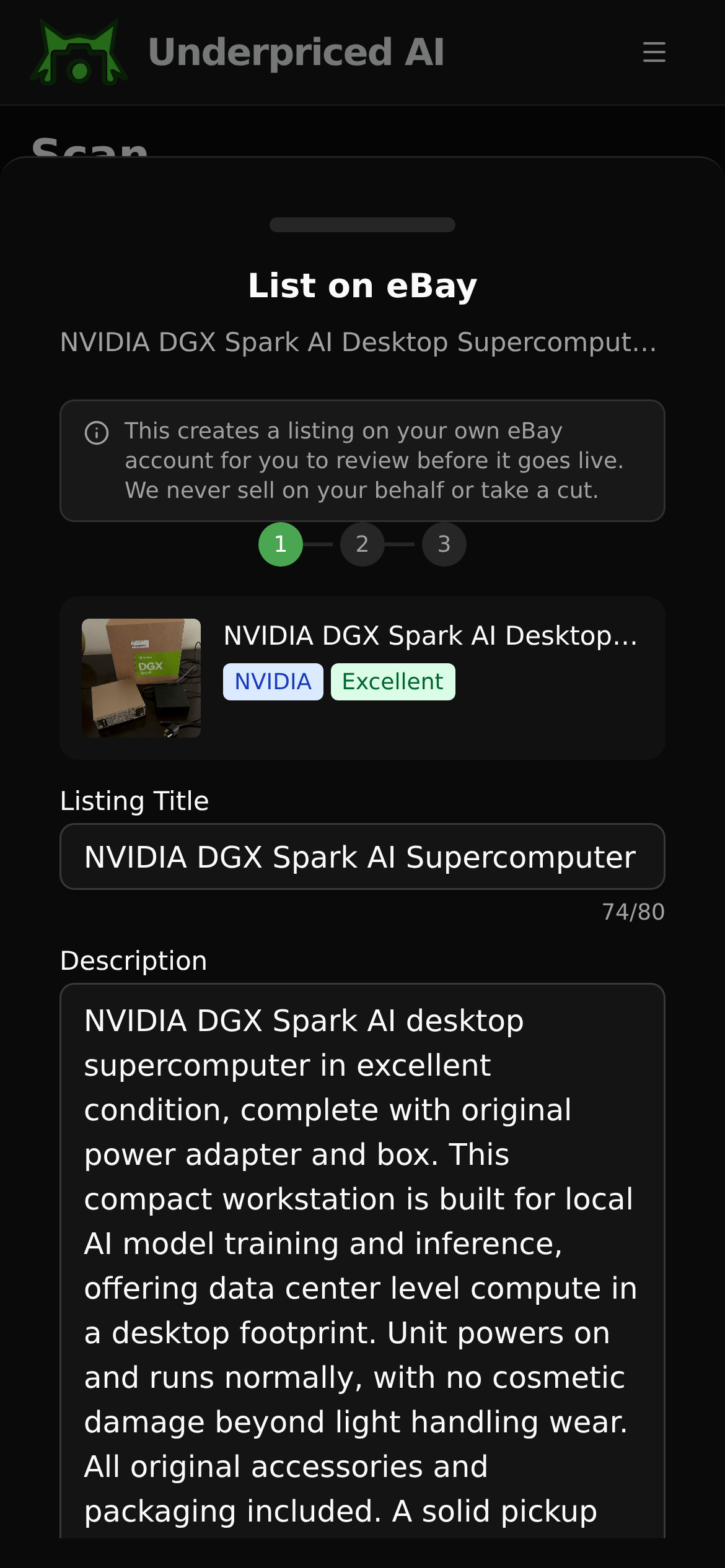
Snap a thrift find and go straight to a live listing. Underpriced AI recognizes the item, pulls real sold comps from eBay, Poshmark, Mercari and category specialists, then builds the listing and posts it to eBay in any of 10 countries. As the market shifts, refresh value updates your prices. Try your first scan free, no card required.
Scan, value, and list, all in one app.
Snap a photo and see real sold prices from eBay, Poshmark and Mercari, then cross-list to all of them in a few taps. Your first scan is free.
Try a Free ScanFree first scan, no credit card required
Founder of Underpriced AI. Building tools for resellers with 30+ years of software engineering experience.
Know a reseller who'd want this?
Related Articles


Ready to find out what your stuff is worth?
Snap a photo and see what it actually sold for, with the real sold listings behind the price. First scan free, no credit card.
1. Photograph it
2. See what it sold for
3. List it
Find our guides useful? Get more of them in Google Search.