
How to Flip Items for Profit | Complete Beginner's Guide
Learn how to flip items for profit with this complete beginner's guide. Covers sourcing, pricing, listing, budgeting, and common mistakes new flippers make.

Flipping items for profit is one of the simplest business models that exists. You find something undervalued, buy it, and sell it to someone who recognizes what it is actually worth. People have been doing this for centuries at flea markets and antique shops. The internet just made it dramatically easier.
If you have ever wondered how to flip items for profit but felt unsure where to start, this guide walks you through the entire process. No fluff, no hype about overnight riches. Just practical steps you can follow this weekend with money you probably already have in your wallet.
What Flipping Is and Why It Works
Flipping is buying items at a low price and reselling them at a higher price. That is it. The profit comes from the gap between what you pay and what the market is willing to pay.
This gap exists because of information asymmetry. A thrift store prices a vintage Pyrex bowl at $3.99 because they process thousands of donations and cannot research every single item. A collector on eBay will pay $45 for that same bowl because they know exactly what it is and have been searching for it. Your job as a flipper is to bridge that gap.
The best flippers are not the ones who spend the most money. They are the ones who know what something is worth before they buy it.
Flipping works as a side hustle or a full-time business because the barriers to entry are almost nonexistent. You do not need a storefront, a business degree, or thousands of dollars in startup capital. You need a phone, a willingness to learn, and enough discipline to start small.
How to Start Flipping Items with Little Money
One of the biggest misconceptions about flipping is that you need a large bankroll. You do not. Some of the most successful resellers started with $20 and a trip to a garage sale.
Start with What You Already Own
Before you spend a dollar on inventory, look around your home. Most people have items sitting in closets, garages, and storage bins that could sell online. Old electronics, clothing you no longer wear, books, sporting equipment, kitchen appliances. These are all fair game.
Selling your own stuff accomplishes two things. First, it generates seed money for buying inventory. Second, it teaches you the mechanics of listing, shipping, and customer service without any financial risk.
Set a Small Initial Budget
Once you have sold a few personal items, take the profits and reinvest them. A realistic starting budget for your first sourcing trip is $20 to $50. That is enough to pick up several items at a thrift store or garage sale with strong resale potential.
Never spend money you cannot afford to lose, especially while you are still learning. Treat your first month as paid education. Some items will sell quickly. Others will sit. That is normal.
Keep Your Overhead Near Zero
Starting out, you do not need a dedicated workspace, professional photography equipment, or inventory management software. Use your phone camera, a clean background (a white bedsheet works), and a corner of a room for storage. Reinvest profits before spending on tools.
Where to Source Items for Flipping
Sourcing is where flippers spend most of their time, and it is where the real skill develops. The more places you source from, the more opportunities you find.
Thrift Stores
Thrift stores are the backbone of most flipping businesses. Goodwill, Salvation Army, Savers, and local charity shops receive constant donations, which means fresh inventory shows up daily. Pricing is based on general categories rather than actual market value, so a $300 leather jacket might be tagged at $12.99.
The trick is going regularly and knowing which sections to focus on. We cover this in depth in our thrift store flipping guide. The short version: visit two to three stores per week, learn the restock schedules, and spend your time in the sections you know best.
Garage Sales and Yard Sales
Garage sales are where the steepest discounts live. Sellers want items gone, not top dollar. Negotiation is expected, and you can often buy entire lots for a fraction of what individual pieces would cost.
Planning a route the night before makes a huge difference. Check Craigslist, Facebook Marketplace, and local yard sale apps for listings with photos. Prioritize moving sales, estate-type garage sales, and multi-family events. Our garage sale flipping guide breaks down exactly how to plan your Saturday morning for maximum efficiency.
Estate Sales
Estate sales tend to have higher-quality items than garage sales, including antiques, vintage collectibles, fine china, and specialized tools. Pricing is more structured since estate sale companies often do some research, but plenty of items still slip through underpriced.
Show up early on the first day for the best selection. If you can wait, show up on the last day when everything is typically 50% off or more.
Retail Clearance and Liquidation
Big box retailers regularly mark down products to clear shelf space. Target, Walmart, and Home Depot all run clearance cycles. When you find a product marked down 70% or more, check its selling price on eBay. If there is a healthy margin after fees, buy it.
Liquidation pallets from sites like Bulq, DirectLiquidation, or local liquidation warehouses are another option. These carry more risk since you often cannot inspect every item before purchasing.
Online Sourcing
Facebook Marketplace, Craigslist, and OfferUp are all viable sourcing channels. People frequently list items below market value because they want a quick local sale. Search for misspelled brand names, vague descriptions, and poor photos. Those are the listings where the seller does not know what they have.
How to Research Prices Before You Buy
Buying without researching is gambling. Researching first is investing. This is the single habit that separates profitable flippers from people who accumulate junk.
Check eBay Sold Listings
eBay's completed and sold listings are the gold standard for price research. Search for the item, then filter by "Sold Items" to see what people actually paid, not what sellers are hoping to get. Look at the last 30 to 90 days of sales to get an accurate average.
Pay attention to:
- Condition. Does your item match the condition of recently sold ones?
- Completeness. Are sold items boxed with accessories, or loose like yours?
- Sell-through rate. If only 2 out of 20 listings sold, demand is low.
- Price consistency. Wide price swings mean the market is volatile.
Use AI-Powered Pricing Tools
Manually searching every item you pick up at a thrift store is slow. Tools like Underpriced AI let you snap a photo and get instant valuations based on real-time sales data. You can evaluate items in seconds rather than minutes while you are still standing in the aisle.
Check Multiple Platforms
eBay is the largest marketplace, but it is not the only one. Some items sell for more on Poshmark (clothing), Mercari (general goods), Facebook Marketplace (furniture and large items), or Amazon (new and like-new retail products). Always check where your item category performs best.
The Most Profitable Items to Flip
Some categories consistently deliver higher margins than others. If you are just starting out, focus on one or two of these and expand as you build knowledge. For a deep dive, check out our full list of the best items to flip for profit.
Electronics
Vintage video game consoles, graphing calculators, wireless headphones, Bluetooth speakers, and networking equipment. These items are common at thrift stores and garage sales, and buyers pay strong prices for tested, working units.
Typical margin: 100-400%
Clothing and Shoes
Brand names drive this category. Patagonia, North Face, Nike, vintage band tees, and designer labels like Coach or Kate Spade can all be sourced for under $10 and sold for $30 to $150 depending on the piece. Learn to check tags, fabric composition, and style numbers.
Typical margin: 100-500%
Books
First editions, college textbooks, niche hobby books, and out-of-print titles sell well. Use a barcode scanning app to check prices quickly. Most books are not worth flipping, but the ones that are can bring $20 to $200 each from a $1 to $2 purchase.
Typical margin: 200-1,000%
Vintage and Collectibles
Pyrex, vintage Corningware, cast iron cookware, mid-century modern decor, and anything with a strong collector community. These require more knowledge to identify but reward expertise with high margins and repeat buyers.
Typical margin: 200-800%
Small Kitchen Appliances
KitchenAid mixers, Vitamix blenders, espresso machines, and bread makers. Thrift stores regularly receive these as donations. Test them before buying, and clean them thoroughly before listing.
Typical margin: 100-300%
How to List and Sell Your Flipped Items
Finding great deals means nothing if you cannot sell the items. Listing quality directly impacts how fast things sell and how much buyers are willing to pay.
Take Good Photos
You do not need a professional camera. Use your phone with natural light and a clean background. Shoot from multiple angles. Include close-ups of brand labels, flaws, model numbers, and any accessories. Listings with five or more clear photos sell faster and for higher prices than those with one or two dark, blurry shots.
Write Descriptive Titles
Pack your title with the words a buyer would search for. Include the brand, model, size, color, and condition. "Patagonia Better Sweater Fleece Jacket Men's Large Blue" will outperform "Nice Blue Jacket" every single time.
For a detailed breakdown of optimizing your listings, read our eBay listing optimization guide.
Price Strategically
Price your items based on sold comparables, not on what you hope to get. If similar items sell for $40 to $55, list at $49.99 or slightly above with "Best Offer" enabled. Competitive pricing moves inventory faster, and fast turnover is more profitable than holding out for an extra few dollars on every item.
Choose the Right Platform
Match your item to the platform where it performs best:
- eBay. Best for electronics, collectibles, vintage items, and anything with a specific model number.
- Poshmark. Best for clothing, shoes, and fashion accessories.
- Mercari. Good all-around marketplace, especially for lower-priced items.
- Facebook Marketplace. Best for furniture, large items, and local-only sales.
- Amazon. Best for new or like-new retail products with a barcode.
Ship Promptly and Professionally
Ship within one business day of a sale when possible. Use appropriate packaging, include a packing slip, and always add tracking. Positive feedback builds your reputation, and reputation drives future sales.
Your First-Month Budget Breakdown
Here is a realistic budget for someone starting from scratch with a modest investment. Adjust based on what you already have at home.
| Expense | Estimated Cost |
|---|---|
| Sourcing budget (4 weekend trips) | $80 - $120 |
| Shipping supplies (boxes, tape, poly mailers) | $15 - $25 |
| Packing materials (bubble wrap, tissue paper) | $10 - $15 |
| Kitchen scale for postage | $10 - $15 |
| Printer paper and labels (if needed) | $5 - $10 |
| Total startup cost | $120 - $185 |
A few notes on this budget:
- Shipping supplies can be free. USPS offers free Priority Mail boxes. Ask local stores for spare boxes. Save bubble wrap and packing materials from your own deliveries.
- The sourcing budget is your real investment. Start conservative. As you learn what sells, your hit rate improves and your return on every dollar spent goes up.
- Expect 50-70% sell-through in month one. Not everything you buy will sell quickly. That is part of the learning curve. By month two or three, your sourcing instincts sharpen considerably.
A reasonable first-month revenue target is $200 to $500, depending on how aggressively you source and how quickly you list. That means a net profit of roughly $50 to $350 after subtracting your costs. It is not retirement money, but it proves the model works and gives you capital to reinvest.
Common Mistakes That Kill New Flippers' Profits
Almost every beginner makes the same handful of mistakes. Knowing them in advance saves you weeks of frustration and wasted money.
Buying Before Researching
This is the number one mistake. You see something that "looks valuable" and buy it on instinct. Then you get home, search for it, and discover it sells for less than you paid. Always research before you buy. Every time. No exceptions.
Spending Too Much on Inventory Too Soon
Enthusiasm is great, but dumping your entire budget into inventory on your first trip is risky. You do not yet know what sells well, what ships easily, or what your target buyers actually want. Start with five to ten items per trip and scale up as you learn.
Ignoring Fees and Shipping Costs
A $30 sale is not $30 in profit. After eBay's 13.25% final value fee, payment processing, and shipping costs, your actual take-home might be $18 to $22. Always factor in platform fees, shipping, and the cost of packing materials when calculating whether an item is worth buying.
Listing Items and Forgetting About Them
Posting a listing is not the finish line. If an item is not selling after two to three weeks, revisit your pricing, photos, and title. Are your photos competitive with other listings? Is your price in line with recent sold comparables? Sometimes a small adjustment is all it takes.
Trying to Flip Everything at Once
New flippers often try to sell clothing, electronics, books, toys, and furniture simultaneously. This spreads your knowledge thin. Pick one or two categories, learn them deeply, and expand later. Specialists outperform generalists in reselling, especially in the early months.
Holding Inventory Too Long
If an item has not sold in 60 to 90 days, lower the price significantly or donate it. Dead inventory takes up space, ties up capital, and drags down your average return on investment. Moving items at a smaller profit beats storing them indefinitely.
Scaling Up: From Side Hustle to Serious Income
Once you have a few months of flipping under your belt and a consistent process, scaling becomes straightforward.
- Reinvest your profits. Plow earnings back into inventory for the first three to six months. This compounds quickly.
- Track your numbers. Record what you paid, what you sold for, platform fees, and shipping costs for every item. Without data, you are guessing.
- Expand your sourcing. Add new stores, new sale types, and new online sourcing channels. The more inventory pipelines you have, the more consistent your income becomes.
- Batch your work. Dedicate specific days to sourcing, specific blocks to photographing and listing, and specific times to packing and shipping. Batching is significantly more efficient than switching between tasks constantly.
- Learn new categories. Each new category you master is a new revenue stream. Approach them one at a time, research thoroughly, and start with small buys until you build confidence.
Frequently Asked Questions
How do I know what an item is worth before I buy it at a thrift store?
Check eBay sold listings, not active ones, filtered to the last 30 to 90 days, and compare condition, completeness and sell-through rate. If only 2 of 20 listings sold, demand is weak. To move faster in the aisle, Underpriced AI lets you snap a photo on web or mobile and get a value from real eBay, Poshmark and Mercari sold comps. The first scan is free, no card.
How much can you realistically make flipping items in your first month?
A reasonable first month target is $200 to $500 in revenue, which works out to roughly $50 to $350 in net profit after your costs. Startup expenses run about $120 to $185, including a sourcing budget of $80 to $120. Expect only 50 to 70 percent of what you buy to sell in month one while your instincts sharpen.
How much do I actually keep after eBay fees and shipping?
Less than the sale price. On a $30 sale, eBay's 13.25 percent final value fee, payment processing and shipping typically leave you with about $18 to $22. Factor platform fees, postage and packing materials into every buying decision. You can cut costs by using free USPS Priority Mail boxes, asking local stores for spare boxes and saving bubble wrap from your own deliveries.
What should I do if my flipped item is not selling?
Revisit the listing after two to three weeks instead of leaving it up untouched. Compare your photos against competing listings, add close-ups of labels, model numbers and flaws, and rewrite the title with brand, model, size, color and condition. Then check your price against recent sold comparables and consider enabling Best Offer. Fast turnover beats holding out for a few extra dollars.
Start Small, Learn Fast, and Stay Consistent
Flipping items for profit is not complicated, but it does require patience and consistency. The people who succeed are not the ones who start with the most money or the best connections. They are the ones who show up every weekend, research before they buy, list promptly, and learn from every item that does or does not sell.
Start this weekend. Sell five things from your own home. Take the profits to a thrift store or garage sale next Saturday. List what you find by Sunday evening. Repeat. Within a month, you will have a real sense of whether flipping is something you want to grow into a meaningful income stream.
The opportunity is there. The only question is whether you are willing to put in the reps.
Snap a photo and Underpriced AI walks it through to a live listing. The tool recognizes the item, pulls genuine sold comps from eBay, Poshmark, Mercari and category specialists, then writes the listing and posts it to eBay across 10 markets. Refresh value keeps your flip prices current as the market shifts. Try your first scan free, no card required.
Scan, value, and list, all in one app.
Snap a photo and see real sold prices from eBay, Poshmark and Mercari, then cross-list to all of them in a few taps. Your first scan is free.
Try a Free ScanFree first scan, no credit card required
Founder of Underpriced AI. Building tools for resellers with 30+ years of software engineering experience.
Know a reseller who'd want this?
Related Articles


Ready to find out what your stuff is worth?
Snap a photo and see what it actually sold for, with the real sold listings behind the price. First scan free, no credit card.
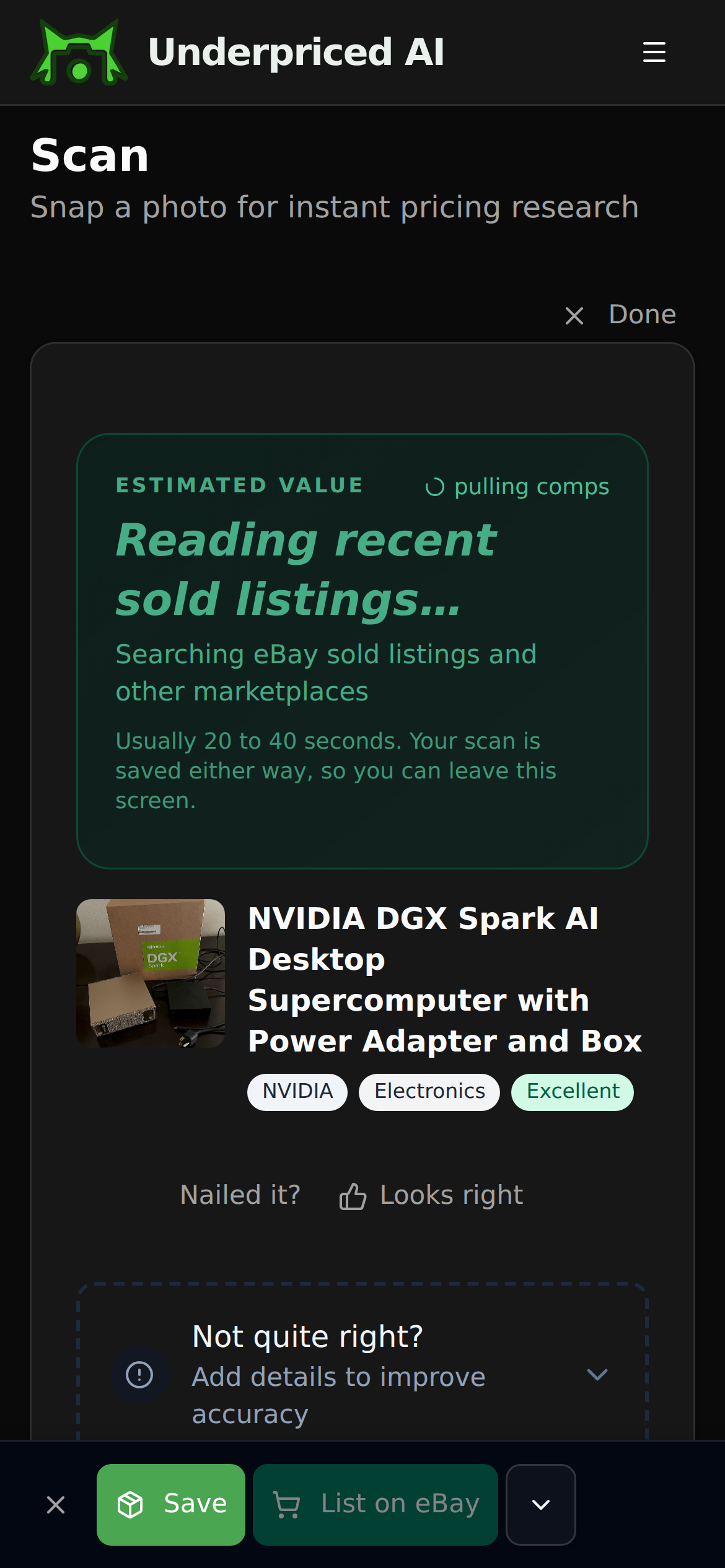
1. Photograph it
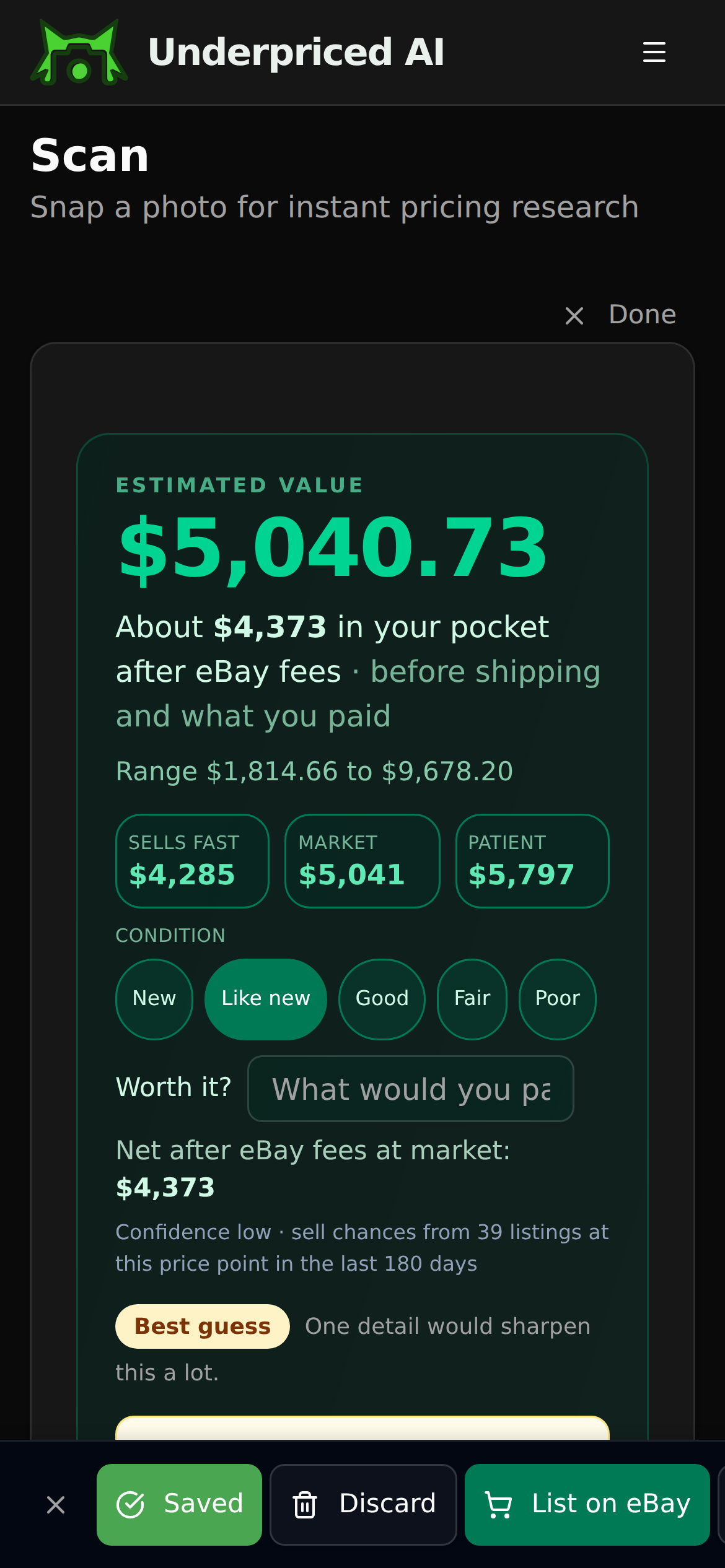
2. See what it sold for

3. List it
Find our guides useful? Get more of them in Google Search.