
Is It Worth Selling on eBay | How to Decide Before You List
Learn how to quickly determine if an item is worth listing on eBay. This practical guide helps you calculate true profit and make smart decisions about what to sell.

Every reseller faces the same question dozens of times per week: is this item worth my time to sell? The answer isn't always obvious. Some items look valuable but yield tiny profits after fees and shipping. Others seem worthless but surprise you with strong sales. This guide provides a practical framework for making quick, accurate decisions about what's worth selling.
The Real Question Is Whether Profit Justifies Your Time
"Is it worth selling on eBay?" really asks whether the profit will justify the time you spend.
This calculation requires understanding both the revenue potential and the true costs involved.
Understanding Your Hourly Rate as a Reseller
Think about what your time is worth:
- If you spend 30 minutes on an item that nets $5 profit, you're making $10/hour
- If you spend 30 minutes on an item that nets $25 profit, you're making $50/hour
Most successful resellers establish a minimum profit threshold, typically $15-25 per item, below which they don't bother listing.
The Hidden Costs of Selling on eBay
Profit isn't sale price minus purchase price. True costs include:
- eBay fees, 13.25% of total including shipping
- Shipping supplies: boxes, tape, poly mailers
- Actual shipping cost, if offering free shipping
- Time to photograph, 5-15 minutes
- Time to list, 5-15 minutes
- Time to pack and ship, 5-15 minutes
- Storage space, an opportunity cost
- Return risk, since some items will come back
When you account for all costs, many items that seem profitable actually aren't.
Why Some Items Aren't Worth Listing Even If They'll Sell
An item selling doesn't mean you should list it:
- A $10 item that takes 30 minutes total time = $20/hour (before fees)
- The same 30 minutes could source an item with $50 profit = $100/hour
- Time spent on low-margin items has opportunity cost
Your time is finite. Spending it on low-profit items means not spending it on high-profit items.
The True Cost of Selling on eBay
Let's break down exactly what selling an item costs.
eBay Fees Breakdown
eBay's fee structure for most sellers:
| Fee Component | Rate |
|---|---|
| Final Value Fee | 13.25% of total sale amount |
| (includes shipping charged to buyer) |
The 13.25% applies to the total paid by the buyer, including shipping.
Consider an example:
- Item price: $30
- Shipping charged: $8
- Total: $38
- eBay fee: $38 × 13.25% = $5.03
Shipping Costs
Shipping costs include multiple components.
Direct costs:
- Carrier charges (USPS, UPS, FedEx)
- Insurance (if purchased)
- Delivery confirmation (usually included)
Indirect costs:
- Boxes and packaging materials
- Tape, labels, paper
- Printer ink for labels
- Time to pack properly
Typical shipping supplies cost $1-3 per item, depending on size and fragility.
Time Costs
Be honest about time investment:
| Task | Time Range |
|---|---|
| Photographing | 5-15 minutes |
| Researching/pricing | 2-10 minutes |
| Creating listing | 5-15 minutes |
| Packing | 5-10 minutes |
| Shipping drop-off | Variable (batch helps) |
| Customer questions | 0-10 minutes |
| Total | 17-60+ minutes |
At 30 minutes average, processing 10 items takes 5 hours. This is real labor with real value.
Return and Problem Costs
Factor in that some sales create problems:
- Return shipping on larger items may fall to you
- Partial refunds for condition disputes
- Full refunds on buyer's remorse
- Lost packages requiring refunds
- Negative feedback from unreasonable buyers
Industry average suggests 5-10% of sales have some issue. Price accordingly.
Creating Your Minimum Profit Threshold
Every reseller needs a personal floor below which items aren't worth listing.
How to Calculate Your Break-Even Point
For any item, calculate:
Break-even = (Time × Your Hourly Rate) + Fixed Costs
If you value your time at $25/hour and spend 30 minutes on an item:
- Time cost: $12.50
- Supplies cost: $2
- Break-even profit needed: $14.50
This is your minimum. Below this, you're better off doing almost anything else.
Setting Your Personal Minimum
Most successful resellers use these thresholds:
| Seller Type | Typical Minimum |
|---|---|
| Casual/hobby | $10-15 profit |
| Part-time | $15-25 profit |
| Full-time | $20-30 profit |
| High-volume | $25-50 profit |
Your minimum should reflect your opportunity cost. Higher-volume sellers can be pickier because they have more opportunities.
Adjusting for Item Complexity
Not all items require equal effort.
Quick items, where a lower threshold is acceptable:
- Items you list frequently (templates ready)
- Small, light items (easy shipping)
- Items needing minimal research
- Commodity items with standard pricing
Complex items, which require a higher threshold:
- Unique items requiring research
- Fragile items needing careful packing
- Large/heavy items with shipping challenges
- Items likely to generate questions
A $15 profit on a quick, simple item may be acceptable. A $15 profit on a complex, fragile item probably isn't.
The Would I Pick This Up For $X Test
A useful mental shortcut:
Imagine someone offered you cash to handle this item: photograph it, list it, pack it, ship it. Would you accept the job for the profit amount?
If you wouldn't pick up $15 off the ground to do 45 minutes of work, don't list an item that will net $15 profit.
Quick Decision Framework for Whether to List It
Use this framework for rapid go/no-go decisions.
Estimate the Selling Price First
Before anything else, determine likely sale price:
- Check eBay sold listings
- Find comparable items in similar condition
- Use the most recent sales (market changes)
- Be conservative, using the lower end of the range
Calculate Expected Fees
Apply eBay's 13.25% to estimated total:
Fees = (Item Price + Shipping Charged) × 13.25%
Estimate Shipping Costs
If you ship free or subsidize shipping:
- Weigh the item (or estimate)
- Check carrier rates
- Add supply costs ($1-3)
- Add your shipping cost to total costs
Factor in Your Time
Estimate time required:
- Standard item: 30 minutes total
- Complex item: 45-60 minutes
- Simple repeat item: 15-20 minutes
Convert to dollar cost based on your hourly rate.
Compare to Your Threshold
Net Profit = Sale Price - Purchase Price - Fees - Shipping - Supplies
If Net Profit is above your minimum threshold, list it. If Net Profit is below your minimum threshold, pass.
How to Quickly Estimate Selling Price
Fast, accurate price estimation is crucial for rapid decisions.
The eBay Sold Search Method
The standard manual approach:
- Open eBay
- Search for item
- Filter by "Sold Items"
- Review recent sales
- Note condition differences
- Estimate your price point
This takes 2-5 minutes per item.
The limitations:
- Slow when evaluating many items
- Requires knowing what to search
- Easy to miss while sourcing
- Condition comparisons require judgment
Why Average Sold Price Can Be Misleading
Don't just take the average of sold prices:
- Condition varies dramatically
- Some sellers price incorrectly
- Auctions may not reflect fixed-price market
- Bundle sales skew averages
- Return rate affects true value
Look at sales most similar to your specific item.
Instant Price Estimates with AI
Modern AI tools eliminate manual research delays. Underpriced AI provides photo-based valuations:
- Photograph the item
- AI identifies what it is
- Instant price recommendation
- Works while you're sourcing
The estimates are data-driven:
- Based on real eBay sold data
- Price ranges (low, mid, high)
- Confidence scores for reliability
- Updated continuously
This turns pricing from a 3-5 minute research task into a 10-second decision. That lets you evaluate far more items.
Factors That Make Items Worth More Effort
Some items justify extra time investment.
High-Value Items Even If Time-Consuming
An item with $100+ profit potential justifies significant effort:
- Extensive photography is worthwhile
- Detailed description increases value
- Careful packing protects your investment
- Research time pays off
The same hour spent on a $500 item versus five $15 items yields vastly different returns.
Items You Can List Quickly
Efficiency makes lower-margin items viable:
- Category expertise, so you know values instantly
- Listing templates for the same category and similar descriptions
- Photography systems with a batch shooting setup
- Shipping templates for standard packages and saved dimensions
If you can list an item in 10 minutes instead of 30, your effective hourly rate triples.
Items That Batch Well Together
Some items work well in groups:
- Same category, for similar listings and efficient workflow
- Same dimensions, so you use the same shipping setup
- Cross-sell potential, since buyers may purchase multiple
- Photography efficiency, with similar styling requirements
Items with Low Return Risk
Some categories have minimal return issues:
- Items easily verified (books, media)
- Standard sizes (doesn't fit is common with clothing)
- Collectibles (buyers know what they want)
- Parts (buyers accept condition)
Lower return risk means higher expected profit.
Factors That Make Items Not Worth It
Learn to quickly identify items to skip.
Low Sale Price Plus High Shipping Cost
Heavy, low-value items destroy margins. Consider an example:
- Item sells for $15
- Weighs 8 lbs
- Shipping cost: $12
- eBay fees: ~$2 (on $15)
- Net before purchase cost: $1
Unless you got it free and have nothing better to do, skip it.
Items Requiring Extensive Research
Research time has value. Skip items that require:
- Hours identifying maker or origin
- Expert consultation
- Multiple authentication steps
- Extensive documentation gathering
The exception is when potential value is high enough to justify the time investment.
Fragile Items with Packing Time and Breakage Risk
Fragile items compound problems:
- Extra packing time (30+ minutes for delicate items)
- Expensive packing materials
- Breakage risk despite careful packing
- Return/refund probability higher
- Buyer disputes over "arrived damaged"
Factor 20-30% additional margin for fragile items to cover risks.
Items with High Return Rates
Certain categories see frequent returns:
- Clothing (fit issues)
- Electronics (buyer's remorse, compatibility)
- Shoes (sizing varies by brand)
- High-end items (authentication concerns)
Higher return rates mean lower effective profit.
Oversaturated Markets with Price Wars
When too many sellers compete on identical items:
- Prices race to bottom
- Margins compress to nothing
- Listing time wasted on unsold items
- Better items exist elsewhere
Check competition before listing. If 500 sellers have the exact item, find something else.
Understanding Market Saturation Before You List
Competition level directly affects profitability.
What Active Listing Count Tells You
High active listings suggest:
- Many sellers competing
- Price pressure downward
- Slower sales velocity
- Need for competitive pricing
Low active listings suggest:
- Less competition
- More pricing power
- Faster potential sale
- Opportunity for premium pricing
Sell-Through Rate Is the Key Metric
Sell-through rate measures what percentage of listings actually sell:
Sell-through = Sold listings ÷ (Sold + Active listings)
| Sell-through | Market Condition |
|---|---|
| Over 50% | Strong demand, list it |
| 30-50% | Normal market, price competitively |
| 15-30% | Soft market, be careful |
| Under 15% | Avoid unless you have an edge |
Checking Competition in Seconds
Underpriced AI provides competition data automatically:
- Active listings count
- Recent sold count
- Sell-through rate estimate
- Competition level indicator (low/medium/high)
This information helps you decide before investing time in items that won't sell well.
The Items That Are Almost Always Worth Selling
Some categories consistently deliver good returns.
Niche Collectibles with Dedicated Buyers
Collector markets reward knowledge:
- Vintage toys (specific series, characters)
- Sports cards (particular players, years)
- Art pottery (specific makers, patterns)
- Vintage gaming (certain titles, systems)
Collectors pay premiums for exactly what they want.
Vintage Designer Items
Designer pieces maintain value:
- Vintage Louis Vuitton, Gucci, Hermes
- Mid-century designer furniture
- Signed art and limited editions
- Quality watches (Rolex, Omega)
Authentication matters, but margins reward effort.
Small, Light, High-Value Items
Ideal economics: high value, cheap shipping:
- Jewelry (especially gold, silver)
- Small electronics (phones, accessories)
- Vintage computer components
- Designer small accessories
Items You Know Well
Your expertise is an edge:
- Categories you've studied
- Items you can evaluate instantly
- Markets where you understand value
- Niches where you know the buyers
Expertise means faster decisions and fewer mistakes.
The Items That Are Rarely Worth It
Some categories almost never make sense.
Common Books and DVDs
The math rarely works:
- Sales prices often under $10
- Shipping costs $3-5 (media mail)
- Fees eat the rest
- Time spent isn't justified
Exceptions are rare first editions, signed copies and out-of-print titles.
Fast Fashion Clothing
Unless it's brand name or vintage:
- Saturated market
- Low sale prices
- Fit issues cause returns
- Photography time exceeds profit
Focus on recognizable brands or vintage pieces.
Heavy Items with Low Value
Shipping costs destroy margins:
- Common furniture
- Standard appliances
- Exercise equipment
- Basic power tools
The exception is local pickup markets (Facebook Marketplace, Craigslist).
Items Under $20 Sale Price, Usually
At $20 sale price:
- eBay fees: ~$2.65
- Shipping (you pay): $5+
- Supplies: $1-2
- Net before purchase: ~$11
If you paid anything and spent 30 minutes, your hourly rate crashes.
Improving Your Workflow to Make More Items Worth It
Efficiency changes the calculation. Items that weren't worth it become viable when processed quickly.
Batch Processing Similar Items
Group similar items together:
- Photograph all at once (same setup)
- List all at once (similar descriptions)
- Ship all at once (same box sizes)
Batching can cut per-item time by 50%.
Using Templates and Saved Details
Reuse work whenever possible:
- Category-specific description templates
- Saved shipping profiles
- Standard photography setup
- Prefilled item specifics
AI-Generated Listings Save Time
The biggest time sink is creating listings. Underpriced AI reduces this:
- Titles: AI generates SEO-optimized titles automatically
- Descriptions: professional descriptions from photos
- Categories: suggested based on item identification
- Pricing: data-driven recommendations
- Background removal: clean product photos instantly
What took 15 minutes manually takes under 2 minutes.
This changes the profit equation. Items that weren't worth 15 minutes of work may be worth 2 minutes of work.
How Time Savings Changes the Profit Equation
| Scenario | Time | Profit Needed | Effective Rate |
|---|---|---|---|
| Manual listing | 30 min | $25 | $50/hour |
| AI-assisted | 10 min | $25 | $150/hour |
| Manual listing | 30 min | $10 | $20/hour (skip) |
| AI-assisted | 10 min | $10 | $60/hour (worth it) |
Efficiency improvements make more items worth selling.
When to Donate Instead of Sell
Sometimes the right answer is not to sell at all.
The Tax Deduction Consideration
Donations may provide tax benefits:
- Items valued under $500: claim fair market value
- Itemized deduction against income
- May exceed profit you'd have made
- Especially relevant for low-value items
Consult a tax professional for your specific situation.
Mental Energy and Storage Space
Some items aren't worth the mental overhead:
- Cluttering your workspace
- Occupying mental space
- Blocking newer inventory
- Creating decision fatigue
Sometimes clearing items out has more value than the profit potential.
Creating a Donation Threshold
Establish a clear rule:
"If an item won't profit at least $X, it goes in the donation pile."
This prevents endless deliberation over marginal items.
Making Better Buying Decisions
The best time to evaluate whether it's worth selling is before you buy.
Applying This Framework While Sourcing
Before purchasing any item:
- Estimate sale price (quick research)
- Calculate likely profit (mental math)
- Compare to your threshold
- Buy only if clearly above threshold
This prevents accumulating unprofitable inventory.
The Quick Math Before You Buy
Standing at a thrift store, asking price $5:
- "This will sell for about $30"
- "Fees will be about $4"
- "Shipping will be about $6"
- "Net profit: $30 - $5 - $4 - $6 = $15"
- "Above my $15 minimum? Yes, buy it."
With practice, this calculation takes seconds.
Pre-Purchase Valuations
Underpriced AI enables instant valuations while sourcing:
- Photograph the item in-store
- Get price estimate immediately
- Know your margin before buying
- Make confident purchase decisions
This prevents buying items that seem valuable but aren't. It also keeps you from passing on items that look unimpressive but have strong markets.
Frequently Asked Questions
What is the minimum profit an item should make to be worth listing on eBay?
Most successful resellers set a floor of $15 to $25 profit per item. Typical thresholds by seller type: casual sellers $10 to $15, part-time $15 to $25, full-time $20 to $30, and high-volume $25 to $50. Your own floor should reflect opportunity cost, since time spent on low-margin items is time not spent on better ones.
How do I calculate my break-even point before listing an item?
Use this formula: Break-even = (Time x Your Hourly Rate) + Fixed Costs. If you value your time at $25 per hour and spend 30 minutes on an item, that is $12.50 in time plus roughly $2 in supplies, so you need about $14.50 in profit to break even. Below that number, your effort is better spent elsewhere.
How much does eBay take from a sale?
eBay charges a final value fee of 13.25% of the total sale amount for most sellers, and that total includes the shipping the buyer pays. Example: a $30 item with $8 shipping totals $38, so the fee is $5.03. Add shipping supplies at $1 to $3 per item and your actual carrier cost if you offer free shipping.
What sell-through rate is good enough to bother listing an item?
Sell-through is sold listings divided by sold plus active listings. Over 50% signals strong demand and a clear go. 30 to 50% is a normal market, so price competitively. 15 to 30% is soft, so be careful. Under 15% is best avoided unless you have an edge. Underpriced AI shows active count, sold count and a competition level on web or mobile.
Sell the Right Things, Not Everything
Successful reselling isn't about selling everything. It's about selling the right things.
The key principles:
- Know your threshold: establish minimum profit per item
- Calculate true costs: include fees, shipping and time
- Research before listing: verify value before investing time
- Work efficiently: use tools that reduce time per item
- Skip marginal items: your time has opportunity cost
- Track results: measure what actually works
The question "Is it worth selling on eBay?" has a clear answer when you have the right data and framework.
Underpriced AI provides instant valuations, market competition data, and AI-powered listings. These help you quickly identify what's worth selling and process it efficiently. Try Underpriced AI on web or mobile. A 5-scan pack is $4, or start on the $5/month Starter plan for 30 scans and see how data-driven decisions improve your reselling profits.
Scan, value, and list, all in one app.
Snap a photo and see real sold prices from eBay, Poshmark and Mercari, then cross-list to all of them in a few taps. Your first scan is free.
Try a Free ScanFree first scan, no credit card required
Founder of Underpriced AI. Building tools for resellers with 30+ years of software engineering experience.
Know a reseller who'd want this?
Related Articles


Ready to find out what your stuff is worth?
Snap a photo and see what it actually sold for, with the real sold listings behind the price. First scan free, no credit card.
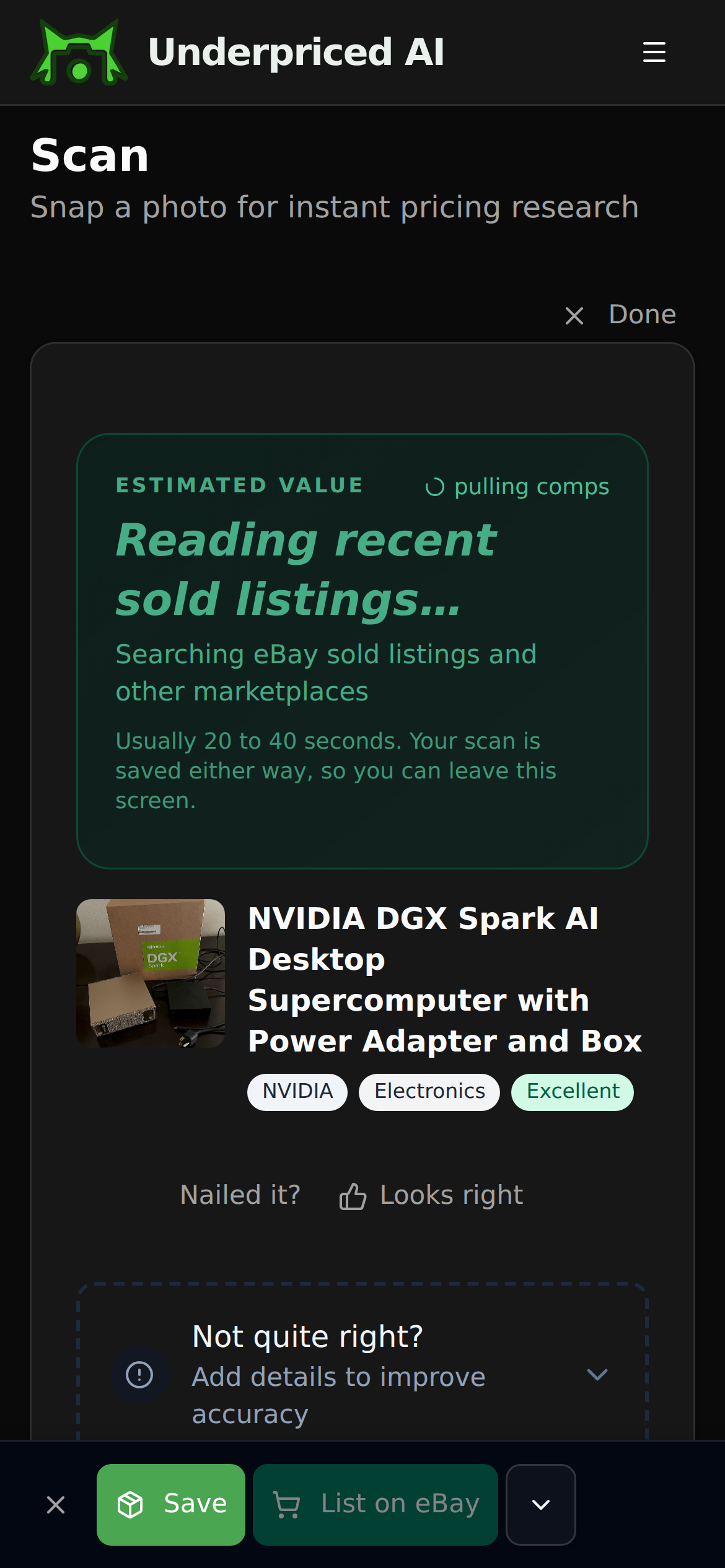
1. Photograph it
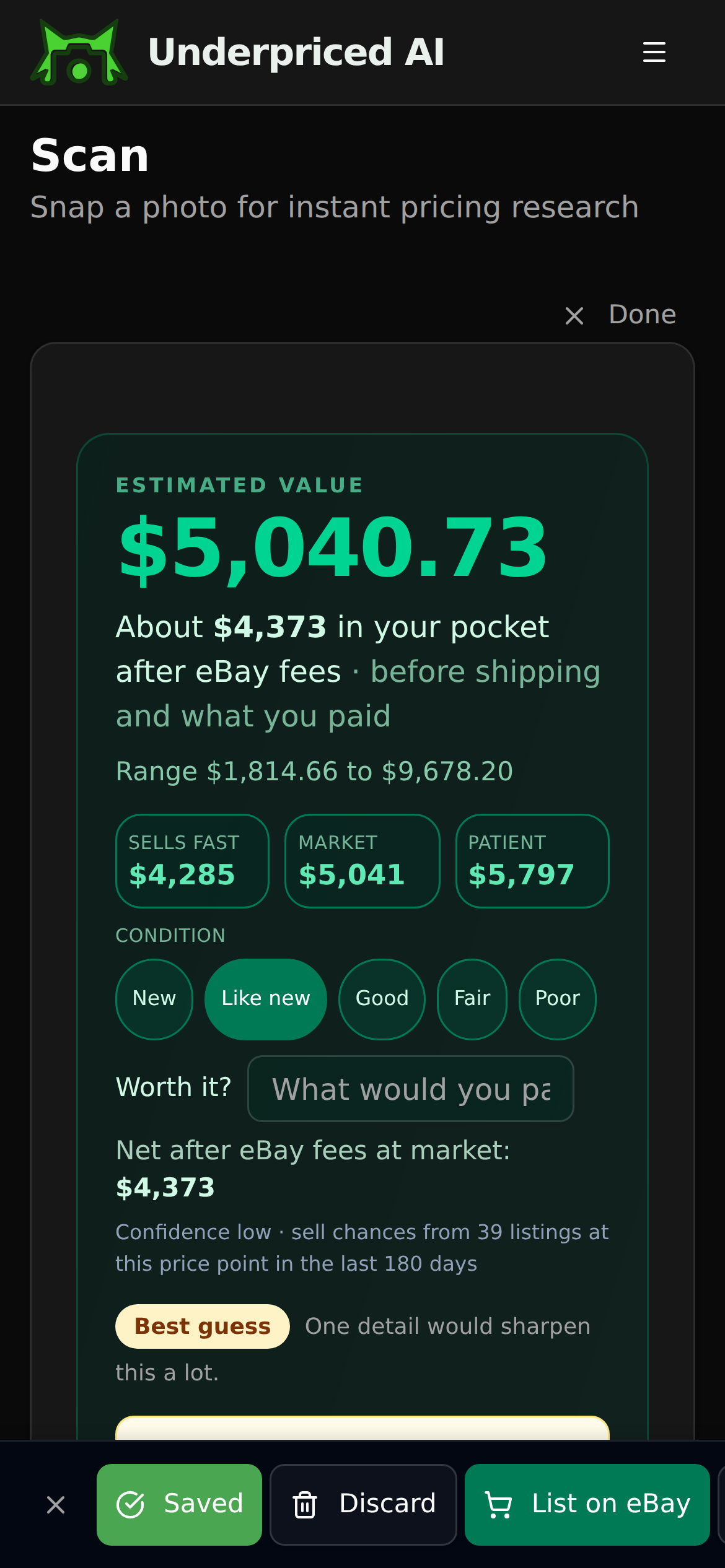
2. See what it sold for
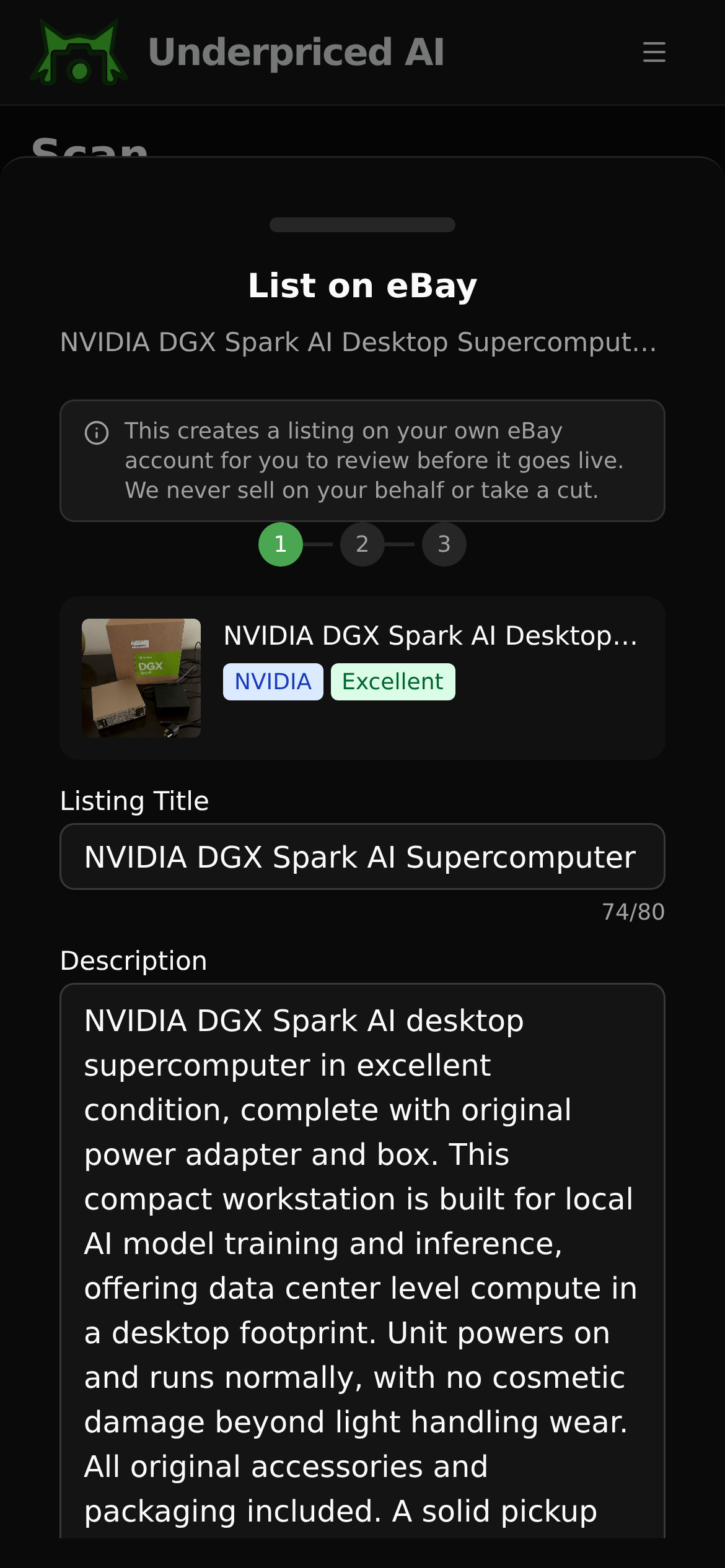
3. List it
Find our guides useful? Get more of them in Google Search.