
How to Price Vintage Items | Data-Driven Resale Pricing Guide
Master the art of pricing vintage items with this guide. Learn how to research values, understand market factors, and price strategically for maximum profit.

Updated April 2026: eBay's 2026 promoted-listings changes (Priority CPC, halo attribution) shifted pricing strategy for Q2. The workflow below includes how to adjust for the new ad environment.
Pricing vintage items correctly is one of the hardest parts of reselling. New items have established MSRPs. Vintage pieces require research, market understanding, and strategic thinking. Price too high and items languish unsold. Price too low and you leave money on the table. This guide teaches you a systematic, data-driven approach to pricing vintage items.
Why Pricing Vintage Items Is Different and Harder
New items have reference points: retail price, wholesale cost, competitor pricing. Vintage items have none of these, making pricing both art and science.
Vintage Items Have No Fixed MSRP
A vintage piece has no manufacturer's suggested retail price. The original price from 40 years ago is irrelevant. Value comes from:
- What collectors are willing to pay today
- Current supply and demand dynamics
- Condition relative to age
- Provenance and documentation
- Market trends and nostalgia cycles
Condition Matters More Than Age
A common misconception is that older automatically means more valuable. In reality:
- A 50-year-old item in poor condition may be worthless
- A 30-year-old item in excellent condition may be highly valuable
- Condition often matters more than rarity
- Original packaging and documentation multiply value
Trends Affect Vintage Prices Dramatically
Vintage markets follow trend cycles:
- 1970s items were undesirable in the 1990s, now sought-after
- 1990s fashion recently became "vintage" and prices spiked
- Mid-century modern has been popular for decades
- Certain brands cycle in and out of favor
What's unpopular today may be valuable tomorrow, and vice versa.
The Cost of Pricing Wrong
Underpricing costs you in several ways:
- Direct profit loss on every sale
- Training buyers to expect low prices
- Devaluing your inventory overall
- Missing opportunities for legitimate value
Overpricing costs you too:
- Items sit unsold, tying up capital
- Storage space consumed
- Eventually forced to reduce prices anyway
- Opportunity cost of not listing new items
The goal is accurate pricing that balances speed of sale with fair profit.
Understanding What Makes Vintage Items Valuable
Before pricing, understand the factors that create value.
Rarity and Scarcity
Rarity drives value when demand exists:
- Limited production runs: items made in small quantities
- Short production periods: pieces made briefly
- Survival rate: how many still exist
- Geographic scarcity: rare in your market, common elsewhere
Rarity without demand creates no value. Many rare items have no market.
Maker and Brand Recognition
Brand affects value dramatically.
High-value indicators:
- Recognized premium brands (Hermes, Rolex, Stickley)
- Famous designers (Eames, Nakashima)
- Prestigious manufacturers (Meissen, Steuben)
- Companies no longer in business (prized by collectors)
Value also varies by era:
- Certain brand eras are more valuable than others
- "Made in USA" periods often worth more
- Pre-acquisition pieces (before buyouts) often preferred
- Specific designer collaborations command premiums
Condition Grading for Vintage Items
Establish consistent condition standards:
| Grade | Description | Price Impact |
|---|---|---|
| Mint | Perfect, like new, unused | Premium pricing |
| Excellent | Minimal wear, no significant flaws | Strong pricing |
| Very Good | Light wear, minor flaws | Moderate discount |
| Good | Obvious wear, visible flaws | Significant discount |
| Fair | Heavy wear, damage | Deep discount or parts only |
| Poor | Major damage, incomplete | Minimal value |
Be honest about condition. Experienced buyers know what to look for, and overgrading damages your reputation.
Provenance and History
Documentation increases value:
- Original receipts prove authenticity and purchase date
- Certificates of authenticity, for art and signed items
- Historical significance: celebrity ownership, notable events
- Family history is sometimes interesting but rarely adds value
- Original packaging significantly increases value
Current Design Trends
Stay aware of what's popular.
Currently trending:
- 1990s fashion and memorabilia
- Vintage outdoor and camping gear
- Retro gaming and electronics
- Mid-century modern (ongoing)
- Vintage band and concert tees
- Specific Pyrex patterns
Declining or stable:
- Brown furniture (Victorian, traditional)
- China sets (most patterns)
- Crystal stemware (oversupplied)
- Beanie Babies (though rare ones retain value)
Traditional Vintage Pricing Methods
Before exploring modern approaches, understand traditional methods.
Completed Listings Research
The standard approach using eBay:
- Search for similar items
- Filter by "Sold Items"
- Analyze recent sales
- Note condition differences
- Calculate average sold price
The limitations are real:
- Time-consuming (3-5 minutes per item)
- Requires accurate search terms
- Doesn't account for condition variations
- Missing items sold elsewhere
Price Guide Books
Published price guides exist for many categories.
Advantages:
- Comprehensive category coverage
- Expert opinions on value
- Historical price trends
Disadvantages:
- Outdated by publication time
- Don't reflect current market
- Based on "retail" not actual sales
- Category-specific (need many books)
Antique Dealer Consultations
Experienced dealers can appraise items.
Advantages:
- Expert knowledge
- Account for nuances
- Identify fakes and reproductions
Disadvantages:
- Cost of consultations
- May lowball for purchase potential
- Not practical for many items
- Specialists limited to categories
Auction House Estimates
Major auction houses provide estimates.
Advantages:
- Professional assessment
- Market expertise
- Access to collector networks
Disadvantages:
- Only interested in high-value items
- Estimates are ranges, not prices
- Focused on auction, not retail market
- Not practical for everyday items
These Methods Are Time-Consuming
Traditional research methods work but don't scale:
- 5 minutes per item x 20 items = nearly 2 hours of research
- Doesn't include listing time
- Creates bottleneck in your workflow
- Leads to shortcuts and pricing errors
The Data-Driven Approach to Vintage Pricing
Modern tools enable faster, more accurate pricing decisions.
Why Data Beats Gut Feelings
Emotional pricing leads to errors:
- We overvalue items we love
- We undervalue items we don't understand
- Memory of similar items is unreliable
- Market changes faster than intuition adapts
Data provides objective reference points free from personal bias.
Understanding Price Ranges
Vintage items typically sell across a range:
- Low end: quick sales, buyers seeking deals
- Mid range: normal market price, reasonable sale time
- High end: premium price, patient wait required
Decide where to price based on your goals:
- Need cash fast? Price at low-mid range
- Patient seller? Price higher, expect longer hold
- Testing the market? Start high, reduce strategically
AI-Powered Vintage Valuations
Artificial intelligence has transformed vintage pricing. Underpriced AI analyzes photos to identify the item:
- Recognize makers, patterns, and models
- Identify era and production period
- Detect brand variations and special editions
It researches the current market:
- Search real-time sales data
- Analyze eBay sold listings
- Include web search results for rare items
And it provides actionable pricing:
- Price range recommendations
- Confidence scores indicating reliability
- Market saturation data
- Competition level assessment
This means evaluating a vintage item in seconds rather than minutes. The data comes from sources you couldn't manually check.
Pricing Strategies by Vintage Category
Different categories require different approaches.
Vintage Clothing and Fashion
Key factors:
- Brand and designer
- Era (certain decades more valuable)
- Condition (vintage clothing shows wear)
- Size (common sizes sell easier, but rare sizes can command premiums)
- Style relevance (is it trendy now)
Pricing approach:
- Identify brand, era, and specific style
- Research sold comparables in similar condition
- Adjust for size (very small or very large may sell slower)
- Consider current fashion trends
- Price slightly higher than average if excellent condition
Common mistakes:
- Overvaluing brand names without considering specific items
- Ignoring condition issues
- Not measuring accurately
Mid-Century Modern Furniture and Decor
Key factors:
- Designer attribution (documented vs. "in the style of")
- Original vs. reproduction
- Condition and originality (refinished pieces worth less)
- Size and shippability
- Brand markings and labels
Pricing approach:
- Identify maker and designer if possible
- Verify authenticity (reproductions common)
- Assess condition (original finish preferred)
- Research specific piece, not just style
- Factor in shipping challenges for large pieces
Common mistakes:
- Assuming all MCM is valuable
- Not verifying authenticity
- Ignoring refinishing that destroys value
Vintage Kitchenware: Pyrex, Fire-King, Cast Iron
Key factors:
- Pattern identification (some worth 10x others)
- Completeness (sets worth more than pieces)
- Condition (no chips, cracks, fading)
- Rarity of specific pieces
- Regional variations
Pricing approach:
- Identify exact pattern and piece
- Check for damage (check pattern wear on Pyrex)
- Research specific pattern values
- Premium pricing for rare patterns
- Bundle complete sets when possible
Common mistakes:
- Assuming all Pyrex is valuable
- Missing damage in pattern areas
- Not identifying rare patterns
Antique Porcelain and China
Key factors:
- Maker identification (marks matter)
- Pattern identification
- Condition (chips, cracks, crazing)
- Completeness of sets
- Age and production period
Pricing approach:
- Identify maker through marks (research unfamiliar marks)
- Identify pattern through databases
- Assess condition carefully (damage kills value)
- Research specific pattern demand
- Price sets as sets, not individual pieces
Common mistakes:
- Misidentifying marks
- Overlooking damage
- Assuming all old china is valuable
Vintage Electronics and Cameras
Key factors:
- Working condition (critical)
- Cosmetic condition
- Completeness (accessories, manuals)
- Brand and model desirability
- Collector vs. user market
Pricing approach:
- Test functionality if possible
- Research specific model values
- Check for common issues with the model
- Premium for complete sets with accessories
- Note if for collectors or actual users
Common mistakes:
- Selling untested items as working
- Not researching specific model variations
- Missing value in accessories
Accounting for Condition in Your Pricing
Condition adjustment is often the difference between profit and loss.
Creating a Condition Grading System
Develop consistent standards for your inventory.
For clothing:
- Excellent: No visible wear, stains, or damage
- Very Good: Minimal wear, no stains, minor issues
- Good: Moderate wear, small flaws acceptable
- Fair: Visible wear, may have issues
- Poor: Significant problems, for fabric/parts only
For hard goods:
- Excellent: Like new, no wear
- Very Good: Light use, minimal signs
- Good: Moderate use, some visible wear
- Fair: Heavy use, noticeable wear
- Poor: Damaged, incomplete, or non-functional
How Much Condition Affects Price
Rough guidelines for condition adjustments:
| Condition | Adjustment from "Very Good" |
|---|---|
| Mint/Excellent | +20-40% |
| Very Good | Baseline |
| Good | -20-30% |
| Fair | -40-60% |
| Poor | -70-90% or parts only |
These vary by category. Collector items see larger swings. Functional items may tolerate condition issues better.
Describing Condition in Your Listings
Write accurate condition descriptions:
- Be specific: "Small 1/4 inch stain on hem" not "minor stain"
- Photograph flaws: show every issue clearly
- Use measurements: quantify damage when possible
- Note positives: "No odors, no pet environment"
- Compare to age: "Excellent condition for 50-year-old piece"
When Flaws Don't Matter and When They Kill Value
Flaws that may be acceptable:
- Age-appropriate wear
- Patina on metals (often preferred)
- Minor wear in hidden areas
- Small issues on large pieces
- Fixable problems (loose buttons, minor repairs)
Flaws that kill value:
- Cracks, chips on ceramics
- Stains on visible areas of clothing
- Non-functioning electronics
- Missing pieces from sets
- Odors (smoke, must, pet)
- Structural damage on furniture
Market Saturation, the Hidden Pricing Factor
Even valuable items sell poorly in oversaturated markets.
What Market Saturation Means
Market saturation measures supply vs. demand:
- High saturation: many sellers, fewer buyers, price pressure
- Low saturation: few sellers, many buyers, pricing power
A valuable item in a saturated market will sell slowly or require lower pricing.
How Competition Affects Your Pricing Strategy
Saturation requires strategic adjustments.
In a high saturation market:
- Price competitively to stand out
- Emphasize unique aspects (better photos, better condition)
- Consider holding inventory for market changes
- Or price to move quickly
In a low saturation market:
- Price at or above market
- No rush to undercut
- Buyers have few alternatives
- Patience rewards
Checking Competition Before You Price
Before setting prices, research the competition:
- Search your item on eBay
- Count active listings (supply)
- Check sold listings frequency (demand)
- Calculate sell-through rate
- Note price clustering
For example:
- 100 active listings
- 30 sold in last 90 days
- 30% sell-through rate = moderate market
- Price at market for reasonable sale time
Underpriced AI provides this competition data automatically, showing:
- Active listings count
- Sell-through rates
- Competition level (low/medium/high)
This helps you adjust pricing strategy based on real market conditions.
Pricing Psychology for Faster Sales
Psychology affects how buyers perceive prices.
The Power of Price Anchoring
Buyers evaluate prices relative to references:
- List original retail (if relevant) to show discount
- Show comparable sales at higher prices
- Start higher and reduce rather than starting low
- Use "price drop" notifications on platforms that support them
Round Numbers vs. Specific Prices
Research shows specific prices feel more researched:
- $47 feels more calculated than $50
- $149 feels cheaper than $150 (left digit effect)
- But very specific prices ($47.83) feel arbitrary
Use prices ending in 7, 8, or 9 that are slightly below round numbers.
When to Use Best Offer
Best Offer works well when:
- You're unsure of exact value
- Market is thin (few comparables)
- You have time to negotiate
- Item may appeal to different buyer types
Best Offer is less ideal when:
- Item is priced very competitively already
- You need quick sale
- High-demand item will sell at asking price
- You don't want negotiation hassle
Strategic Repricing Over Time
Most items don't sell at first price. Plan repricing:
- Week 1-2: List at target price
- Week 3-4: Reduce 10-15% if no interest
- Week 5-8: Evaluate, reduce further or hold
- Monthly: Review all aged inventory
Platforms reward fresh listings. Regular repricing keeps items visible.
Tracking Your Pricing Success
Improvement requires measurement.
Measuring Sell-Through Rate
Calculate what percentage of listings sell. The formula is sold items divided by listed items.
- Below 30%: Pricing too high or wrong items
- 30-50%: Normal, room for improvement
- Above 50%: Good execution (or possibly underpricing)
Track by category to identify where pricing works and where it doesn't.
Average Days to Sell
How long items take to sell indicates pricing accuracy:
- Under 7 days: Possibly underpriced
- 7-30 days: Good pricing
- 30-90 days: Consider price reduction
- Over 90 days: Significantly overpriced or wrong venue
Tracking Profit and ROI on Every Item
True profit requires tracking all costs. Profit equals sale price minus the total of purchase price, fees, shipping cost, and supplies.
Underpriced AI tracks:
- Purchase price for every item
- Platform fees (eBay 13.25%)
- Shipping costs
- Net profit per item
- ROI percentage
This data reveals which categories and price points actually make money vs. those that just seem profitable.
Common Vintage Pricing Mistakes
Avoid these frequent errors.
Emotional Pricing
Sellers often price based on feelings:
- "I love this, someone else will pay a premium"
- "I paid a lot, so it must be worth a lot"
- "This was my grandmother's, so it's priceless"
Market value is determined by what buyers pay, not what sellers feel.
Ignoring Recent Market Changes
Markets shift constantly:
- A hot category 6 months ago may be cooling
- New supply (estate liquidation) can flood markets
- Trends change faster than intuition adapts
- Economic conditions affect discretionary spending
Always check current sold data, not memory of past sales.
Not Accounting for Shipping Costs
Shipping affects net profit dramatically:
- Heavy items cost more to ship
- Fragile items need expensive packing
- Large items have dimensional weight
- Returns on heavy items cost double
Factor shipping into pricing decisions, especially for heavy or fragile items.
Pricing Based on Asking Prices, Not Sold Prices
A critical mistake is using active listing prices as reference. Active listings show what sellers hope to get. Sold listings show what buyers actually paid.
An item with dozens of listings at $100 and sold listings at $40 is a $40 item, regardless of asking prices. Always research sold prices, not asking prices.
Frequently Asked Questions
How do I find out what my vintage item is actually worth?
Start with sold comparables, not asking prices. On eBay, search the item, filter to Sold Items, then compare condition, era and completeness before averaging. Underpriced AI does this from a photo: it identifies the maker, pattern or model, pulls real sold comps, and returns a price range with a confidence score and market saturation data. First scan is free on web or mobile, no card.
Is an older vintage item always worth more money?
No. Age alone does not create value. A 50 year old piece in poor condition can be worthless, while a 30 year old piece in excellent condition can sell high. Condition often matters more than rarity, and rarity without demand creates no value at all. Original packaging, documentation and receipts multiply what buyers will pay.
Should I price vintage items high and lower the price later?
It depends on your goal. Vintage items sell across a range: the low end brings quick sales from deal seekers, the mid range sells in normal time, and the high end needs patience. If you need cash fast, price low to mid. If you can wait, start high and reduce strategically. Overpricing ties up capital and storage space.
Are vintage price guide books accurate for resale pricing?
They are useful for identification and historical trends, but limited for pricing. Guides are often outdated by the time they publish, they reflect retail opinions rather than actual sold prices, and you need a separate book for each category. Recent sold listings show what buyers paid this month, which is what your pricing should be based on.
Building Your Pricing System
Consistent pricing success requires:
- Learn your categories deeply
- Check data before pricing
- Grade condition consistently
- Stay current on trends
- Measure results
- Adjust based on data
Vintage pricing will always require judgment, but data-driven decisions consistently outperform gut feelings.
Underpriced AI provides instant valuations from photos, real-time market data, and profit tracking to help you price accurately and profitably. Try Underpriced AI on web or mobile. A 5-scan pack is $4, or start on the $5/month Starter plan for 30 scans and see how AI can transform your pricing accuracy.
Photograph a vintage piece and Underpriced AI carries it from image to live listing. It identifies the item, draws genuine sold comps from eBay, Poshmark, Mercari and category specialists, then composes the listing and sends it to eBay across 10 markets. Refresh value keeps your pricing in step with the market. Try your first scan free - no card required.
Scan, value, and list, all in one app.
Snap a photo and see real sold prices from eBay, Poshmark and Mercari, then cross-list to all of them in a few taps. Your first scan is free.
Try a Free ScanFree first scan, no credit card required
Founder of Underpriced AI. Building tools for resellers with 30+ years of software engineering experience.
Know a reseller who'd want this?
Related Articles


Ready to find out what your stuff is worth?
Snap a photo and see what it actually sold for, with the real sold listings behind the price. First scan free, no credit card.

1. Photograph it
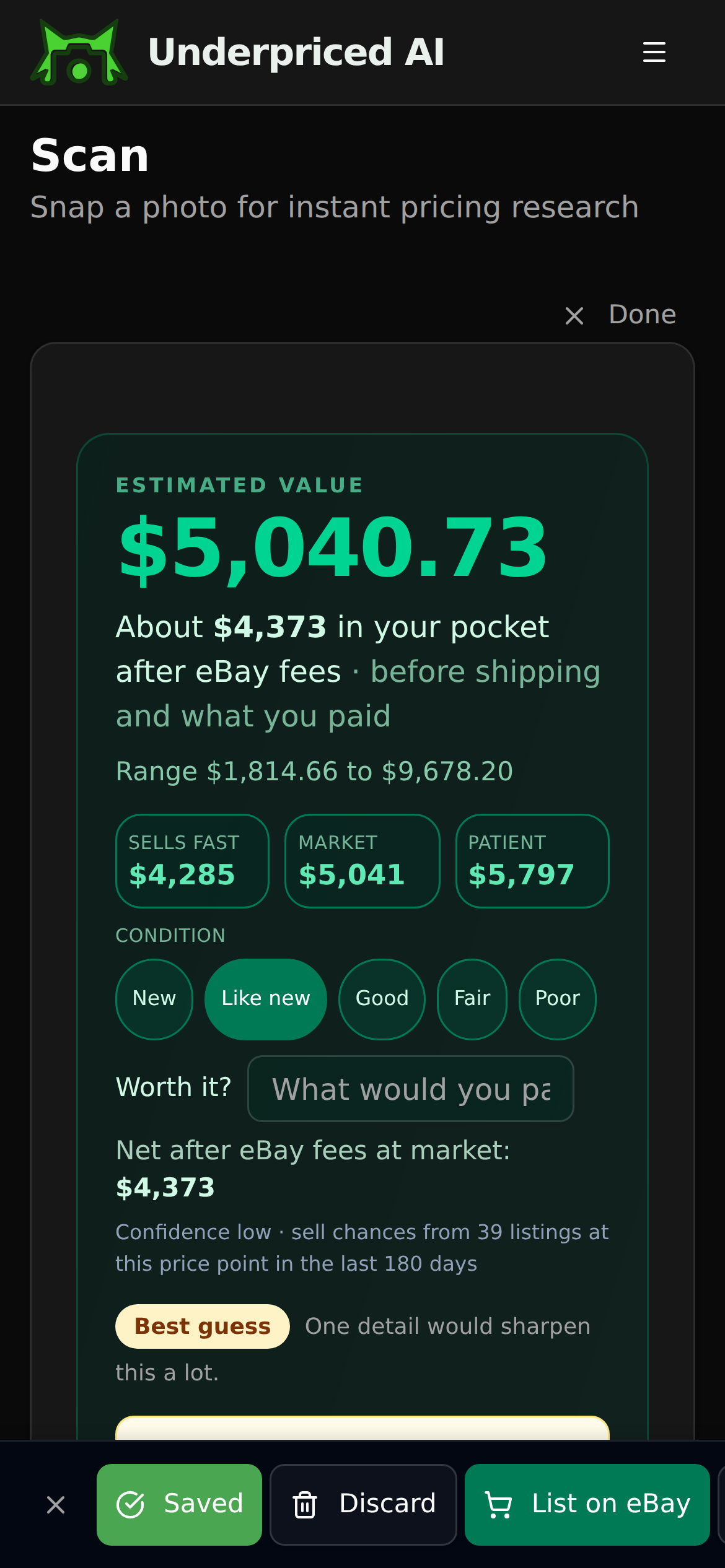
2. See what it sold for

3. List it
Find our guides useful? Get more of them in Google Search.