
Reseller Tax Guide 2026 | What Every Flipper Needs to Know
The complete reseller tax guide for 2026. Learn about 1099-K thresholds, deductible expenses, quarterly taxes, and record-keeping tips every flipper needs.

Nobody gets into reselling because they love tax season. You got into it because you spotted a vintage Pyrex set at a garage sale for $5 and sold it for $80 on eBay. But once those profits add up, the IRS takes notice. Understanding taxes for resellers is not optional. It is the difference between a sustainable business and a financial headache.
This reseller tax guide covers what you need to know for 2026: when you owe, what you can deduct, how to stay organized, and how to avoid the mistakes that trip up most flippers.
This is general information, not tax advice. Tax law is complex and your situation is unique. Consult a tax professional for your specific situation.
Do I Need to Pay Taxes on Reselling?
The short answer is yes, if you are making a profit. The IRS considers reselling income to be taxable income. This holds whether it is your full-time gig or a weekend side hustle. It applies whether you sell on eBay, Poshmark, Mercari, Facebook Marketplace, or at local flea markets.
There is a common myth that you only owe taxes if you receive a 1099-K form. That is not true. You are legally required to report all income, even if no platform sends you a tax form. The 1099-K is a reporting mechanism. It does not determine whether you owe taxes.
The Hobby vs. Business Distinction
The IRS distinguishes between a hobby and a business. Selling a few personal items at a loss is generally not taxable. But regularly buying items to resell at a profit is a business activity. Several factors indicate a business:
- You buy inventory specifically to resell
- You operate with continuity and regularity
- You track income and expenses
- You depend on the income or intend to make a profit
- You put significant time and effort into the activity
If reselling is your business, and for most readers of this guide it is, you need to report that income.
Understanding the 1099-K Threshold for Resellers
The 1099-K reporting threshold is one of the most discussed topics in the reselling community. Starting with the 2024 tax year, third-party payment platforms must send a 1099-K to any seller who receives $600 or more in gross payments during the calendar year.
This is a dramatic change from the old threshold of $20,000 and 200 transactions. Here is what it means in practice:
- eBay will send you a 1099-K if your gross sales hit $600
- Poshmark, Mercari, and other platforms follow the same rule
- PayPal and Venmo report payments received for goods and services at $600
- The $600 figure is based on gross sales, not profit
What "Gross Sales" Means for Your 1099-K
Your 1099-K will show the total amount buyers paid, including shipping. If you sold $5,000 worth of items and collected $800 in shipping fees, your 1099-K will show $5,800. This does not mean you owe taxes on $5,800. You will offset that number with your cost of goods sold and deductible expenses on your tax return.
Do not panic when you see a large number on your 1099-K. It is a starting point, not a tax bill.
Self-Employment Tax Basics for Resellers
This is where taxes for resellers differ from a regular W-2 job. When you are self-employed, you pay both the employer and employee portions of Social Security and Medicare taxes. This is called self-employment tax, and it currently sits at 15.3% on your net earnings.
That breaks down as:
- 12.4% for Social Security (on the first $168,600 of net earnings in 2026)
- 2.9% for Medicare (on all net earnings)
- 0.9% additional Medicare tax on net earnings above $200,000 (single) or $250,000 (married filing jointly)
Self-employment tax is in addition to your regular income tax. If you are in the 22% income tax bracket and owe 15.3% in self-employment tax, your effective rate on reselling profits is roughly 37%. The silver lining: you can deduct half of your self-employment tax when calculating your adjusted gross income.
Where Resellers Save the Most on Deductions
Deductions are your best friend. Every legitimate business expense reduces your taxable profit, which reduces both your income tax and self-employment tax. Here is a breakdown of what resellers can typically deduct.
Cost of Goods Sold (COGS)
This is your largest deduction. Every dollar you spend acquiring inventory is subtracted from your revenue before calculating profit. This includes:
- Purchase price of items you resell
- Auction fees paid when buying inventory
- Sales tax paid on inventory purchases
Tracking your purchase prices accurately is critical. If you cannot prove what you paid for an item, you may lose the deduction entirely. Tools like Underpriced AI can help here. When you scan items to get pricing data, you are also building a record of what you sourced and what you paid. That record becomes invaluable at tax time.
Shipping, Packaging, and Platform Fees
All shipping expenses and selling fees reduce your taxable income:
- Postage, shipping labels, boxes, poly mailers, bubble wrap, and tape
- Shipping scale, printer ink, and labels
- eBay final value fees and promoted listing fees
- Poshmark's 20% commission and Mercari's 10% selling fee
- PayPal or payment processing fees
- Store subscription fees (eBay Store, etc.)
Supplies, Equipment, and Software
Items and tools you use to run your business are deductible:
- Photography equipment (camera, lightbox, tripod)
- Steamer, iron, cleaning supplies, hangers, mannequins
- Storage bins, shelving, and packaging supplies bought in bulk
- Smartphone and computer (business-use percentage)
- Listing and inventory management software
- Pricing tools and accounting software (QuickBooks, Wave, etc.)
- Shipping platform subscriptions (Pirate Ship, etc.)
Mileage and Transportation
If you drive to source inventory, those miles are deductible. For the 2026 tax year, the standard mileage rate is expected to be around 0.70 per mile (check the IRS announcement for the exact figure). This covers:
- Driving to thrift stores, garage sales, and estate sales
- Trips to the post office or shipping drop-off points
- Driving to buy packaging supplies
- Travel to reselling meetups or conferences
Most resellers use the standard mileage rate for simplicity. Either way, you must keep a mileage log noting the date, destination, purpose, and miles driven. Several free apps can automate this for you.
Home Office Deduction
If you have a dedicated space in your home used exclusively for your reselling business, you may qualify for the home office deduction. There are two methods:
- Simplified method: $5 per square foot, up to 300 square feet (maximum $1,500 deduction)
- Regular method: Calculate the actual percentage of your home used for business and deduct that percentage of rent/mortgage, utilities, insurance, and repairs
The key word is "exclusively." A spare bedroom that doubles as a guest room does not qualify. A dedicated room where you photograph, store inventory, and manage listings does.
Other Deductible Expenses
Do not overlook these additional deductions: books and courses about reselling, conference attendance fees, membership dues for reselling organizations, and business insurance premiums.
Record-Keeping Best Practices for Resellers
Good records are your defense in an audit and the foundation for maximizing your deductions. Here is what every reseller should track.
What to Track for Every Item
For each item you sell, maintain a record of:
- Date purchased and where
- Purchase price (keep receipts)
- Date sold and on which platform
- Sale price and fees charged
- Shipping cost (what you paid vs. what the buyer paid)
- Net profit after all costs
Tools for Tracking
You do not need expensive software. A simple Google Sheets spreadsheet, a dedicated inventory app, or accounting software like QuickBooks Self-Employed all work. The critical habit is consistency. Record purchases and sales as they happen, not in a frantic scramble during tax season.
Keep your reselling records for at least seven years. The IRS generally has three years to audit your return. This extends to six years if they suspect significant underreporting.
Avoid the Big Surprise With Quarterly Estimated Taxes
If you expect to owe $1,000 or more in taxes for the year, the IRS wants you to pay quarterly estimated taxes rather than one lump sum in April. The due dates for 2026 are:
- Q1: April 15, 2026
- Q2: June 15, 2026
- Q3: September 15, 2026
- Q4: January 15, 2027
How to Calculate Quarterly Payments
The simplest approach is the safe harbor method. Pay at least 100% of last year's total tax liability divided into four equal payments (110% if your AGI was over $150,000). This protects you from underpayment penalties even if you earn more this year. Alternatively, estimate your current year income each quarter and pay accordingly.
How to Pay
Use IRS Direct Pay (irs.gov/payments) or the Electronic Federal Tax Payment System (EFTPS) to make quarterly payments. Do not forget state estimated taxes if your state has an income tax.
State Sales Tax for Online Resellers
Sales tax is separate from income tax and can be confusing for online sellers. The rules vary significantly by state, but here are the general principles.
When You Need to Collect Sales Tax
After the 2018 Supreme Court decision in South Dakota v. Wayfair, states can require online sellers to collect sales tax even without physical presence. Most states have economic nexus thresholds, typically $100,000 in sales or 200 transactions.
The good news: major platforms like eBay, Poshmark, Mercari, and Amazon now collect and remit sales tax for you in all states that require it. If you sell exclusively on these platforms, sales tax collection is handled. If you sell at local events or through your own website, you may need to register for a sales tax permit and collect tax yourself.
Resale Certificates
If your state has sales tax, consider getting a resale certificate. This lets you buy inventory without paying sales tax at the point of purchase, since you will be reselling the items. You are not avoiding the tax. The end buyer pays it. This improves your cash flow and simplifies accounting.
When Should a Reseller Get an LLC?
This is one of the most common questions in reselling communities. The answer depends on your situation, but here is a general framework.
Reasons to Consider an LLC
- Liability protection: separates your personal assets from business liabilities
- Professional credibility: looks more legitimate to suppliers and wholesale contacts
- Tax flexibility: can elect S-corp taxation, which may reduce self-employment tax once net income exceeds roughly $40,000 to $50,000 per year
When an LLC May Not Be Necessary
If you are just starting out, your revenue is under a few thousand dollars, or you sell only low-risk items, an LLC may be unnecessary overhead. You can operate as a sole proprietor and still deduct all the same business expenses. An LLC is about liability protection and structure, not tax deductions.
If you are still weighing whether reselling is the right path for you, our post on whether it is worth selling on eBay can help you run the numbers.
Common Tax Mistakes Resellers Make
Avoid these pitfalls that cost flippers money every year.
Not Tracking Cost of Goods Sold
If you cannot document what you paid for inventory, you cannot deduct it. That $3 thrift store receipt you tossed could have saved you money on your taxes. Save every receipt. Photograph them if they are on thermal paper that fades.
Confusing Gross Sales with Profit
Your 1099-K shows gross sales. You owe taxes on net profit: gross sales minus cost of goods, fees, shipping, and other deductible expenses. Failing to deduct expenses means massively overpaying.
Ignoring Quarterly Estimated Taxes
Waiting until April to pay your full tax bill means an underpayment penalty on top of the taxes. Paying quarterly is not optional when you owe more than $1,000 for the year.
Missing Deductions
Many resellers forget to deduct legitimate expenses:
- Mileage driven to source inventory
- Home office space
- Phone and internet costs (business percentage)
- Software subscriptions and pricing tools
- Packaging and shipping supplies bought in bulk
Every missed deduction increases your tax bill unnecessarily. Our pricing guide for resellers covers how understanding your true costs, including tax impact, leads to smarter pricing decisions.
Not Separating Business and Personal Finances
Open a dedicated bank account and credit card for your reselling business. Mixing personal and business expenses makes record-keeping a nightmare and raises red flags in an audit.
Forgetting About State Obligations
Do not overlook state requirements. Depending on where you live, you may owe state income tax, need a business license, or be required to register for a sales tax permit.
Filing Your Taxes as a Reseller
As a sole proprietor or single-member LLC, you will file Schedule C (business income and expenses) and Schedule SE (self-employment tax) with your Form 1040. If you claim the regular home office deduction, you will also need Form 8829.
If your reselling business is straightforward, quality tax software like TurboTax Self-Employed or FreeTaxUSA can handle your return. If your situation involves multiple platforms, significant revenue, or you are considering an S-corp election, a tax professional who understands e-commerce is worth the investment. Their fee is deductible too.
Building Good Tax Habits Year-Round
Taxes do not have to be painful if you stay organized throughout the year:
- Weekly: log all purchases and sales, save receipts
- Monthly: reconcile your sales records with bank and platform statements
- Quarterly: calculate estimated taxes and make payments by the due date
- Annually: compile your records, review deductions, and file your return
The resellers who dread tax season are the ones who wait until April to think about it. The resellers who find it painless spend 15 minutes a week keeping their records current.
Frequently Asked Questions
Do I still owe taxes on reselling if I never receive a 1099-K?
Yes. You are legally required to report all income, even when no platform sends you a form. The 1099-K is only a reporting mechanism, not the thing that creates the tax liability. Starting with the 2024 tax year, platforms send a 1099-K at $600 in gross payments, but income below that is still reportable if you are selling for profit.
How much of my reselling profit should I set aside for taxes?
Plan for both income tax and self-employment tax. Self-employment tax is 15.3% of net earnings: 12.4% for Social Security and 2.9% for Medicare. If you are in the 22% income tax bracket, your effective rate on reselling profits lands around 37%. Remember you pay on net profit after cost of goods, fees and shipping, not gross sales.
Do I need to collect sales tax if I only sell on eBay, Poshmark and Mercari?
No. eBay, Poshmark, Mercari and Amazon now collect and remit sales tax for you in all states that require it, so selling exclusively on those platforms means collection is handled. If you also sell at local events or through your own website, you may need to register for a sales tax permit and collect the tax yourself.
What records do I need to prove what I paid for inventory?
For each item, keep the date and place of purchase, purchase price with the receipt, date sold, platform, sale price, fees, shipping paid and net profit. Photograph thermal receipts before they fade, and keep records at least seven years. Scanning items with Underpriced AI on web or mobile also builds a record of what you sourced, which helps at tax time.
Getting Organized Beats Panicking
Taxes are unavoidable, but they do not have to be overwhelming. The 1099-K threshold at $600 means most active resellers will receive tax forms from the platforms they sell on. That is not a reason to panic. It is a reason to get organized.
Track your cost of goods. Save your receipts. Log your mileage. Deduct every legitimate expense. Pay quarterly. And when in doubt, spend a few hundred dollars on a tax professional. That consultation fee is deductible too.
Remember: This is general information, not tax advice. Tax laws change, and your specific situation may have nuances that require professional guidance. Consult a qualified tax professional for advice tailored to your circumstances.
Scan, value, and list, all in one app.
Snap a photo and see real sold prices from eBay, Poshmark and Mercari, then cross-list to all of them in a few taps. Your first scan is free.
Try a Free ScanFree first scan, no credit card required
Founder of Underpriced AI. Building tools for resellers with 30+ years of software engineering experience.
Know a reseller who'd want this?
Related Articles


Ready to find out what your stuff is worth?
Snap a photo and see what it actually sold for, with the real sold listings behind the price. First scan free, no credit card.

1. Photograph it
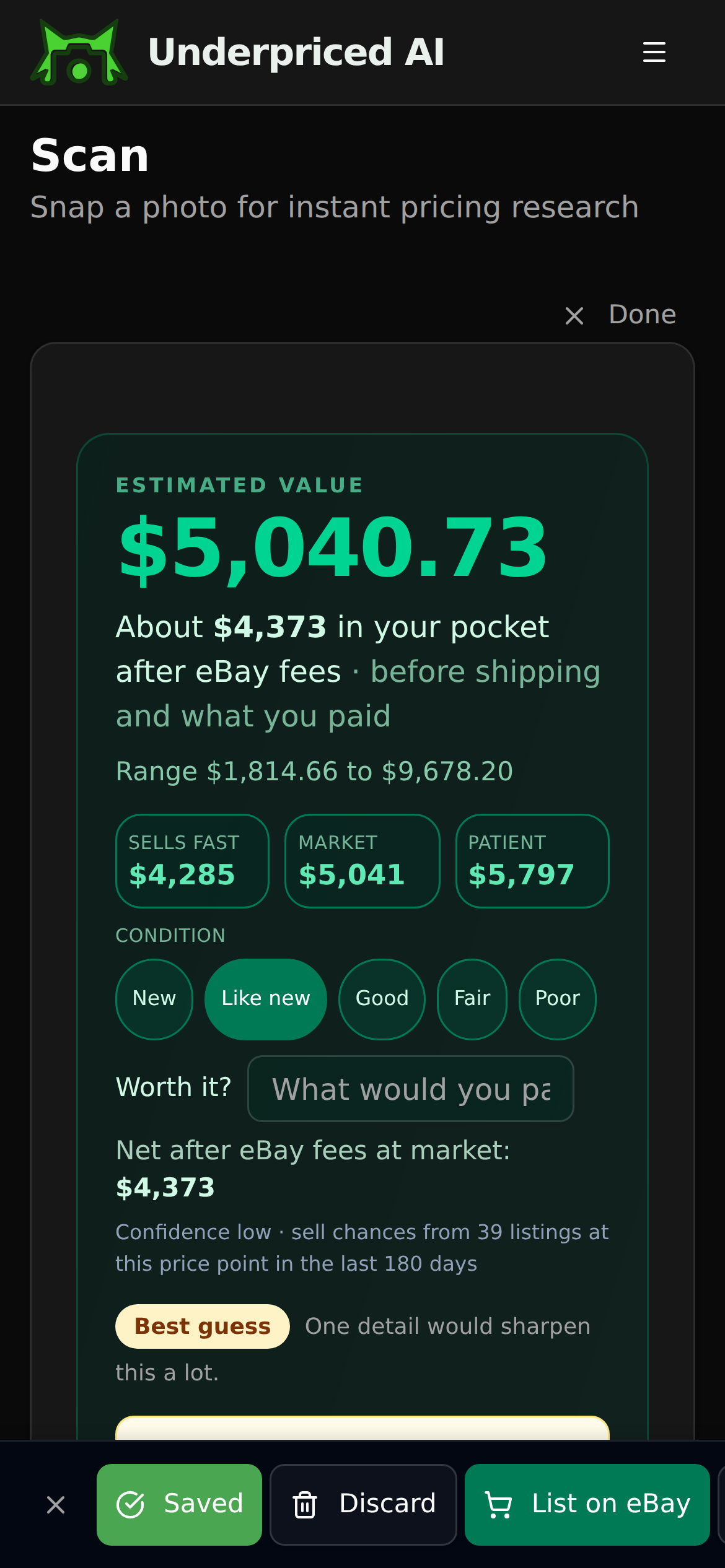
2. See what it sold for

3. List it
Find our guides useful? Get more of them in Google Search.