
Antique Identification by Markings | Read Maker's Marks and Labels
Learn how to identify antiques by reading maker's marks, hallmarks, and signatures. A practical guide to pottery marks, silver hallmarks, and more.

If you have ever flipped over a piece of pottery at a thrift store or estate sale and wondered what that tiny stamped symbol means, you are not alone. Knowing how to identify antiques by their maker's marks, signatures, and labels is one of the most valuable skills a reseller can develop. A single mark on the bottom of a vase or the back of a piece of silver can be the difference between a five-dollar find and a five-hundred-dollar payday. This guide walks you through what to look for, where to find it, and how to decode the most common marks across pottery, silver, furniture, glass, and jewelry.
What Maker's Marks Are and Why They Matter
A maker's mark is any stamp, signature, label, or symbol applied by a manufacturer, artisan, or workshop to identify the origin of an item. These marks serve as a kind of fingerprint for antiques and collectibles. They tell you who made the piece, when it was made, and sometimes where it was produced.
Understanding maker's marks matters for several reasons:
- Authentication. Marks help confirm whether a piece is genuine or a reproduction.
- Dating. Many manufacturers changed their marks over the decades, so the specific mark can narrow down the production date.
- Valuation. Items from certain makers command significantly higher prices. A piece of unmarked pottery might sell for a few dollars, while the same form with a Roseville or Rookwood mark could be worth hundreds.
- Provenance. Marks contribute to the story behind an item, which buyers care about.
For resellers who frequent estate sales and thrift stores, learning to quickly read marks reveals hidden value all around you.
Where to Find Marks on Different Types of Antiques
Before you can read a mark, you need to know where to look. The placement varies by category, but there are reliable patterns.
Pottery and Ceramics
Check the bottom of the piece first. Most pottery marks are stamped, impressed, or painted on the underside. On larger pieces like jardinieres or umbrella stands, look near the base or on the inside bottom. Some pieces carry paper labels instead of permanent marks, so handle items gently since those labels can fall off.
Silver and Metalwork
Silver marks are typically found on the bottom of flatware handles, the underside of trays and bowls, or near the rim on hollow pieces like teapots and pitchers. On jewelry, check the clasp, the inside of a ring band, or the back of a brooch. You may need a magnifying glass since silver hallmarks can be extremely small.
Furniture
Furniture marks are less standardized. Look in these spots:
- The back of the piece (especially dressers and cabinets)
- Inside or underneath drawers
- On the underside of tabletops or chair seats
- On the back of mirror frames
- Burned-in brands, paper labels, or metal tags
Glass
Glass marks are usually found on the bottom of the piece. They may be molded into the glass, etched, or applied as a paper sticker. Stickers are frequently lost over time, which is why unmarked glass can sometimes still be identified by pattern, color, and form.
Jewelry
Jewelry marks appear in small, hidden locations: the inside of ring bands, the back of pendants, the clasp area of necklaces and bracelets, and the post or back of earrings. Look for hallmarks, karat stamps (10K, 14K, 18K), and maker's initials.
How to Read Common Antique Maker's Marks
Reading marks takes practice, but there are general principles that apply across categories. Most marks include one or more of the following elements:
- The maker's name or initials, the company or artisan who produced the item.
- The country of origin. Items imported to the U.S. after 1891 are required to be marked with the country of origin. "Made in" phrasing generally indicates production after 1914.
- The pattern name or number, which helps identify the specific design.
- Date marks or codes. Some manufacturers used letter or number systems to indicate the year of production.
- Quality marks, especially common on silver and gold, indicating metal purity.
A useful rule of thumb: the more information a mark contains, the easier it is to research. Even a partial mark can be enough to identify a maker if you know what to look for.
Identifying Ceramics by Their Major Pottery Marks
Pottery is one of the most commonly found categories at estate sales and thrift stores, and it is also one of the most rewarding to learn. Here are some of the marks you are most likely to encounter.
McCoy Pottery
McCoy is one of the most collected American pottery brands. Genuine McCoy pieces are marked with "McCoy" or "McCoy USA" on the bottom. Be cautious: many unmarked pieces are attributed to McCoy but cannot be confirmed. Also watch out for pieces marked "McCoy" that were actually made by the Nelson McCoy Sanitary and Stoneware Company versus the J.W. McCoy Pottery Company, as these were separate entities.
Roseville Pottery
Early Roseville pieces (pre-1935) often carry only a paper label or an "Rv" ink stamp, making them harder to identify. Later pieces have "Roseville" or "Roseville, U.S.A." impressed or raised on the bottom, often accompanied by a shape number and size. Roseville is highly collectible, and even damaged pieces can hold value.
Fiesta (Fiestaware)
Fiesta dinnerware by Homer Laughlin is marked with "FIESTA" and "HLC USA" stamped or impressed on the bottom. Vintage Fiesta (1936-1973) uses a slightly different mark than modern production pieces. The most valuable vintage colors include medium green, red (radioactive uranium glaze), and ivory.
Royal Doulton
Royal Doulton marks are well-documented and include a lion standing on a crown. The specific details of the mark, including the presence of "England" versus "Made in England," help date the piece. Royal Doulton figurines carry an "HN" number that identifies the specific figure and can be looked up in reference guides.
| Pottery Brand | Common Mark Style | Key Detail to Watch |
|---|---|---|
| McCoy | "McCoy" or "McCoy USA" impressed | Distinguish from Lancaster Colony reproductions |
| Roseville | "Roseville, U.S.A." with shape number | Early pieces may only have paper labels |
| Fiesta | "FIESTA / HLC USA" stamped | Vintage vs. modern mark differences |
| Royal Doulton | Lion on crown with "Royal Doulton England" | HN numbers identify figurines |
| Weller | "Weller" or "Weller Pottery" hand-incised | Some lines are unmarked |
| Hull | "Hull" or "Hull Art USA" with number | Pre-1950 pieces are more valuable |
How to Identify Sterling, Silver Plate, and More
Silver identification has its own rich system of marks. Learning the basics will save you from confusing a silver-plated tray with a sterling piece worth ten times as much.
Sterling vs. Silver Plate
This is the most important distinction to make. Look for these indicators:
- Sterling silver is marked "Sterling," "925," or ".925," meaning 92.5% pure silver. American sterling often includes a maker's mark alongside the sterling stamp.
- Silver plate is marked "EPNS" (Electroplated Nickel Silver), "Silver Plate," "Quadruple Plate," "A1," or "Sheffield Plate." Silver plate has a thin layer of silver over a base metal and is worth far less than sterling.
- Coin silver is marked "Coin," "Pure Coin," "Dollar," or "900." This is an older American standard (90% silver) found on pieces made before sterling became the norm in the 1860s.
British Hallmarks
The British hallmark system is one of the oldest and most detailed in the world. A full British hallmark includes:
- The sponsor's mark, the maker's initials in a specific shield shape.
- The standard mark, a lion passant (walking lion) for sterling silver in England.
- The assay office mark, which indicates where the piece was tested. A leopard's head means London, an anchor means Birmingham, a rose means Sheffield, and a castle means Edinburgh.
- The date letter, a single letter in a specific font and shield shape that corresponds to the year of assay. Date letter charts are available in reference books and online.
American Silver Marks
American silver marking is less standardized than British hallmarks. Most American sterling is marked with the maker's name or logo plus "Sterling" or "925." Major American silver companies include Gorham (a lion, anchor, and Gothic "G"), Tiffany and Co. (usually spelled out), Reed and Barton, and Wallace. Knowing these company marks helps you quickly assess value.
How to Identify Antique Furniture by Construction Details
Furniture often lacks clear maker's marks, so identification relies heavily on construction techniques, materials, and hardware. These physical clues can tell you as much as any stamp.
Dovetail Joints
The dovetail joint on a drawer is one of the most reliable dating tools for furniture:
- Hand-cut dovetails (pre-1890s) have irregular spacing, varying pin sizes, and visible scribe marks. This indicates hand craftsmanship and generally an earlier date.
- Machine-cut dovetails (1890s onward) are uniform, evenly spaced, with identical pins. This still indicates quality construction but a later date.
- No dovetails (stapled, nailed, or glued) usually indicates mass production from the mid-20th century onward or inexpensive construction.
Wood Types and Construction
The type of wood used offers clues about age and origin:
- Walnut dominated American furniture from roughly 1700 to 1780.
- Mahogany was popular from the 1750s through the early 1800s, especially in Federal and Chippendale styles.
- Oak was common in Arts and Crafts and Mission-style furniture from the early 1900s. It was also prevalent in much earlier English furniture.
- Pine and poplar were frequently used for secondary woods (drawer interiors, backs) in quality furniture of all periods.
Check the back and underside of furniture for saw marks. Straight, parallel marks indicate a circular saw (post-1830s). Curved marks indicate a band saw (post-1850s). Irregular marks suggest hand-sawing, pointing to an earlier date.
Hardware Styles
Original hardware is another dating tool. Hand-forged nails and hinges suggest pre-1800 construction. Machine-cut square nails were common from around 1800 to 1890. Modern round wire nails appeared after 1890. If you see Phillips head screws, the piece or that component dates to after 1930 at the earliest.
Replaced hardware does not necessarily reduce value, but original hardware adds to authenticity. Look for filled holes or outlines on wood that suggest hardware was swapped at some point.
Identifying Fenton, Depression Glass, and Murano
Glass identification can be tricky because many pieces are unmarked or carry only small, easily missed marks. Here is what to look for in the most commonly encountered categories.
Fenton Glass
Fenton Art Glass began marking pieces with a stamped oval "Fenton" logo in 1970. Pieces made before 1970 are generally unmarked, which makes them harder to identify but sometimes more valuable. After 2007, a small "8" was added inside the logo. Fenton ceased production in 2011, and their pieces have been steadily increasing in value.
Look for Fenton's signature characteristics: hand-painted details, hobnail patterns, carnival glass iridescence, and distinctive milk glass. If a piece is unmarked but shows these traits, pattern identification guides can help confirm it as Fenton.
Depression Glass
Depression glass (1920s-1940s) is rarely marked with a maker's name. Identification relies almost entirely on pattern and color recognition. There are hundreds of documented patterns, and reference books like "Warman's Depression Glass" are essential tools.
Key manufacturers include:
- Anchor Hocking. Look for an anchor symbol on later pieces.
- Hazel-Atlas. Marked with an "H" over an "A" on some pieces.
- Federal Glass. An "F" inside a shield.
- Indiana Glass. Often unmarked.
Popular and valuable patterns include American Sweetheart, Cherry Blossom, Cameo, Royal Lace, and Manhattan. Rare colors like cobalt blue, tangerine, and alexandrite (color-changing) command premium prices.
Murano Glass
Authentic Murano glass from the island of Murano near Venice, Italy, can be extremely valuable. However, the market is flooded with imitations. Genuine Murano pieces may carry a "Murano" sticker, an etched signature, or a "Vetro Artistico Murano" trademark (introduced in 1994).
Older pieces may be completely unmarked. In those cases, look for these indicators of authentic Murano:
- Slight imperfections and air bubbles (indicating hand-blown production)
- Vivid, rich colors
- Pontil marks on the bottom (the rough spot where the glass was attached to the blowpipe)
- Weight and quality of the glass
Practical Tips for Identifying Antiques in the Field
Knowing what marks to look for is only half the battle. Here are practical tips for identifying antiques efficiently when you are out shopping at estate sales or thrift stores.
Essential Tools to Carry
- A jeweler's loupe or magnifying glass (10x magnification). Many marks are tiny and impossible to read with the naked eye. A loupe is the single most useful tool for a reseller.
- Your smartphone. Take clear, well-lit photos of every mark you find. Photograph the entire piece as well as close-ups of marks, signatures, labels, and any damage.
- A small flashlight. It helps illuminate marks in dim store lighting and reveals details in glass and pottery glazes.
- A reference card or app. Keep a quick-reference guide to common marks on your phone.
Research Strategies
When you find a mark you do not recognize, try these approaches:
- Search the mark visually. Describe what you see (for example, "crown with crossed swords pottery mark") in a search engine. Image searches work well for this.
- Use specialized databases. Sites like the Kovels database, Replacements.com (for china and crystal patterns), and the Online Encyclopedia of Silver Marks are invaluable free resources.
- Snap a photo and use AI tools. Apps like Underpriced AI let you photograph marks and items to get identification and pricing information quickly. This is especially helpful when you are standing in a store trying to make a fast buying decision.
- Consult reference books. "Kovels' New Dictionary of Marks" and "Miller's Antiques Handbook" are two of the most comprehensive printed references available.
If you are building your reselling knowledge, pairing mark identification with smart pricing strategies will help you consistently find profitable items.
Common Pitfalls to Avoid
- Do not assume all marks are genuine. Reproductions and fakes often carry marks designed to fool buyers. If a deal seems too good to be true, research the piece thoroughly before buying.
- Do not overlook unmarked pieces. Many valuable antiques, especially early American pottery and furniture, were never marked. Construction details and style can still reveal age and origin.
- Do not ignore condition. A rare mark on a badly damaged piece may not translate to high value. Factor in chips, cracks, repairs, and missing parts when assessing any antique.
- Do not confuse pattern numbers with date marks. A number on the bottom of a piece might indicate the shape, size, or mold number rather than the year of production.
Building Your Antique Identification Skills Over Time
Learning to identify antiques is a gradual process. Nobody masters every category overnight. The most effective approach is to pick one or two categories that interest you, whether that is pottery, silver, glass, or furniture, and go deep.
Here are a few ways to accelerate your learning:
- Handle as many pieces as possible. Visit antique malls, estate sales, and museums. The more you touch and examine authentic pieces, the better your eye becomes. Check out our estate sale tips for resellers if you are just getting started.
- Study sold listings. Look at completed sales on eBay and other platforms to see what specific marks and items actually sell for. This grounds your knowledge in real market data.
- Join collector communities. Online forums and social media groups for specific collecting categories are full of experienced collectors who can help with identification questions.
- Keep a photo library. Every time you encounter a new mark, photograph it and note what it is. Over time, you will build your own personal reference guide.
- Practice at thrift stores. Thrift stores are low-risk environments to practice identification skills. Flip over every piece of pottery, check the bottom of every glass, and look at the back of every picture frame.
Frequently Asked Questions
How can I tell if a maker's mark is genuine or a reproduction?
Compare the mark against documented examples for that maker and check whether the mark style matches the era claimed. Watch for known trouble spots: pieces marked McCoy that came from separate companies, and Lancaster Colony reproductions. Also confirm the mark matches the item's construction, glaze, wear and form. A mark that looks too crisp on a supposedly old piece deserves a closer look with a loupe.
What does the country of origin on a mark tell me about the age?
Items imported into the U.S. after 1891 were required to carry a country of origin mark, so a piece stamped with a country name generally dates from 1891 or later. Wording matters too: "Made in" phrasing usually indicates production after 1914. On Royal Doulton, the difference between "England" and "Made in England" helps narrow the date range.
How do you identify an antique that has no mark at all?
Use physical clues instead. For furniture, check dovetails, saw marks, wood type and nail or screw styles for a date range. For glass, identify by pattern, color and form, since Depression glass and pre-1970 Fenton are often unmarked. For Murano, look for air bubbles, pontil marks, vivid color and weight. Paper labels also fall off, so unmarked does not mean worthless.
Once I identify the mark, how do I find out what the piece is worth?
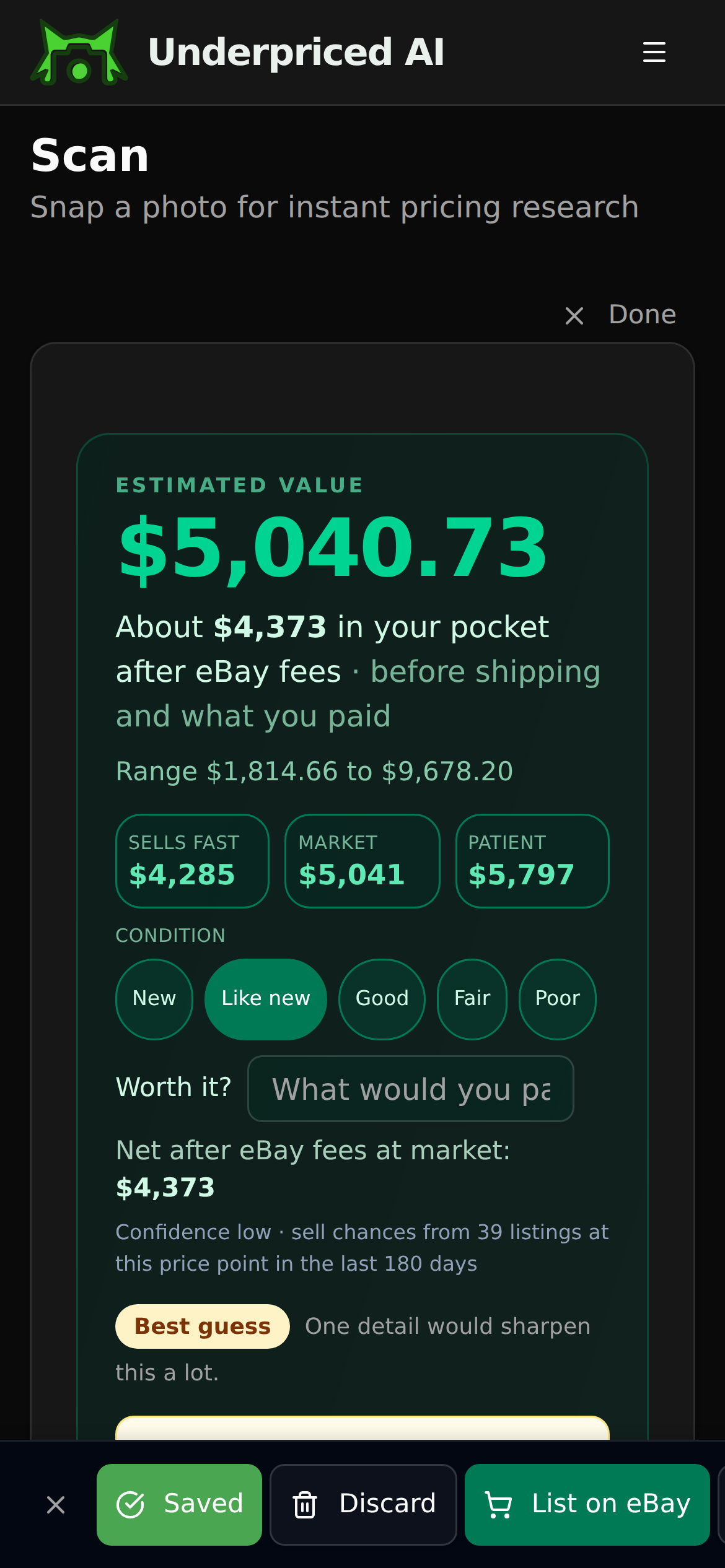
Check what identical or similar pieces actually sold for, not what sellers are asking. Underpriced AI does this from a photo on web or mobile: it pulls real sold comps from eBay, Poshmark and Mercari and gives you a resale value, then lets you publish the listing to eBay. The first scan is free with no card required.
Start With the Categories You See Most Often
Learning how to identify antiques by their maker's marks, hallmarks, and construction details is one of the most rewarding skills you can develop as a reseller or collector. It turns a cluttered shelf at a thrift store into a treasure hunt where knowledge is your edge. You do not need to memorize every mark in existence. Start with the categories you encounter most often, learn the key indicators of age and quality, and build from there.
The more you practice, the faster you will get at spotting valuable pieces that others walk right past. When you are in the field and need a quick identification or pricing check, tools like Underpriced AI can help you make confident buying decisions in seconds. The marks are already there on the pieces, waiting for someone who knows how to read them.
A single flow takes an antique from photo to live listing. Underpriced AI recognizes the piece, pulls real sold comps from eBay, Poshmark, Mercari and category specialists, then writes the listing and posts it to eBay across 10 markets. Refresh value keeps your prices current. Try your first scan free - no card required.
Scan, value, and list, all in one app.
Snap a photo and see real sold prices from eBay, Poshmark and Mercari, then cross-list to all of them in a few taps. Your first scan is free.
Try a Free ScanFree first scan, no credit card required
Founder of Underpriced AI. Building tools for resellers with 30+ years of software engineering experience.
Know a reseller who'd want this?
Related Articles


Ready to find out what your stuff is worth?
Snap a photo and see what it actually sold for, with the real sold listings behind the price. First scan free, no credit card.

1. Photograph it
2. See what it sold for

3. List it
Find our guides useful? Get more of them in Google Search.