
Collectibles Worth Flipping: What to Buy Secondhand, What to Skip
Which collectibles actually resell. How to spot valuable vintage toys, records, books and memorabilia at thrift shops and flea markets, with prices.

Updated August 2026: refreshed with current values and what is moving in the collector market this year.
Why Collectibles Beat General Thrift Flipping
Most resellers start with clothes, electronics, and housewares. Those categories work, but they're crowded. Collectibles are different. When you find the right item in the right condition, you're not competing with fifty other sellers listing the same H&M jacket. You're selling to a motivated collector who has been looking for that exact piece for months, sometimes years.
That's the fundamental advantage of collectible reselling: buyers come with intent and budget. Vintage toys, rare books, and collectible records have loyal, knowledgeable buyers who pay premium prices without much friction. The challenge is knowing what to look for before you're standing in the thrift store aisle wondering if that dusty action figure is worth $4 or $400.
This guide breaks down the high-demand collectible categories. It covers what to look for, and how to validate that demand before you spend a dollar.
High-Demand Collectible Categories Worth Your Time
Not all collectibles are equal. Some categories have deep, liquid markets with thousands of active buyers. Others are passion-project niches with ten collectors nationwide. Here's where experienced resellers consistently find profit.
Vintage Toys Have the Highest Markup Potential
Toys from the 1970s through the 1990s are arguably the single best collectible category for thrift-store sourcing. The buyers are now adults in their 30s-50s with disposable income, and nostalgia is a powerful pricing engine.
High-value vintage toy targets:
- Star Wars (1977-1985 Kenner): Original 12-back carded figures in any condition sell for $50-$500+. Complete playsets like the Death Star can hit $300-$800.
- Masters of the Universe (He-Man): Loose figures with all accessories run $15-$80 each. A complete Castle Grayskull runs $200-$500.
- G.I. Joe (1982-1994 Hasbro): Individual figures with filecard and accessories run $20-$150. Vehicles in box run $100-$600.
- Hot Wheels Redlines (1968-1977): A single car in excellent condition runs $30-$300 depending on color variant.
- Transformers G1 (1984-1990): Boxed with all parts, $100-$1,500+. Even loose with accessories, $40-$300.
The vintage toy value equation is simple: original accessories plus original packaging equals exponential price increases. A loose He-Man figure without his sword might fetch $8. That same figure with the sword and cross sells for $35. Add the original card backing and you're at $200+.
Vinyl Records Are a Market That Never Peaked
The record collecting revival isn't a trend, it's structural. According to the Recording Industry Association of America, vinyl sales have outpaced CDs for three consecutive years. That means collector demand is broad and growing.
Collectible records worth money, what to prioritize:
- Original pressings over reissues, always. A Beatles "White Album" first UK pressing with low serial number runs $200-$800. A 1980s repress runs $15.
- Jazz originals: Blue Note, Prestige, and Verve pressings from the 1950s-1960s. A VG+ copy of John Coltrane's Blue Train on Blue Note original runs $300-$1,200.
- Classic rock and soul first pressings: Led Zeppelin, Pink Floyd, Marvin Gaye, Stevie Wonder. Condition is everything here.
- Promo copies: "Not for Sale" stamped promos are often first pressings and command premiums.
- Regional pressings: A Bob Dylan album pressed in South Africa or Japan with unique artwork can be 3-5x the US version price.
What to look for in the bin: Check the label for original catalog numbers. Check the matrix etchings in the dead wax, the catalog number hand-etched near the center. Check whether it's a first-label version, like the original "red and plum" Capitol for Beatles versus the later Capitol rainbow. A $3 record can be a $150 record if you know the matrix.
Rare Books Almost Nobody Sources
Books are the most underpriced collectible category in most thrift stores. Staff rarely know what they're looking at, and the margins can be extraordinary.
What actually makes a book valuable:
- First edition, first printing: Always check the copyright page. Publishers use different methods: "First Edition" stated, number lines (1 2 3 4 5 being first), or printing codes.
- Dust jacket presence: A first edition without the jacket might be worth $40. With a near-fine jacket, $400.
- Author signatures: Signed copies can 2-10x the value, but verify authenticity carefully.
- Scarce subject matter: Regional histories, early science fiction, certain illustrated children's books (Sendak, Gorey, early Tolkien).
Real examples: A first edition of The Hitchhiker's Guide to the Galaxy (Douglas Adams, 1979 UK first) in fine condition with jacket runs $1,500-$4,000. Found it at an estate sale for $2? That happens. A signed first edition of Stephen King's The Shining realistically runs $800-$2,500 depending on condition.
The rare book principle: learn one genre deeply rather than trying to know everything. Horror, science fiction, Southern literature, pick a lane and become the person who knows it cold.
Sports and Entertainment Memorabilia
Pre-1980 sports cards, autographed items, and vintage entertainment memorabilia have institutional collector markets behind them. PSA grading, Beckett, and Heritage Auctions create transparent pricing benchmarks.
High-demand sub-categories:
- Pre-1980 baseball cards (especially T206 era tobacco cards)
- 1980s-1990s basketball cards (Jordan rookie cards, Shaquille O'Neal XRC)
- Concert posters: Original Fillmore and Fillmore West posters from the late 1960s, $200-$2,000+
- Movie lobby cards and pressbooks from the 1930s-1960s
Spotting Rare Editions and Limited Releases
The difference between a general collectibles picker and a serious flipper is the ability to identify limited releases and variant editions on sight, or at minimum, know enough to investigate.
What "Limited" Actually Means in Different Categories
In vinyl, a limited pressing might be color vinyl, a specific regional release, or a short-run promotional version. In toys, it's often a short-production color variant. The "blue Snaggletooth" Star Wars figure is rare because it was only available in a Sears exclusive set. In books, it's frequently a small-press limited edition with a numbered colophon.
Train yourself to look for:
- Numbering ("27/500" on the copyright page or label)
- Regional identifiers (country of pressing or publication)
- Variant packaging or artwork
- Production anomalies. Misprints, errors, and recalled items are frequently worth more than the "correct" version.
A misprint can make a common item rare. The 1979 "baggie" Magneto figure by Kenner (Star Wars) with the wrong limbs is worth 4x a standard version. A record pressed with the wrong label can be highly sought by collectors.
Condition Grading and Its Impact on Resale Value
Collectors don't just want items, they want items in specific conditions. They'll pay dramatically more to upgrade from "good" to "fine." Understanding condition grading is arguably the most high-use skill in collectible reselling.
The Condition Premium in Practice
Here's a real example from the vinyl market. A copy of Miles Davis's Kind of Blue (original Columbia 6-eye pressing):
- Poor (plays but scratched): $25-$40
- Good (some marks, plays fine): $60-$90
- Very Good Plus (light marks, great sound): $150-$200
- Near Mint: $300-$500+
That's a 10-15x spread based entirely on condition. The same dynamic applies to toys, books, and cards.
Standard grading scales to know:
- Records: Goldmine Standard (M, NM, VG+, VG, G+, G, F, P)
- Comics and cards: CGC/PSA numerical scale (1-10)
- Books: Fine, Near Fine, Very Good, Good, Fair, Poor
- Toys: Mint in Sealed Box (MISB), Mint on Card (MOC), Mint in Box (MIB), Near Mint, Excellent, Good
One grading principle that many resellers miss: never clean something you don't understand. Improperly cleaning a record, polishing a toy, or erasing pencil marks from a book can actually decrease value. Learn category-specific cleaning protocols before you touch anything.
Using Sold Listings to Validate Market Demand
Here's where many newer resellers make expensive mistakes: they price based on asking prices, not sold prices. A $500 listing means nothing if the item hasn't sold in 14 months.
How to Read Sold Data Correctly
On eBay, filter your search to "Sold Listings" and look for:
- Sell-through rate: If 40 items sold out of 50 listed, that's strong demand. If 3 sold out of 80, that's a slow market regardless of price.
- Price consistency: Are sold prices clustered in a range, or all over the place? Tight clustering means predictable value. Wide variance means condition and knowledge matter more.
- Recency: A record that sold for $200 in 2019 might sell for $80 today, or $350. Check the last 90 days specifically.
For deeper market validation, learning how to use Terapeak for eBay market research is worth the time. It surfaces sell-through rates and average sold prices across categories with much more precision than manual searching.
The 3-Sale Rule: Before buying a collectible for more than $20, find at least three sold examples in comparable condition within the last 90 days. One high sale is an outlier. Three consistent sales are a market.
Niche Collectibles Mean Lower Competition, Higher Margins
The most counterintuitive insight in collectible reselling is that the more obscure the category, the less competition you face, and sometimes the higher the prices. Mainstream items like common baseball cards or well-known Star Wars figures attract hundreds of competing listings. Niche markets attract fewer sellers but buyers who know exactly what they want.
Underexplored Niche Categories Worth Learning
- View-Master reels and viewers: Rare scenic and educational reels from the 1950s-1960s run $15-$150 per reel. Thrift stores price them at $2-$5 universally.
- Vintage advertising tins and signage: Pre-1960 lithographed tins for tobacco, coffee, biscuits run $40-$400.
- Souvenir spoons: Sterling silver souvenir spoons from the late 1800s to 1930s run $25-$200 each. Almost always underpriced at thrift stores.
- Vintage sewing patterns: Rare Vogue couture patterns from the 1950s-1960s run $30-$150. Common thrift price: $0.50-$2.
- Magic lantern slides: Hand-painted glass slides from the 19th century run $20-$200 each.
- Celebrity-signed items outside sports: Authors, politicians, scientists. A signed letter from a notable figure in science or literature can dramatically outperform sports autographs on a per-dollar basis.
Building a Collector Network for Premium Inventory
The best deals don't come from thrift stores, they come from other collectors who need to liquidate. Building relationships with serious collectors gives you access to inventory that never hits the public market.
How to Build Your Network
Start at collector shows and conventions. Comic cons, record fairs, antique shows, and toy conventions are where serious collectors gather. Go as a buyer first, not a seller. Learn who the major dealers are, who has knowledge, and who might be looking to downsize.
Join collector forums and Facebook groups. Categories like Tonka trucks, vintage Fisher-Price, first-edition books, and Blue Note jazz have dedicated online communities. Many will have "for sale" sections with motivated sellers who'd rather sell to a knowledgeable buyer than deal with eBay fees.
Develop relationships with estate sale companies. Estate sales are where collections go when collectors pass away or downsize. The best items often get previewed or negotiated before the public sale. Our estate sale sourcing guide covers exactly how to build these relationships with estate sale organizers to get early access to premium inventory.
Talk to thrift store staff. Many thrift stores have staff who pull items for regular customers they trust. If you're consistent, knowledgeable, and friendly, you can sometimes be first to know when a significant collection donation comes in.
Solving the Identification Problem
The single biggest barrier for most collectible resellers isn't finding items, it's identifying them quickly and accurately. A record without a visible matrix, a toy you don't recognize, a book whose value you're unsure of, every minute you spend researching in the aisle is time you're not buying.
Knowing pottery marks, foundry marks, silver hallmarks, and manufacturer codes helps across many collectible categories. If you're not already familiar with how to read these identifiers, those are skills worth building systematically. Our guides on pottery marks identification and bronze foundry marks cover the manufacturer identification process in detail for those specific categories.
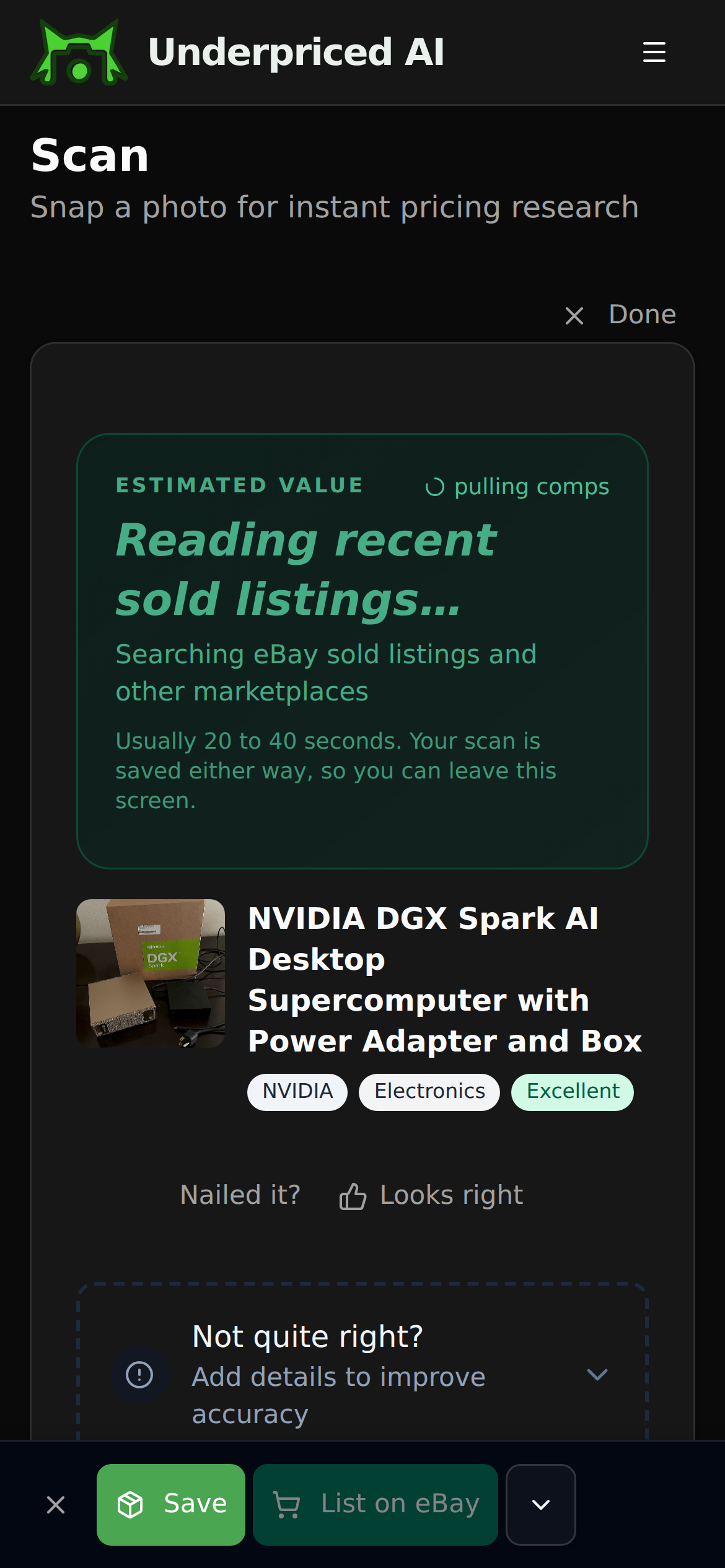
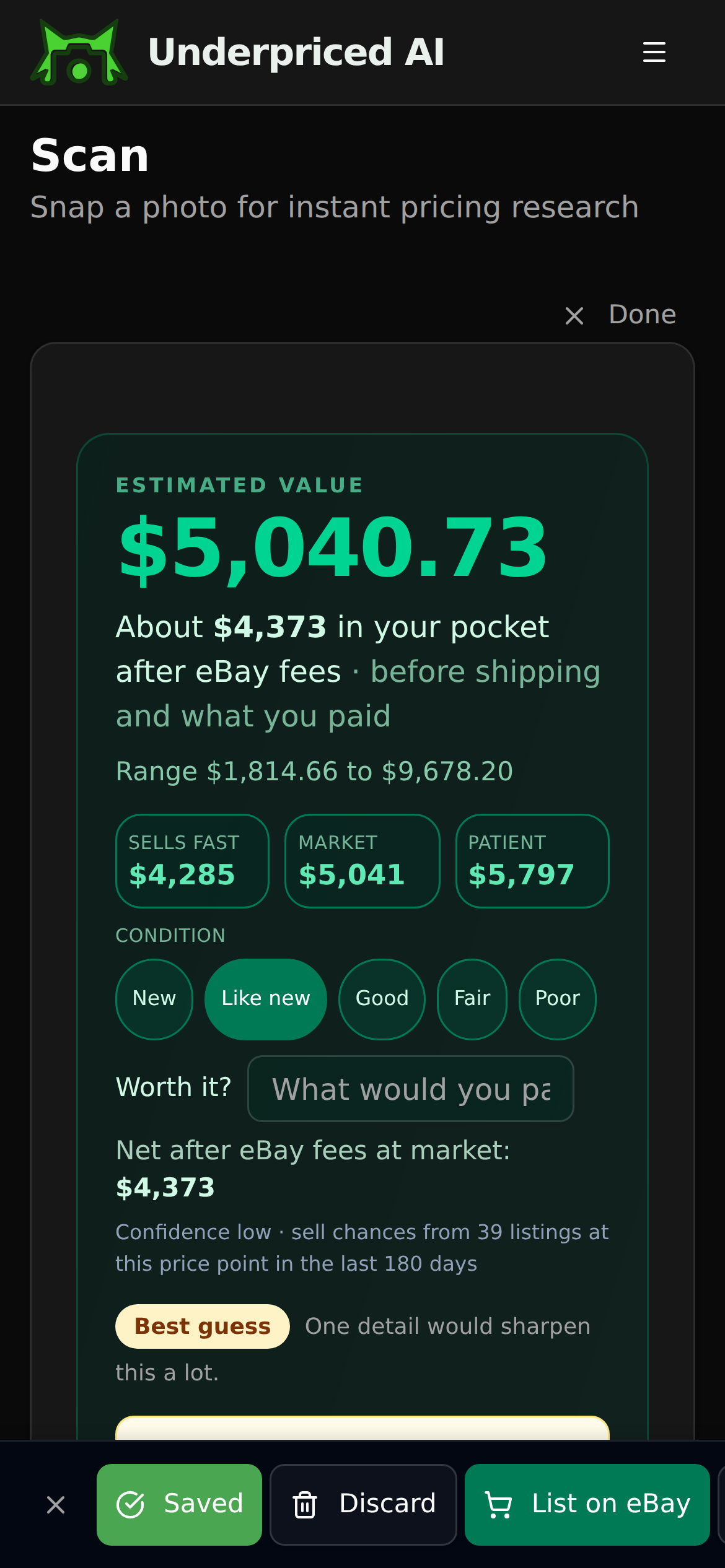
For everything else, having a way to scan an item and get immediate pricing data matters. Underpriced AI's scan-to-price feature is built specifically for this. Point your phone at an item and surface comparable sold listings and market data in seconds. It's most useful when you're holding something and need to make a quick buy decision before someone else does.
Frequently Asked Questions
How do I know if a collectible is actually worth buying before I pay for it?
Use sold listings, not asking prices. The post's 3-Sale Rule says before spending more than $20 on a collectible, find at least three sold examples in comparable condition within the last 90 days. One high sale is an outlier. Three consistent sales prove a market. Also check sell-through rate: 40 sold out of 50 listed signals strong demand.
Does a vintage toy need its original box and accessories to be worth money?
Not required, but it changes the price dramatically. Original accessories plus original packaging create exponential increases. A loose He-Man figure without his sword might fetch $8. With the sword and cross it sells around $35. Add the original card backing and you are at $200 or more. Boxed Transformers G1 can reach $100 to $1,500 or more.
How can I tell if a vinyl record is a first pressing while I'm still in the store?
Check three things: the label for original catalog numbers, the matrix etchings hand scratched in the dead wax near the center, and whether the label design is the first version, such as the original red and plum Capitol versus the later rainbow label. Original pressings beat reissues every time. A Beatles White Album first UK pressing can bring $200 to $800 while an 1980s repress brings $15.
What's the fastest way to identify an unfamiliar collectible in a thrift store aisle?
Scan it. Underpriced AI's scan to price feature works on web or mobile: point your phone at the item and it surfaces comparable sold listings and market data in seconds, which is what you need when someone else is walking toward the same shelf. The first scan is free with no card, then credit packs start at $3 for 5 scans or you can subscribe.
A Buying Framework
When you're in front of a potential collectible purchase, run this mental checklist:
- Category check: Is this a category with a known, active buyer market?
- Condition assessment: What grade would this realistically receive? Be honest.
- Rarity signals: Any variant, limited edition, or first-edition indicators?
- Sold data: Can you find 3 recent comparable sold listings?
- Cost vs. value: Does the margin justify the purchase after fees, shipping, and time?
Collectible reselling rewards knowledge over luck. The resellers who consistently find valuable items aren't stumbling onto them. They've invested time learning specific markets until pattern recognition becomes automatic. Start with one category, go deep, and expand from there.
The secondhand stores, estate sales, and flea markets are full of items waiting for someone who knows what they're looking at. That knowledge advantage is the entire business model.
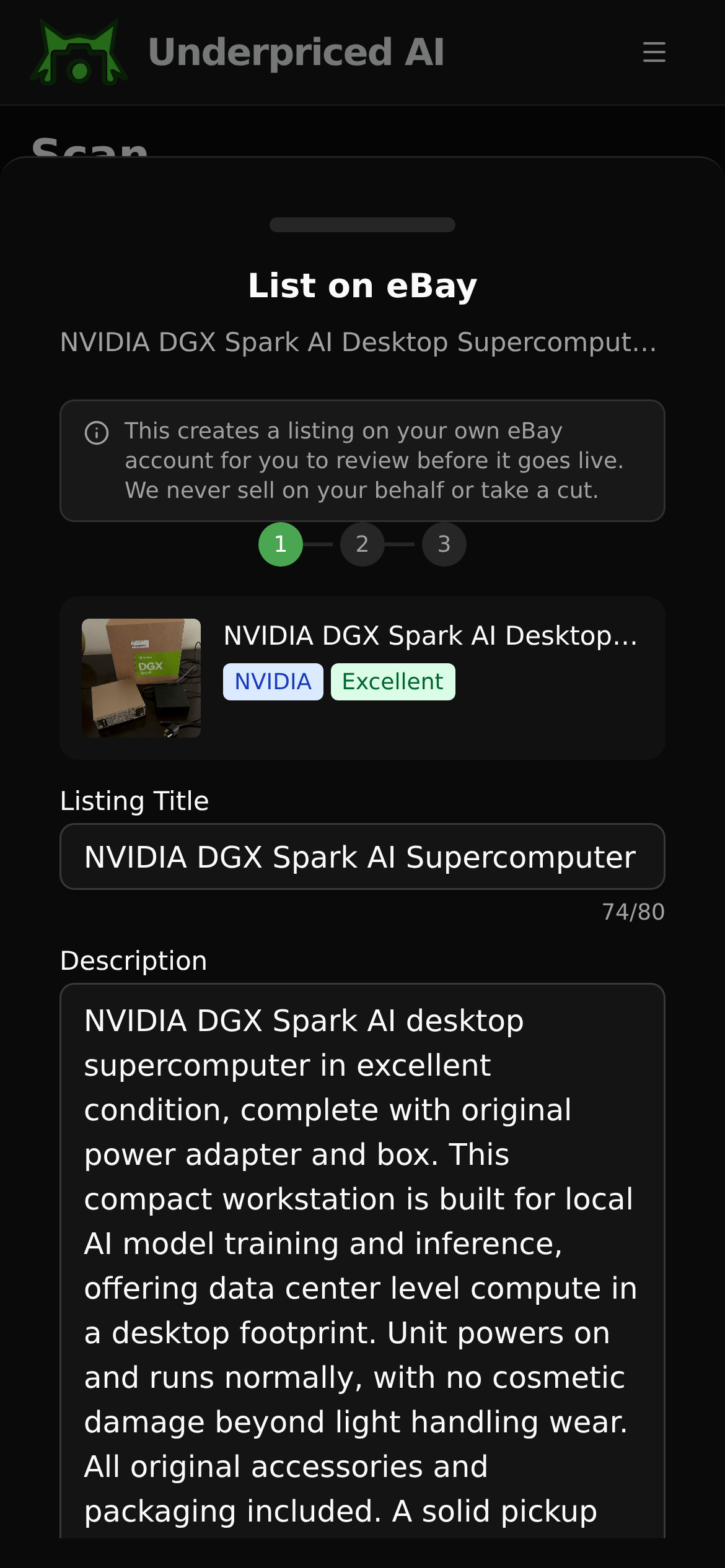
From photo to listed in one flow. Underpriced AI identifies any item from a photo, shows real sold comps from eBay, Poshmark and Mercari plus category specialists, then generates the listing and publishes it straight to eBay across 10 markets. Refresh value keeps your prices current in a tap. Try your first scan free on web or mobile, no card required.
Scan, value, and list, all in one app.
Snap a photo and see real sold prices from eBay, Poshmark and Mercari, then cross-list to all of them in a few taps. Your first scan is free.
Try a Free ScanFree first scan, no credit card required
Founder of Underpriced AI. Building tools for resellers with 30+ years of software engineering experience.
How this was made: drafted with AI from our own sold-listings data and the sources cited, and published by Frank for Underpriced AI. Spot something wrong? Tell us and we'll fix it.
Know a reseller who'd want this?
Related Articles


Ready to find out what your stuff is worth?
Snap a photo and see what it actually sold for, with the real sold listings behind the price. First scan free, no credit card.
1. Photograph it
2. See what it sold for
3. List it
Find our guides useful? Get more of them in Google Search.